Understanding Your RV Electrical System
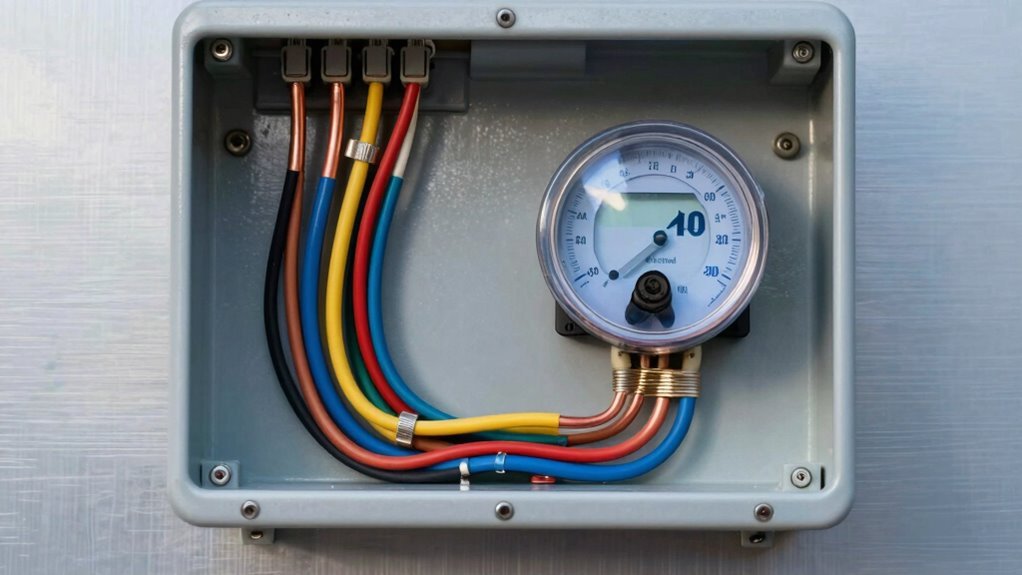
Your RV runs on two power teams: 12-volt DC for lights, pumps, and fridges, powered by house batteries, and 120-volt AC for your microwave and AC, running on shore power or a generator. Understanding your RV electrical system helps you make the most of both power sources wherever you roam.
You’ve got converters charging batteries and inverters making AC power off-grid—smart, right? Add solar and a surge protector, and you’re golden.
Keep those battery terminals clean, mind the juice levels, and you’ll laugh off most hiccups. Bet you didn’t know it could be this easy—there’s even more fun stuff coming your way.
The Role of 12-Volt DC Power in Your RV
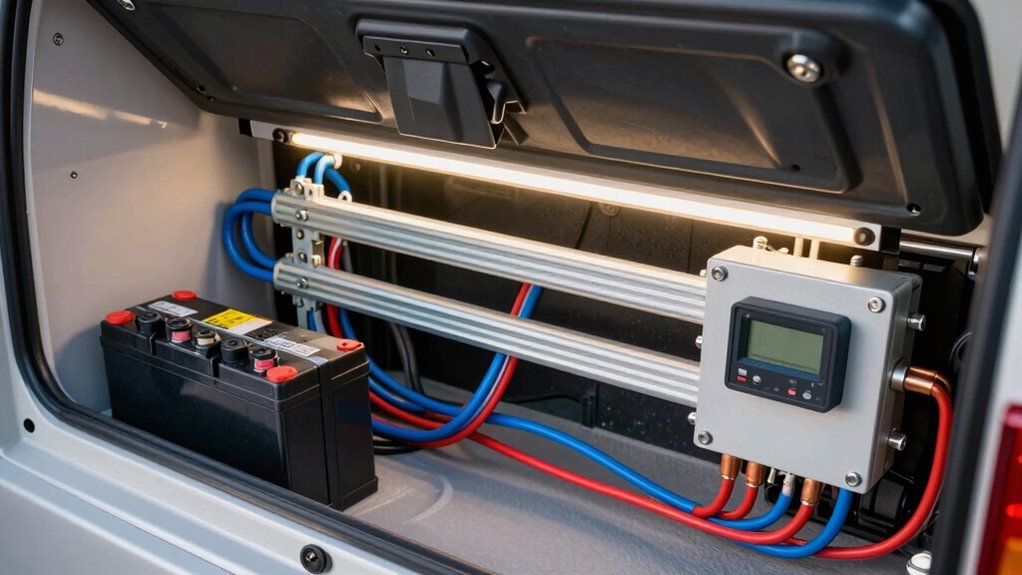
Ever wonder what keeps the lights on and the fridge humming while you’re off the grid? That’s your 12-volt DC system at work—the quiet hero of your RV life.
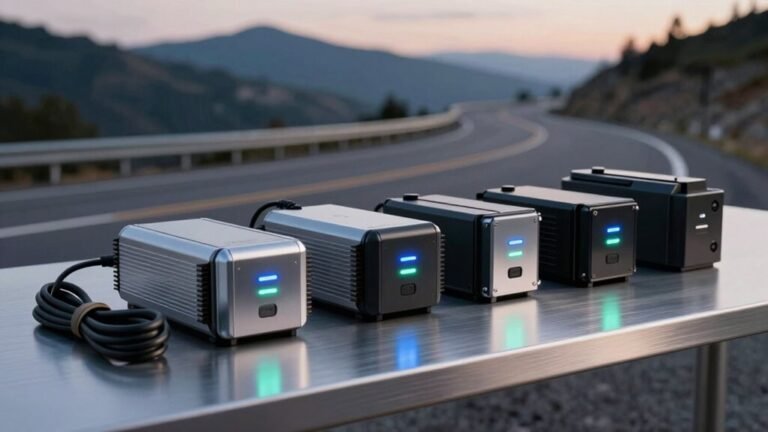
Your deep cycle or lithium-ion house batteries store the juice, safely separated from the starter battery so you’re never stranded.
Whether you’re solar-powered under the stars, plugged into shore power, or charging through your tow vehicle, that energy flows right into your battery bank.
From there, power zips through the distribution panel, fuses guarding every circuit like tiny superheroes.
You’ll run lights, water pumps, fans, even the fridge—all without flipping a single AC switch.
And hey, no need to worry about draining the engine battery, thanks to the trusty isolator switch.
It’s simple, smart, and seriously reliable.
Think of it as your RV’s heartbeat: steady, essential, and always ready for adventure.
This entire system relies on a power converter to transform incoming AC power into DC to charge your batteries.
How 120-Volt AC Power Powers Major Appliances
How does your RV keep the coffee brewing and the AC blasting on a scorching afternoon?
It’s all thanks to 120-volt AC power—your RV’s heavy lifter for high-demand appliances.
Whether you’re plugged into shore power or running a generator, this system delivers the juice your big-ticket items crave.
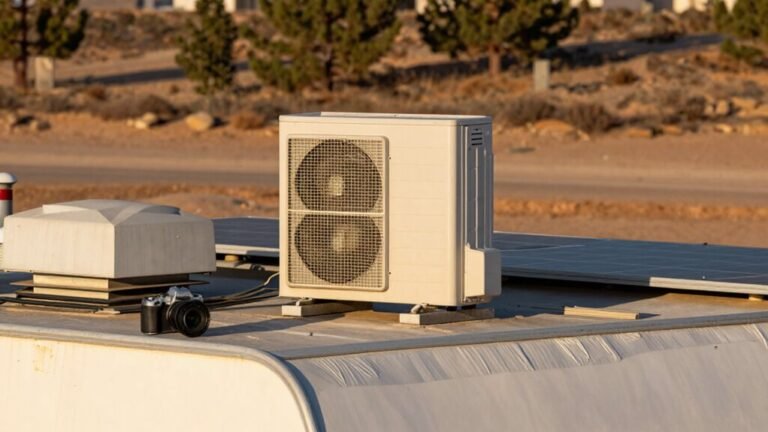
Your microwave, rooftop air conditioner, electric water heater, and fridge’s AC mode all rely on it to perform like champs.
- 1. Power sources seamlessly switch via transfer switches, so you never miss a beat
- 2. Inverters turn battery power into AC when off-grid, keeping essentials running
- 3. Breaker panels protect circuits from overloads—safety with smarts
- 4. Converters simultaneously charge batteries while powering AC appliances
No magic, just smart engineering—keeping your comforts cool, hot, and ready!
This continuous flow is possible because shore power provides a reliable external shore power supply when available.
Using Shore Power at Campgrounds
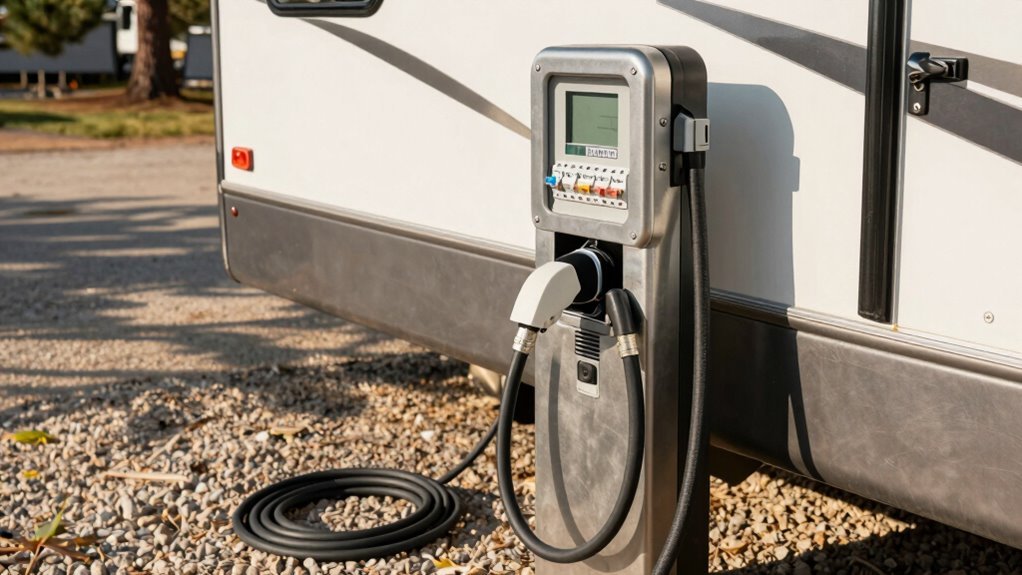
You’ve got your 120-volt AC system humming, keeping the coffee hot and the air conditioner fighting the summer heat—now it’s time to plug into the lifeline that keeps it all running: shore power at the campground.
Park close to the pedestal so your cord reaches without stress.
Check the outlet—30-amp, 50-amp, or maybe even a basic 20-amp—and match it to your RV’s needs.
Use heavy-duty, RV-specific cords and avoid flimsy household extensions—they’re a fire hazard!
Got a mismatch? Grab a sturdy “dogbone” adapter, but skip the cheap ones.
Always turn off the pedestal’s breaker first, plug in snugly with a twist-lock, then flip the power on.
Add a surge protector—it’s like seatbelt for your wiring.
Inspect connections for heat or wobble, and laugh it off if you forget and plug in backward once (we’ve all done it).
Ensures a safe ground connection to protect your RV’s electrical system and prevent shock hazards.
Stay grounded, stay safe, and keep the popcorn popping!
Running Off-Grid With a Generator
When the campground lights fade and you’re left under a sky thick with stars, your generator kicks in like a trusty sidekick, ready to keep the comforts of home humming.
You’ve got power for your AC, microwave, and fridge—no plugs needed.
Just fire it up, plug in via the shore power inlet, and boom: instant electricity.
To make the most of your off-grid freedom, keep these tips in mind:
- Size it right—aim for 4500+ watts if you’re running an AC.
- Go inverter-style for quieter runs and better fuel savings.
- Use dual-fuel models to switch between gas and propane when one runs out (oops!).
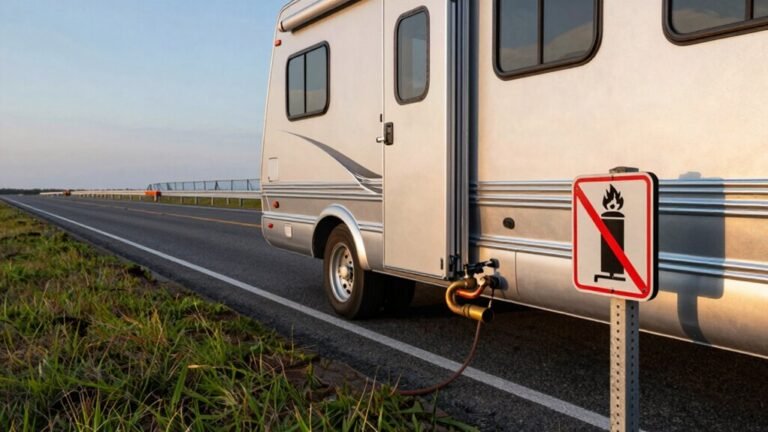
- Place it 20+ feet away, pointing exhaust away—safety first, even under the stars.
You’re not just camping—you’re glamping with gusto!
Maximizing Battery Life and Performance
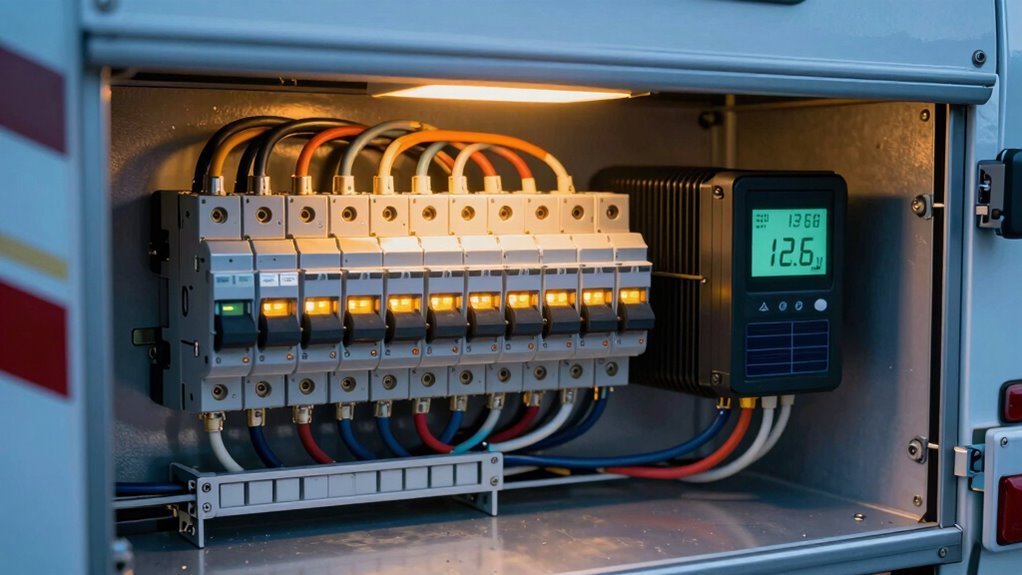
Keep your RV’s heart alive and kicking with a few savvy habits that’ll boost battery life and keep power flowing strong.
Clean terminals every 1-2 months—scrub off that white or green gunk with a baking soda-water paste and a good brush, then seal the deal with dielectric grease.
For flooded lead-acid batteries, keep the electrolyte topped up with distilled water (not the tap stuff—your battery isn’t a tea kettle).
Never let lead-acid batteries drop below 50% charge, and always use a smart charger with float mode to avoid overcharging.
Lithium? They’re low-maintenance but still like a wipe-down now and then.
Charge monthly, store batteries cool and full, and never, ever charge when frozen—it’s like giving your battery brain freeze.
With these easy steps, you’ll stay powered up and stress-free, mile after mile.
Integrating Solar Panels Into Your System
How about tapping into free, endless sunshine to power your adventures?
You’re not just saving cash—you’re turning your RV into a mini solar-powered fortress on wheels! Here’s how to nail it:
1. Pick your mount: Use adhesive for drill-free peace of mind, or go with Z-brackets for a sleek, permanent fit.
Tilting mounts? Great for chasing the sun, but a bit fussy.
2. Find the sweet spot: Flat roof area, no shadows from vents, and close to where wires enter—keep it short and smart.
3. Gear up: Grab solar cables, MC4 connectors, a charge controller,
and don’t forget the sealant—roofs hate leaks more than you hate flat batteries.
4. Wire it right: Route cables safely, add fuses (safety first!),
and connect everything *after* sundown—or risk a spark show you didn’t sign up for.
Bright idea, huh?
Understanding Inverters and Converters
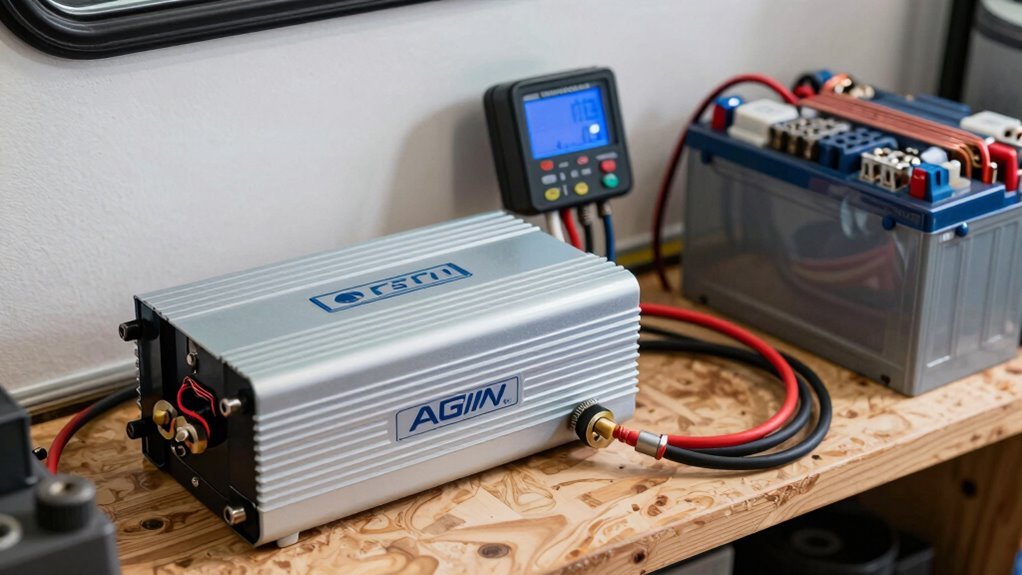
You’ve got your solar panels soaking up the sun like champs, but what about running your coffee maker or TV when the grid’s nowhere in sight?
That’s where inverters and converters come in—your RV’s unsung electrical heroes.
You use a converter when plugged in, turning shore power into 12V DC to run lights, charge batteries, and keep everything humming.
But once you unplug, your inverter flips the script—converting battery power into 120V AC so you can keep Netflix and your blender happy.
Think of it as magic, but with electrons.
Just remember: inverters drain batteries faster, especially with big draws, and pure sine wave ones play nicer with gadgets.
Choose wisely, size it right, and you’ll power your adventures without a hitch—no drama, just toast, TV, and tunes.
Sweet, right?
Common Electrical Problems and How to Troubleshoot Them
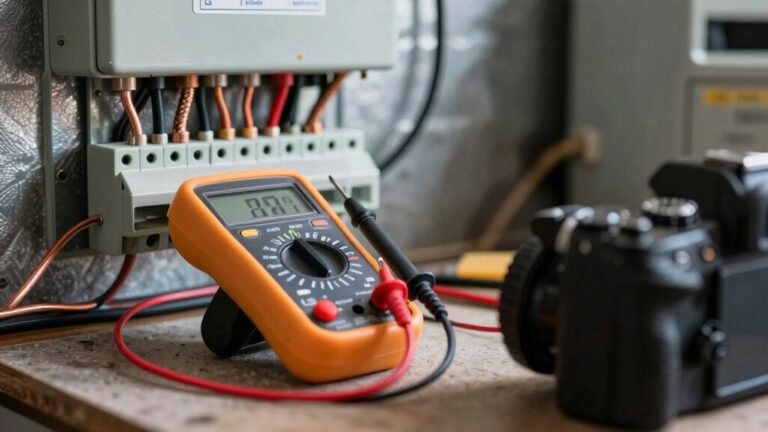
Ever wonder why your RV’s lights suddenly flicker out or your coffee maker quits mid-pour? Don’t sweat it—electrical hiccups happen, but most are easy to fix once you know what to check. Stay calm, grab your owner’s manual, and tackle these common issues like a pro:
- Tripped breakers? Reset them after reducing appliance load—overloads are usually the sneaky culprit.
- Blown fuses? Peek under the entry step or behind the converter—especially after reconnecting batteries.
- GFCI outlets dead? Hit the reset button—yes, that little one in the bathroom might’ve taken down half your RV!
- No 12V power? Check battery connections, fluid levels, and that cutoff switch—loose or corroded cables love to cause drama.
A little detective work goes a long way—keep your rig humming and your coffee hot.
Frequently Asked Questions
Can I Plug My RV Into a Regular Household Outlet?
Yeah, you can plug your RV into a regular household outlet, but don’t get too excited—it’s like putting training wheels on a motorcycle.
You’ll get power, sure, but you can’t run the AC, microwave, and water heater all at once.
Keep it light, monitor the load, and you’ll avoid tripping the breaker.
It’s a handy backup, not a forever fix—think of it as RV camping on a budget, with limits!
What Size Generator Do I Need for My RV?
You’ll probably need a 3,000 to 5,000-watt generator for your RV, depending on what you’re running.
Fire up that AC? That’s around 3,000 watts alone.
Add a fridge, lights, and phone charging, and you’re climbing fast.
Think of it like powering a mini apartment—don’t forget the surge!
Pack snacks, but also plan your watts.
How Do I Know if My RV Is Overloaded Electrically?
You’ll know your RV’s overloaded when lights flicker as the microwave kicks in, or the AC suddenly quits.
If breakers trip often, outlets buzz, or things smell like burnt toast—yep, that’s not breakfast.
You’re pushing too many amps.
Unplug some stuff, check for warm outlets, and give that poor electrical system a break.
It’s not asking for much—just don’t fry it!
Are RV Electrical Systems Grounded Like Home Systems?
Yes, your RV’s electrical system is grounded like a home’s—think of it as a tent at a campout sharing one flashlight with friends; everyone stays safe as long as the path back to power is clear.
You’ve got a ground wire, neutral bonded at one spot, and protection from shocks, but unlike your house, you’re borrowing the campground’s ground instead of using a rod.
It’s simpler, sleeker, and ready to roll—no digging required!
Can I Use Extension Cords for Shore Power Safely?
You can use extension cords for shore power safely, but only if you pick the right one.
Don’t just grab any old cord—use a heavy-duty, RV-rated one that matches your rig’s amperage.
Keep it short, straight, and uncoiled to avoid overheating.
Always plug into a surge protector, and never daisy-chain.
Treat it right, and you’ll keep the juice flowing without frying your setup—because nobody wants a melted plug or a power party foul!
Conclusion
You’ve got this, and now your RV’s electrical system won’t be a mystery anymore. Whether you’re plugged in, running on battery, or soaking up sunshine with solar, power’s always within reach. Just keep things balanced, check connections, and don’t let a blown fuse throw you for a loop. With a little know-how, you’re all set to hit the road, lights on and smile wide—ready to roll!
References
- https://bsbelectric.com/solutions/rv-electrical-components/
- https://www.ecoflow.com/us/blog/how-does-an-rv-electrical-system-work
- https://www.youtube.com/watch?v=c0dygLtrcqE
- https://www.keystonerv.com/owners/12-volt-vs.-120-volt-systems
- https://faroutride.com/electrical-system/
- https://www.rvsupercentre.co.nz/blog/rv-super-centre-guides/buyer-guides/using-12-volt-power-in-your-motorhome/
- https://www.12voltplanet.co.uk
- https://recpro.com/rv-electrical/
- https://www.runawaycampers.com/product/on-board-12v-power-system/136
- https://leisurecw.com/rv_repairs/the-basics-of-rv-electrical-systems/