How to Calculate Your RV Power Needs
To calculate your RV power needs, start by listing every appliance and device that uses electricity—from your coffee maker to your fan. Multiply each device’s wattage by the number of hours it runs daily to get watt-hours.
Add up all the watt-hour totals to determine your daily power consumption. Include a 20% buffer to account for inefficiencies and unexpected usage.
Don’t forget to consider surge spikes, especially when high-power devices like your air conditioner kick on. These moments can draw much more power than normal operation and impact your overall RV power needs.
Size your battery bank and solar array to comfortably cover your daily usage. While lithium batteries handle deep discharges well, it’s still smart to avoid regularly draining them completely. Knowing your RV power needs gives you the freedom to adventure with confidence.
Identify Your RV’s Electrical System Type
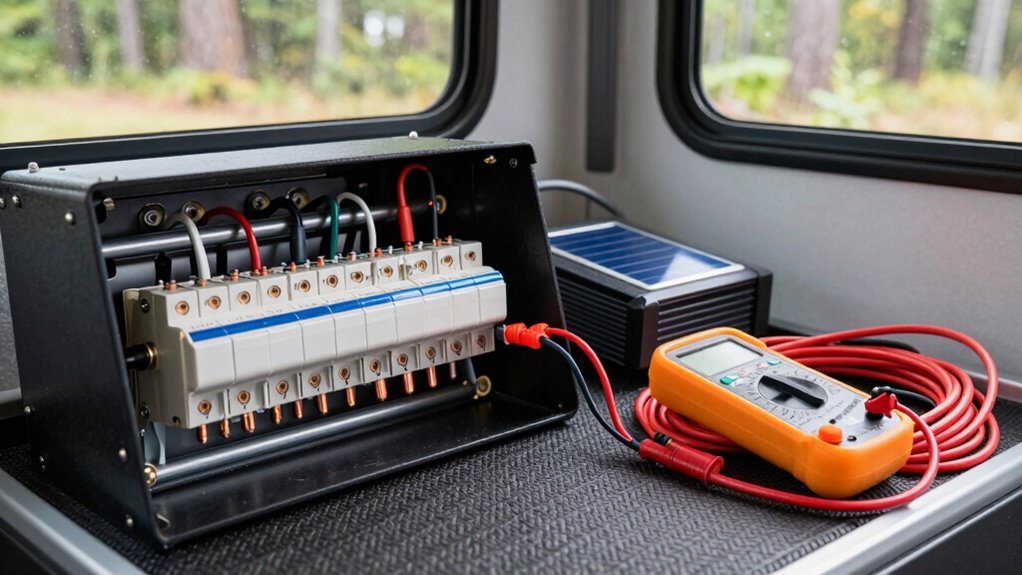
Ever wondered how your RV keeps the lights on and the coffee brewing? You’ve got two main systems working together: 12V DC and 120V AC.
The 12V system runs your basics—lights, water pump, fans, and phone charging—using deep cycle batteries, flowing quietly from negative to positive like a sleepy river.
It powers essentials so you’re not in the dark—literally.
Then there’s the 120V AC system, which kicks in when you want residential-style comfort: microwave, AC unit, TV, and that all-important coffee maker.
You get this power from shore connections—30A or 50A—at campsites.
Bigger rigs usually rock 50A with split-phase power, while smaller ones use 30A.
Knowing which system you have is key—not just for comfort, but so you don’t accidentally “brown out” your adventure!
This setup often relies on House Batteries to maintain power when off-grid.
List All Appliances and Power Devices
Now that you’ve got a handle on whether your RV runs on 12V DC, 120V AC, or a tag-team combo of both, it’s time to take inventory of what’s actually sucking up that juice.
Grab a notepad and start listing—everything counts, from your AC and fridge to your coffee maker and hair dryer.
Got a 13,500 BTU air conditioner? It’s pulling around 1,325 watts.
That tiny toaster? Still a 900-watt powerhouse.
Don’t forget the small stuff—your laptop, TV, even the water pump.
Yeah, even that electric blanket has opinions about power.
Think of your RV like a tiny, road-loving house; every gadget wants a snack of electricity.
Write it all down, no shame if your list looks like a gadget grocery run.
This is the fun part—knowing what you’ve got before we crunch the numbers and keep your power from saying “nope” mid-road trip.
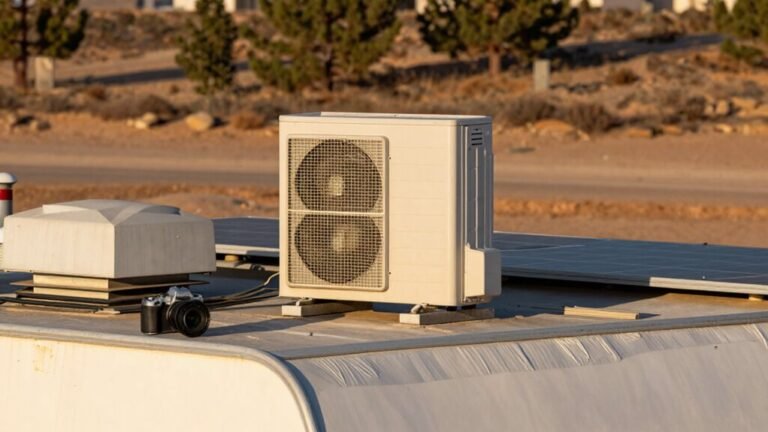
Air conditioning alone can dominate your electrical load, especially in hot climates, so be sure to note how many AC units you have and their BTU ratings.
Determine Running and Starting Wattage
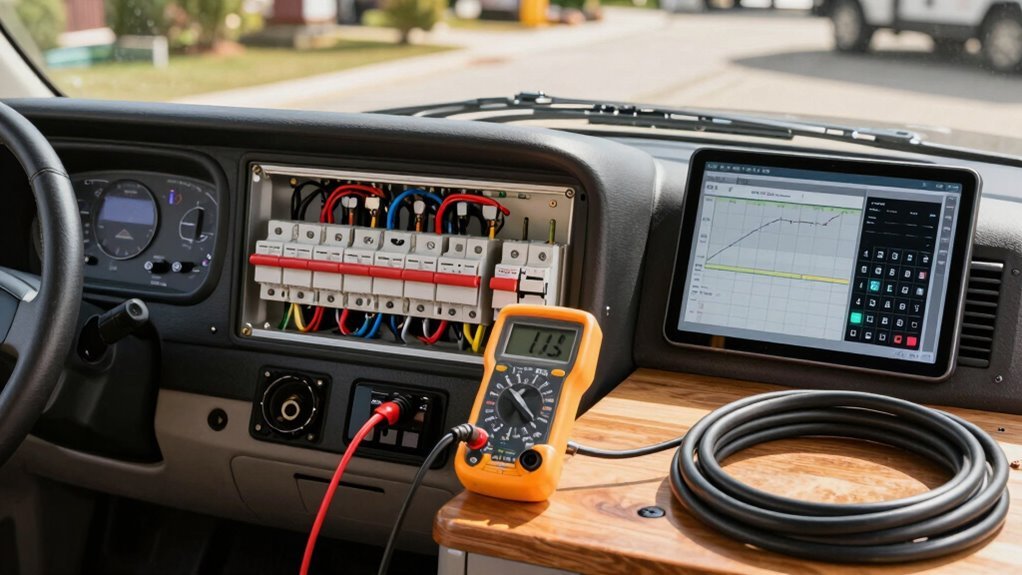
What’s the real juice hungry appliance in your RV—the one that guzzles watts like it’s paid to?
Chances are, it’s your air conditioner.
It needs serious power to kick on, especially that first surge—up to 3,500 watts—before settling into a steady 1,800 to 1,900 watt groove.
Yep, starting watts are the heavy hitters, thanks to the compressor and fan motor needing that extra oomph.
Devices without motors only need running watts, but for anything with a compressor, ignore starting watts and you’re begging for a tripped breaker.
Use the nameplate on your AC—add the compressor and fan amps, multiply by 120 volts, and boom, you’ve got running watts.
For true precision, grab a clamp meter to measure startup surge.
Always add a 20–30% safety margin, too.
That 15K BTU unit? It’ll play nice with a 4,000-watt generator, not a smaller one sweating under the load.
Starting watts correspond to the initial burst of power needed to overcome inertia in motor-driven appliances.
Calculate Daily Watt-Hour Consumption
How much power does your RV really sip—or guzzle—over the course of a day?
Most RVs drink up 20–30 kWh daily, but your number depends on your setup and habits.
Start by estimating how long each device runs: your AC might chug power for 8–16 hours on a scorching day, while the fridge quietly cycles 8–12 hours.
Lights? Maybe 4–8, depending on how much you love that midnight snack.
Multiply each appliance’s watts by its hours—that’s your watt-hours.
A 1,500W AC running 8 hours uses 12,000 Wh (or 12 kWh).
Add ‘em all up, from the coffee maker to the TV, and you’ve got your total daily consumption.
Toss in a little extra for surprise gadgets or inefficiencies.
Use online calculators if math isn’t your thing—they’re like cheat codes for RV power.
It’s not rocket science, just smart camping!
Understand the Role of Your Inverter
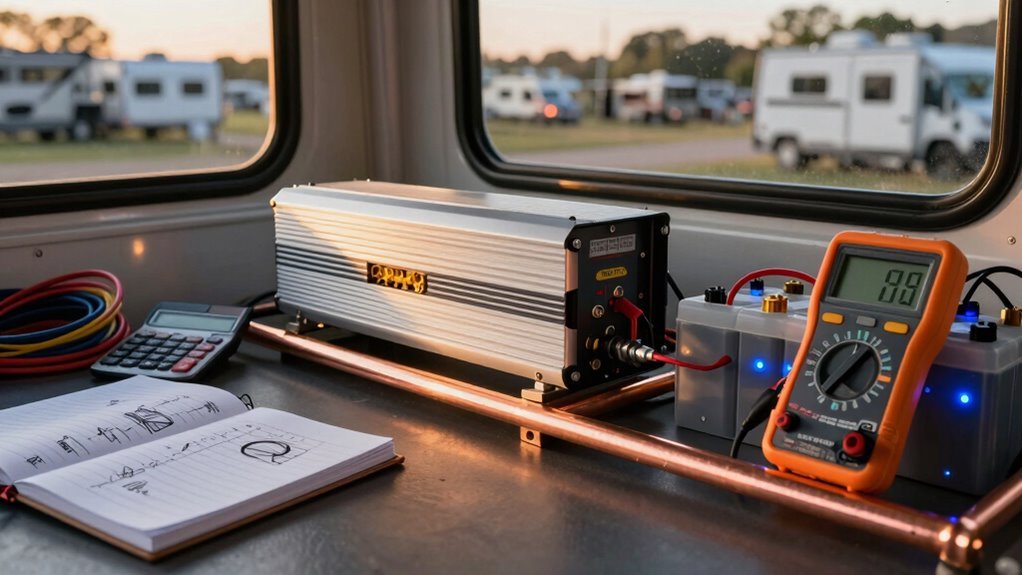
Imagine this: flipping on your laptop, brewing coffee, and catching up on your favorite show—all while parked deep in the woods with no power hookups.
That’s your inverter at work! It converts 12-volt DC power from your RV batteries into 120-volt AC power, so you can run everyday gadgets just like at home.
Think of it as a magic box that turns stored battery juice into usable electricity for your TV, blender, or laptop charger.
It doesn’t charge the batteries—just taps into their power and transforms it.
Without it, no outlets work when you’re off-grid.
Match the inverter size to your needs: small ones for basics, bigger ones if you’re running a fridge or coffee maker.
Just remember, it’s only as strong as your battery bank.
Choose wisely, and boom—you’ve got a rolling power station!
Assess Battery Capacity and Usable Power
You’ve got your inverter humming, turning battery power into the kind of electricity that keeps your morning coffee hot and your evening shows streaming—nice work!
Now, let’s figure out how much juice your batteries can actually give you.
Battery capacity isn’t just about size—it’s about usable power. You measure it in amp-hours (Ah) or watt-hours (Wh), and don’t forget to multiply Ah by voltage to get Wh.
But here’s the kicker: you shouldn’t drain your battery to zero.
Most lead-acid batteries hate that, but lithium ones can handle 80% depth of discharge.
So if you need 100Ah, plan for 125Ah or more to stay safe.
Always add a 20% buffer—because surprise gadget use happens (we’ve all been there).
Smart monitoring, like Coulomb counting, helps track real-time use so you don’t end up in the dark—literally.
Factor in Charging Sources and Efficiency
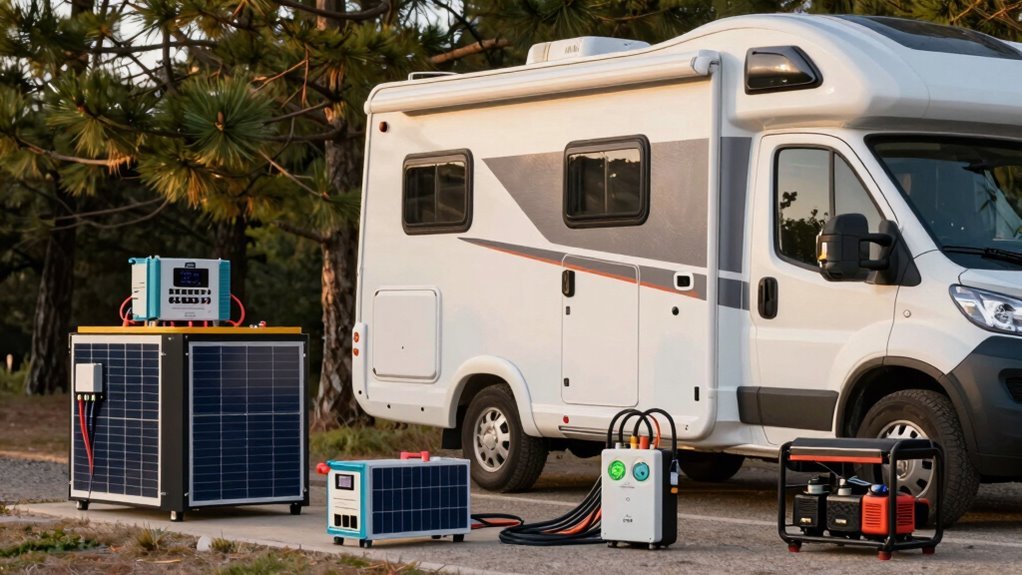
While your batteries keep the lights on, they’re only as good as the power you put back into them—so let’s talk charging.
Plugging into shore power gives you instant juice, but don’t ignore those sneaky voltage hiccups that make your AC work harder.
If you’re running big rigs, a 50-amp feed’s your best friend.
Generators? They’re the muscle for cloudy days, just size them right—3,000 watts minimum, more if you’re powering a mini apartment.
Solar’s your silent hero: aim for 600 watts if you’re off-grid often, and toss in extra panels for hot, sunny days when your AC’s begging for mercy.
Remember, every conversion loses some power—about 15% from inverter drain, another 10–20% in translation.
Combine sources, match your climate, and keep those electrons flowing like your morning coffee.
Plan for Peak Load and Surge Demand
Now that you’ve got your charging game on point—whether it’s sunshine, shore power, or a growling generator feeding your rig—it’s time to talk about what happens when you flip the switch on multiple gadgets at once.
Your RV’s peak load is the max power all your appliances pull together, especially when things like the AC kick on—yep, that little beast can surge up to 4,800 watts!
That’s why your inverter needs a surge rating that covers the biggest startup spike, plus 20–30% extra for safety.
Think of it like seatbelt for your electrical system.
A 2,000W inverter handles most rigs, but if you’ve got big gear, go 3,000W+.
And don’t forget water pumps or furnace fans—they add sneaky little bursts.
Plan wisely, and your lights won’t flicker like a haunted house when the fridge hums to life.
Adjust for Off-Grid or Full-Time Use
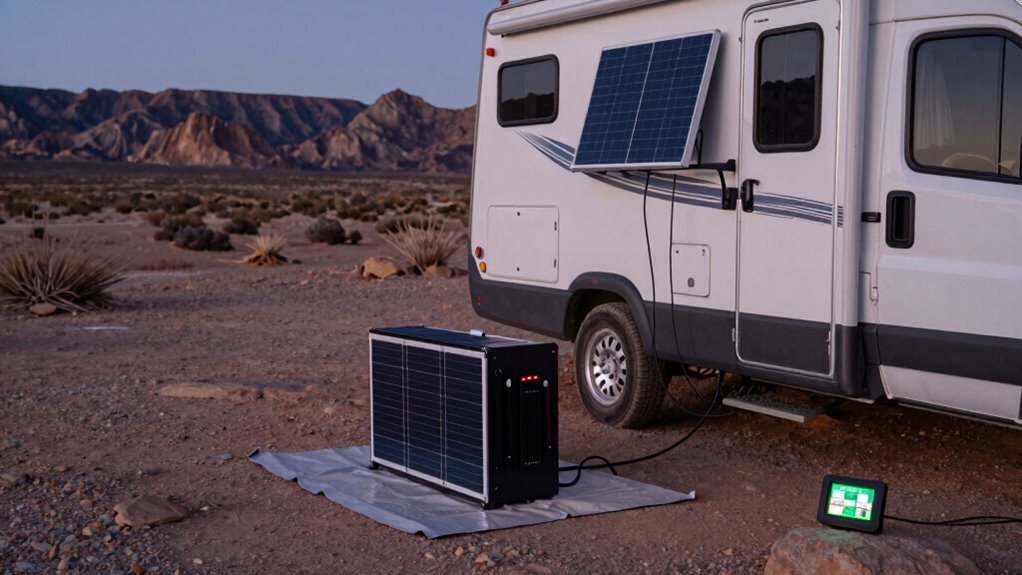
Ever wonder how some RVers live completely off the grid, running AC, fridge, and even charging laptops without ever plugging in?
You can too—but it means scaling up your system.
If you’re full-timing or boondocking often, you’re likely using 7–15+ kWh daily, putting you in the moderate to high usage zone.
That means bigger batteries—think 400Ah to 1,250Ah or more—so you’ve got power even on cloudy days.
Size your battery bank by dividing daily use by your desired days of autonomy, and remember: lithium lets you drain deeper than old-school lead-acid.
You’ll also need more solar—oversize by 25–50%—so a 1.2kW system might become 1.8kW.
More panels, more sunshine, more freedom.
Who knew sunshine could run your Netflix binge?
Just don’t blame us when your laptop dies mid-rom-com.
Monitor and Refine Your Power Budget
Since you’re already powering your life on the road with sunlight and stored energy, it’s smart to keep a close eye on where every amp-hour goes—think of it like budgeting, but way more fun because you’re basically being an energy detective.
You can track your battery’s state of charge and voltage in real time with smart monitors like the Victron BMV-712, which counts every bit of power flowing in and out.
You’ll see exactly how much juice your fridge, AC, or lights are sucking up, and when to fire up the generator or plug into shore power.
These clever little devices even store data, so you can spot energy-hungry habits and tweak your routines.
Pro tip: Use propane for cooling and heating when you can—it’s kinder to your battery.
With alarms, backlit screens, and historical reports, staying powered has never been this easy—or this fun.
You’ve got this!
Frequently Asked Questions
Can I Run My AC All Night on Battery Power?
You can run your AC all night on batteries, but you’ll need enough juice to make it happen.
If you’ve got a 900W efficient unit and a big lithium bank—like 600+ Ah—you’re golden.
Smaller setups might leave you sweating by sunrise.
Pairing solar or shore power helps, and a soft start cuts surge drama.
Just don’t expect miracles from a tiny battery—it’s not magic, it’s watts!
How Often Should I Replace My RV Batteries?
You’ll replace your RV batteries way less often than you’ll check your snacks—lithium ones last a crazy 10–15 years, so you might outlive your batteries before they quit!
Flooded lead acid? Every 4–6 years, maybe sooner if they’re sulking with dim lights or slow starts.
Gel and AGM last 3–6 years, but hey, no one’s counting if you’re off-grid and thriving!
Do LED Lights Really Save Significant Power?
Yeah, LED lights really do save tons of power—you’re cutting energy use by up to 90%!
Swap one incandescent bulb and you’re saving over a whole amp.
Run six LED lights and still use less than a single old bulb.
They’re bright, cool, long-lasting, and your batteries will last way longer.
Honestly, it’s like switching from a gas guzzler to an electric car—same ride, way less juice.
Is Solar Charging Worth the Upfront Cost?
Yep, solar’s totally worth the upfront cost—you’re basically printing free electricity once it’s paid off!
Think of it like swapping a clunky 1950s payphone for a smartphone, but for power.
You’ll slash campground fees, skip noisy generators, and with the 30% tax credit, you’re laughing all the way to boondocking paradise.
Sun-powered freedom? Yes, please!
Can I Mix Old and New Batteries Safely?
Nope, you can’t mix old and new batteries safely—sorry, buddy.
It’s like pairing a sprinter with a sloth; one overworks while the other slacks.
Your new battery takes the hit, draining faster and wearing out young.
Old ones drag down the whole team, risking damage and shortening lifespans.
Keep ‘em matched in age, size, and type—your rig will thank you with steady, reliable power and fewer headaches.
Teamwork makes the dream work!
Conclusion
So, you’ve added up your watts, freaked out over surge spikes, and realized your hair dryer hates boondocking. Congrats! You’re now a part-time electrical detective, hunting phantom loads and outsmarting inverters. Embrace the madness—because nothing says “adventure” like calculating how many panels it takes not to kill your fridge. Tweak, test, maybe laugh when things go beep. Power budgeting: it’s not sexy, but hey, neither is waking up to a dead battery and cold coffee.
References
- https://intellitec.com/2021/03/types-of-power-for-an-rvs-electrical-system/
- https://rv-pro.com/features/rv-electrical-systems-101/
- https://www.nirvc.com/blog/rv-electricity-101-part-2-an-rv-owners-guide-to-rv-electrical-systems/
- https://wis-tek.com/blogs/knowledge/understanding-a-typical-rv-wiring-diagram-and-exploring-better-alternatives
- https://glamperlife.com/rv-electrical-system/
- https://rv101withmarkpolk.com/wp-content/uploads/2021/01/rv-101-electricity-guide.pdf
- https://technorv.com/blogs/articles/how-does-an-rv-electrical-system-work
- https://www.youtube.com/watch?v=P5GNdsURJs8
- https://fixyourcamper.com/beginners-guide-to-rv-camper-electrical-systems/
- https://solartechonline.com/blog/how-much-electricity-does-rv-use/