Tankless Vs Tank RV Water Heaters: Pros & Cons
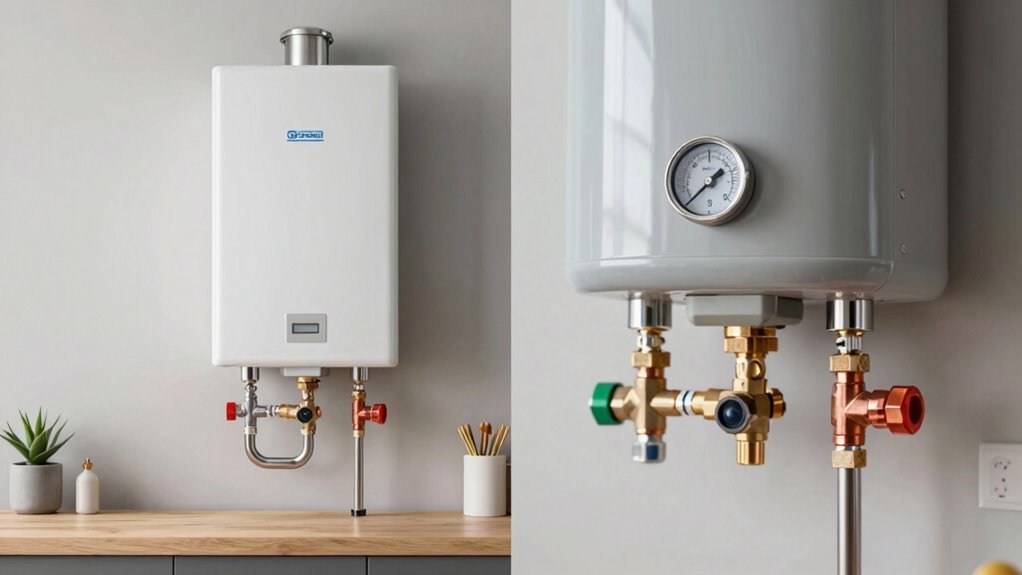
When it comes to choosing between tankless vs tank RV water heaters, efficiency and convenience play key roles. A tankless RV water heater saves propane because it only activates when hot water is needed, unlike tank models that maintain temperature continuously.
Tankless units provide endless hot showers and free up valuable storage space in your RV. However, they require a strong and consistent 12V power supply to operate effectively.
In contrast, tank RV water heaters deliver instant hot water and have a simpler setup, making them ideal for quick rinses. They are generally lighter, which can improve fuel efficiency and overall mileage.
Tank models also tend to perform well off-grid due to their lower electrical demands. Both tankless vs tank RV water heaters have their trade-offs, so your decision should align with your travel style and power availability.
How Tank RV Water Heaters Work
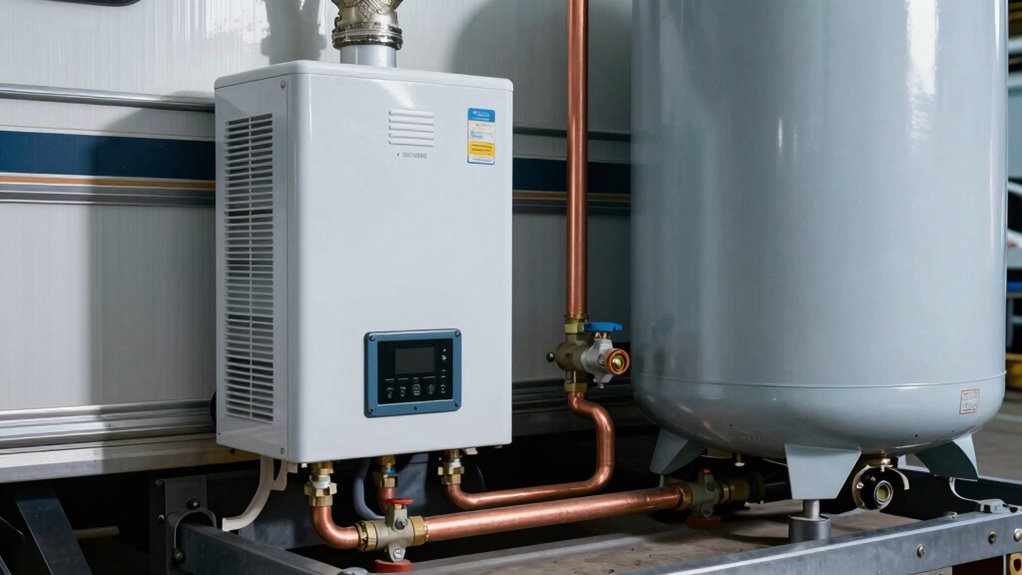
While you’re out chasing sunsets and brewing morning coffee on your RV adventures, your trusty tank water heater’s already hard at work keeping things cozy.
It holds warm water in a steel tank, wrapped in styrofoam like a snuggly blanket, ready whenever you want a quick shower.
You can heat it with propane—flame licking the tank’s belly through a horseshoe flue—or plug in and use the electric element inside.
A smart thermostat cuts power when it hits 140°F, so you don’t boil your bath by accident.
Safety’s built in: a pressure valve pops if things get too steamy, and an anode rod sacrifices itself to stop rust.
The 12-volt system sparks the flame to life, then checks it’s still burning—no ghost flames allowed!
Whether boondocking or parked at a hookup, hot water’s always at the ready, no math or magic required.
cost-effective to purchase and run Cheers to warm socks and clean dishes!
How Tankless RV Water Heaters Work
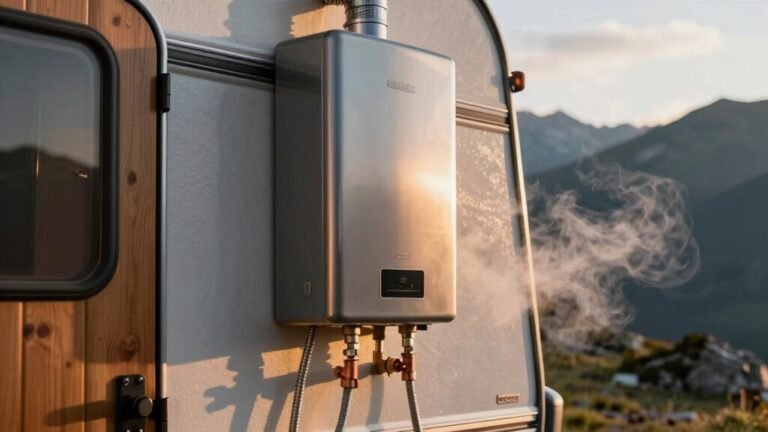
Ever wonder how you can shower for 10 minutes without running cold in an RV? Tankless water heaters make it happen—on demand, no tank needed! Here’s how:
- You turn on the hot water, a flow sensor kicks things off, instantly firing up the propane burner or heating element (with at least 12 VDC power).
- Cold water rushes through a heat exchanger, gets heated fast to your set temp—usually 120–140°F—and flows right out.
- The burner shuts off the moment you close the tap, saving energy and keeping things safe with automatic shutoffs.
No waiting for reheating, no cold surprises—just endless hot water!
Well, unless you run out of propane.
*Then* you’re back to navy showers. But hey, that’s another story.
These systems provide unlimited hot water without storing it, making them ideal for longer showers and full-time RV living.
Space and Installation Requirements
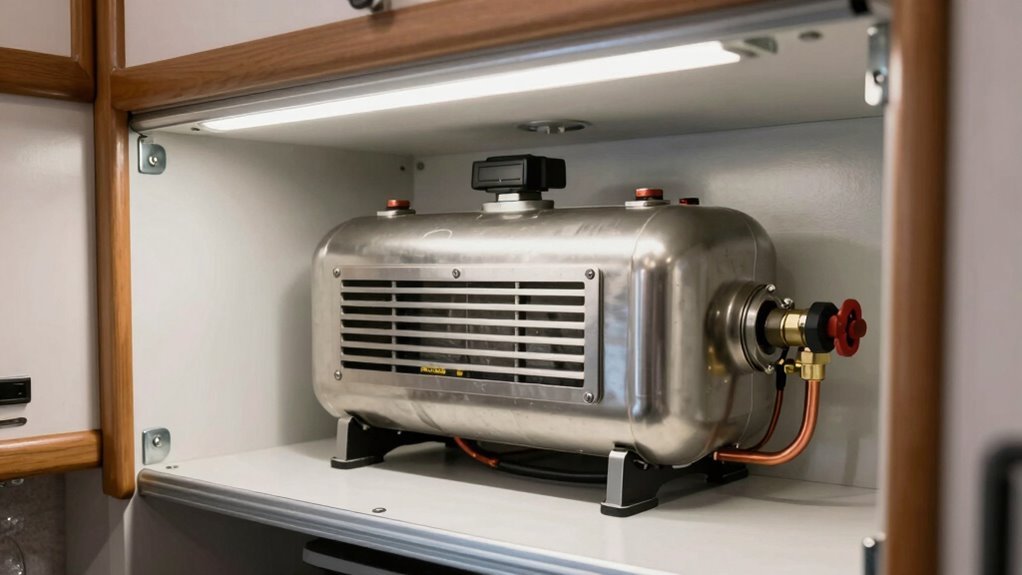
When you’re trying to maximize every inch in your RV, swapping out a bulky water heater for a tankless model feels like discovering secret storage space behind a fake bookshelf.
You’ll love how tankless units save room—most fit neatly in a 15×15-inch exterior compartment, leaving cabin space free for snacks, gear, or that emergency roll of toilet paper.
Without a heavy tank, they’re shallower and lighter, often needing just a small platform for support.
But fair warning: cutting the wall needs precision—straight edges, no curves.
Seal it with butyl tape, slide it in gently, and don’t forget the wiring—12V DC and a wall controller with a long cord.
You’ll drill holes, run propane lines (⅜-inch, please), and tweak plumbing, but the payoff? More room, less bulk, and a setup that feels like a high-tech upgrade.
Ensure all three utilities—water, gas, and power—are turned off before beginning installation for safety, as recommended in proper setup and safety precautions.
Energy Efficiency and Operating Costs
How does your RV stay toasty without guzzling propane like it’s going out of style? With a tankless water heater, you’re only heating water when you need it—no more, no less.
That means no wasted energy keeping a full tank warm while you’re off hiking or sleeping.
Here’s why that saves you serious cash over time:
- You’ll slash energy use by up to 34% if you’re not a non-stop showerer.
- Propane burns only when the tap’s on, skipping the standby waste of traditional tanks.
- Fewer repairs and a 20+ year lifespan mean less money spent fixing things that break.
Sure, tankless costs more upfront, but think of it like buying a hybrid car—it pays you back while being kinder to the planet. No pilot light ghost-sipping your fuel? Yes, please!
Hot Water Availability and Flow Rate
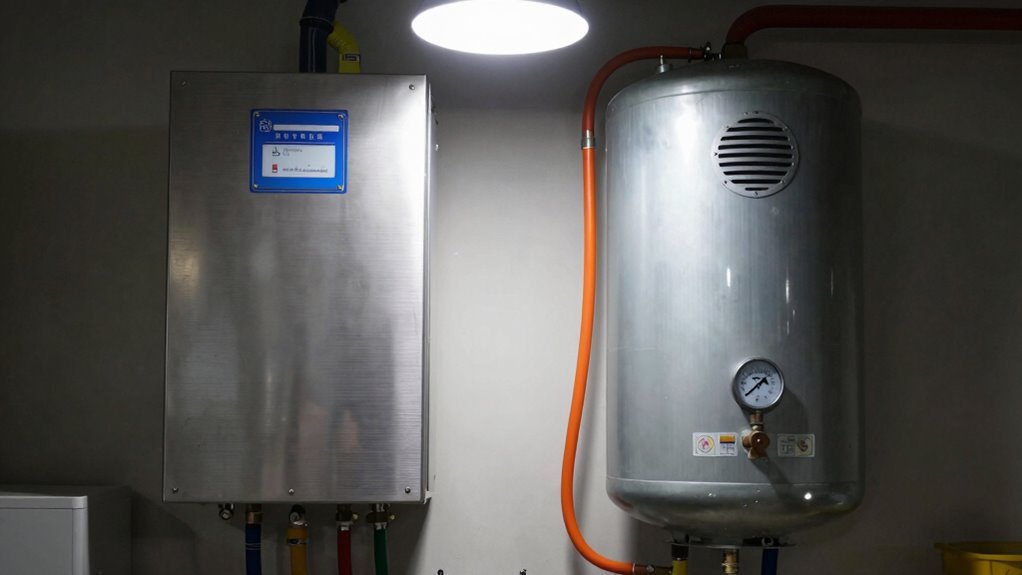
You’re not just saving fuel with a tankless RV water heater—you’re unlocking a whole new level of shower confidence.
Say goodbye to cold splashes while waiting for warm water—tankless units heat on demand, so hot water flows instantly.
No more marathon faucet runs just to rinse your hands!
With a recirculating loop, it’s basically “hot water, ready when you are.”
And guess what? You’ll never run out mid-shower, even if someone jumps in right after you.
Tankless means endless hot water, so you can happily hog the bathroom.
Multiple showers, dishes, and handwashing? No sweat.
High BTU power keeps flow steady and temperature stable, no icy surprises.
Plus, these slim units fit tight spaces and lighten your RV’s load.
Who knew reliability could be this compact—and drama-free?
It’s like your shower just got a glowing review.
Performance in Cold Weather Conditions
While your tankless RV water heater keeps the showers hot and flowing all day, winter can sneak in like an uninvited guest—ready to freeze things before you even say “brrr.”
These sleek units don’t store hot water, which means no built-in buffer when temperatures drop below zero.
To keep your system happy in the cold, you’ve got to take action—luckily, it’s not rocket science.
Here’s how you win the winter battle:
- Wrap your heater and pipes in insulation or heat tape—think of it as a cozy winter jacket.
- Use a heating pad or insulated cover to fight off icy surprises, especially if it’s mounted outside.
- Keep the power on—many models have smart freeze protection that kicks in only when plugged in.
Propane models heat faster, giving you an edge in freezing temps. With the right prep, your tankless heater can handle winter like a champ—no hibernation needed.
Maintenance Needs and Longevity
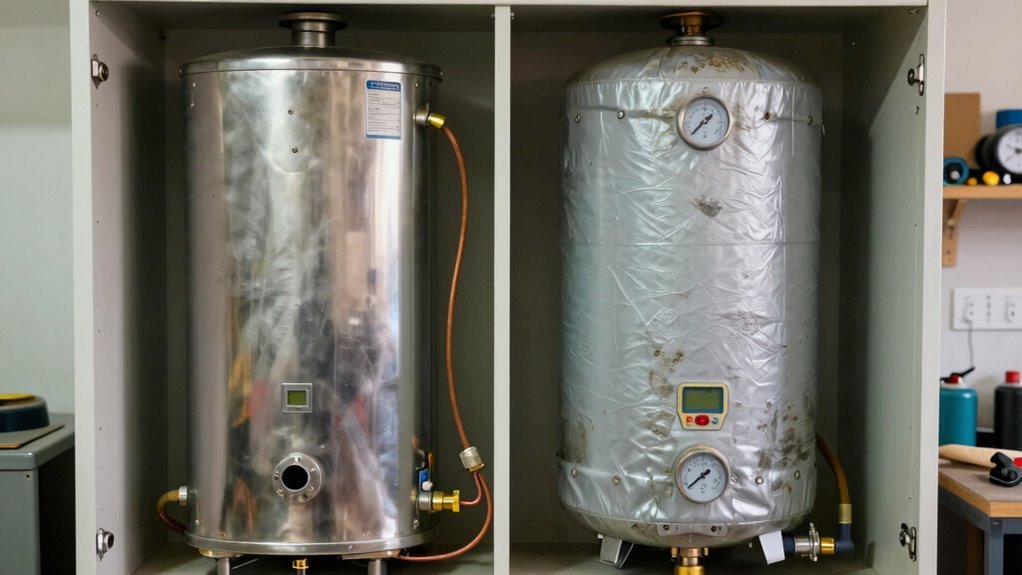
Keeping your RV’s water heater running smoothly doesn’t mean you need a toolbox the size of Montana—especially when you know what to do and when to do it.
With tankless models, you’ll descale once a year and clean filters every three months—simple stuff that keeps gunk and grime at bay.
No anode rod to replace or giant tank to flush means less hassle and more time adventuring.
Tanks, though tough, need more love: flush twice a year, check the anode rod, and clean burners to dodge nasty surprises.
But hey, both types reward you with longer life when you stick to their tune-up schedules.
Clean filters, flush sediment, and follow the manual like it’s your RV’s favorite recipe.
Do that, and your water heater won’t just last—it’ll perform like a champ, warming your showers and your spirit on every road trip.
Upfront Costs and Affordability
A shiny new water heater mightn’t be the first thing you think of when dreaming about life on the road, but it sure makes your RV feel like home—especially when you’re weighing what it’ll cost to get one.
Tank models are your budget buddies, usually running $200 to $500, and they drop right into place if you’re replacing an old one.
But if you’re eyeing a tankless unit, you’ll shell out more up front—anywhere from $200 to $3,000, depending on bells and whistles.
Don’t forget extras like retrofit kits or wiring, which can tack on $100 or more.
Still, here’s the game plan:
- Stick with a traditional tank for lower sticker shock and easy swaps.
- Choose a portable tankless model if you want efficiency on a budget ($200–$400).
- Budget big for high-end tankless setups—they cost more now but save energy down the road.
Impact on RV Weight and Fuel Efficiency
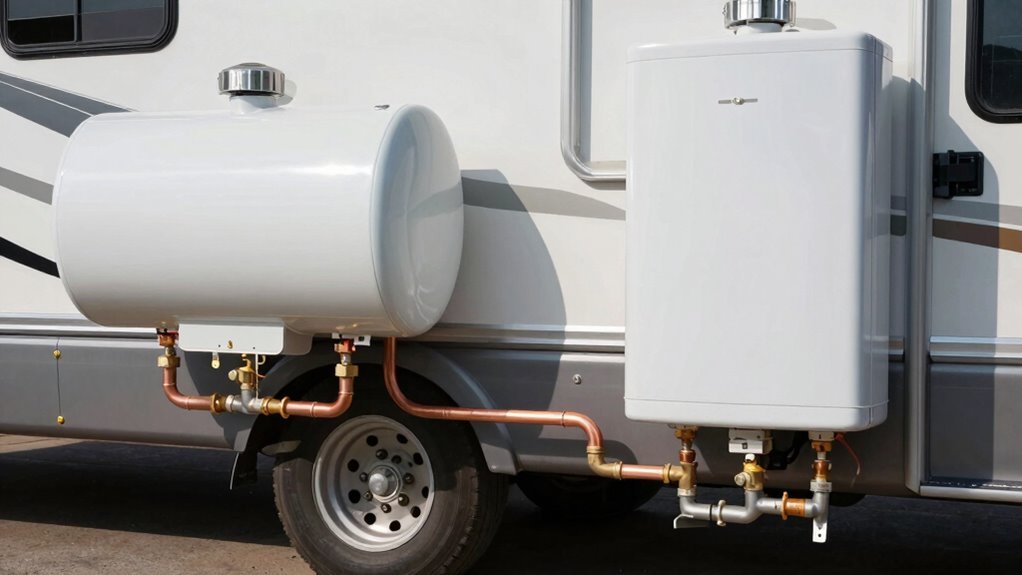
You’ve already saved a few bucks upfront with a tank water heater, but let’s talk about what that savings might cost you on the road—your RV’s weight and fuel efficiency.
That hefty 60-pound tank heater is like lugging around a stubborn suitcase that never leaves.
Switch to a tankless model, and boom—you’re shaving off 20–40 pounds, since most weigh just 19–35 lbs.
Lighter load means better mileage, less strain on your engine, and happier brakes.
Plus, tankless units sip propane only when needed, so you’re not burning fuel just to keep water hot all night.
That stretches your boondocking trips and keeps more cash in your pocket.
Smaller size? Even better—it frees up space and helps balance your rig.
Who knew shedding a few pounds could make your RV run smoother, sip less fuel, and feel downright sprightly on uphill climbs?
Lighten up, literally, and roll easier.
Suitability for Different Types of RVers
Ever wonder if your RV water heater is really matching your lifestyle on the road? Choosing the right one can make your showers happy and your water bills lighter. It all depends on how you roll when you’re out adventuring. Here’s a quick breakdown:
- You’re a full-hookup fan or travel with a crowd? Tankless is your buddy—endless hot water for back-to-back showers, plus it sips propane over time.
- Boondocking solo or living off-grid? A tank heater gives you instant hot water without wasting precious gallons waiting for warm-up.
- Just need a quick handwash or quick rinse? The trusty tank wins again—no cold burst surprises or flow hiccups with low pressure.
Pick the one that fits your rhythm, not just your rig!
Frequently Asked Questions
Can I Install a Tankless Water Heater Myself?
Yeah, you can install it yourself—if you’re comfy with plumbing, wiring, and gas lines.
Electric models are easier and friendlier for DIYers.
Gas ones? Tricky.
You’ll likely need a pro due to codes and safety stuff.
Just don’t wing it with gas; you don’t want to be the star of a “how not to” DIY video.
Safety first, DIY second!
Are Tank Water Heaters Noisy When Operating?
Yeah, tank water heaters can get a little noisy—you’ll hear hisses, ticks, and pops like a mini symphony from the Stone Age.
That’s usually just metal expanding or steam from condensation, totally normal.
But if it starts sounding like a screaming teakettle or a drum solo, something’s up.
Keep an ear out, stay chill, and don’t panic—most ruckus is harmless, though a little maintenance never hurts!
Do Tankless Models Work With Solar Power Systems?
Yes, you can absolutely run tankless models with solar power—especially propane ones!
They sip just a little 12V power to ignite, so your solar panels handle it easily.
No bulky generator or shore power? No problem!
Electric ones? Not so much—they’re power hogs.
But with a propane tankless, you’re golden off-grid, sipping coffee while your solar silently fuels warm showers.
Talk about camping magic!
Will a Tank Heater Freeze if Not Winterized?
No, your tank heater won’t crack if it freezes—good news, right?
Ice expands at the bottom, but the rounded tank handles it without busting.
Still, you’ve gotta drain it properly or that leftover water in pipes will cause trouble.
Skip winterizing, and you’re gambling with frozen lines and costly fixes.
Can I Switch From Tank to Tankless Easily?
You can switch from tank to tankless way easier than teaching a goldfish to jump through a hoop!
Just shut off gas and power, drain the old unit, then unhook lines and wires.
Pop it out, drop the new one in—match the flange, align the screws, connect cold and hot water, gas, and 12V wiring.
Boom, you’re practically a DIY legend!
Conclusion
You’re not just picking a water heater—you’re choosing adventures. A tank heater’s like a cozy campfire: steady, familiar, warming your toes after a muddy hike. Tankless? That’s the swift river—endless flow, always moving. Both keep your shower steamy under starry skies. So, whether you crave simplicity or nonstop hot water, your RV life, your rules. Now go chase sunrise soapsuds—you’ve earned them!
References
- https://blog.campingworld.com/learn-to-rv/how-do-rv-water-heaters-work/
- https://www.youtube.com/watch?v=tacUlGhVqa8
- https://www.youtube.com/watch?v=vk9Nt6RMHps
- https://www.youtube.com/watch?v=PeevvzxdtHs
- https://www.outdoorsy.com/blog/rv-water-heater
- https://www.keamotorhomes.com/helpful-guides/how-do-motorhome-hot-water-systems-work
- https://www.youtube.com/watch?v=nSv_8kr8aSs
- https://www.lippert.com/blog/rv-water-heater-basics
- https://www.youtube.com/watch?v=dtQHir8r2rg
- https://www.youtube.com/watch?v=kdShEdZ1Dhs