How to Quiet a Noisy RV Generator
You can tame that roaring RV generator by checking for loose bolts, cleaning or replacing the air filter, and inspecting the exhaust for leaks or damage. These simple steps can significantly reduce noise and improve performance.
Tighten any shaky parts and add vibration pads to minimize rattling and humming. Keeping the oil and spark plugs fresh also ensures smoother, quieter operation of your RV generator.
If it’s still loud, consider a silencing enclosure or DIY sound baffle. Your campsite neighbors will thank you—and there are even more clever tricks to make your generator whisper like a well-behaved campfire companion.
Identify the Source of the Noise
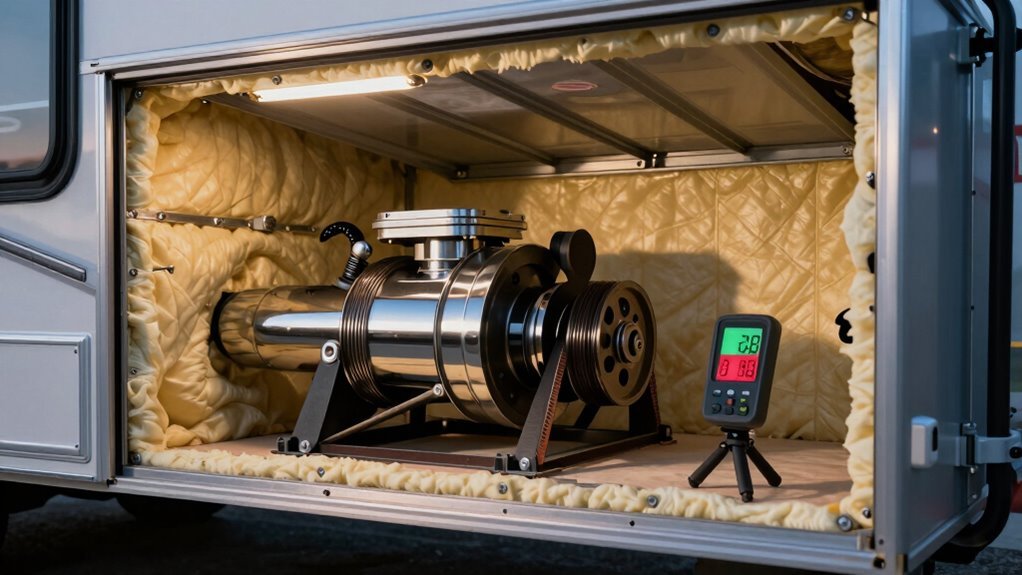
Ever wonder why your RV generator sounds like a jet engine at takeoff? Well, it’s not just one thing—noise comes from several sources, and knowing what’s what helps you fix it.
The engine’s the loudest culprit, hitting up to 121 dB, especially if it’s big or worn out. Combustion roars and mechanical knocks add to the racket.
Then there’s the cooling fan, whooshing at nearly the same volume as the engine.
The exhaust? Oh boy, without a good muffler, it can scream over 130 dB—like a rock concert!
Alternators hum and buzz too, around 80–90 dB, thanks to airflow and electrical surges.
Plus, vibrations travel through mounts and pipes, turning your whole rig into a sounding board.
Spotting which noise is which—engine growl, fan whoosh, or exhaust scream—gets you closer to peace and quiet.
You’ve got this!
A 10 dB increase represents roughly a tenfold increase in noise perception, so even small changes in sound level can have a big impact on how loud your generator seems perceived loudness.
Inspect and Tighten Loose Components
Now that you’ve figured out whether the ruckus is coming from the engine, fan, or exhaust, it’s time to get hands-on and track down any wiggly parts throwing a noisy tantrum inside your generator.
Don’t let loose bolts or shaky wires ruin your peaceful campsite—tighten things up and squash those sound bugs!
- 🔧 Secure all mounting bolts—wiggly hardware turns rumbles into roars
- 🍃 Rebalance fan blades so they spin smooth, not clatter like a tin can in a dryer
- 🔋 Check battery connections—clean, snug terminals keep power steady and quiet
- 🔎 Inspect wiring and switches—loose sparks aren’t cool (and can be noisy too)
A well-tightened generator isn’t just quieter, it’s happier, safer, and way more reliable on the road.
Think of it as giving your machine a good hug—firm, friendly, and full of good vibes!
Vibration analysis can help identify underlying issues before they worsen, especially if the noise persists after tightening; consider checking for loose components systematically to prevent further damage.
Clean or Replace the Air Filter
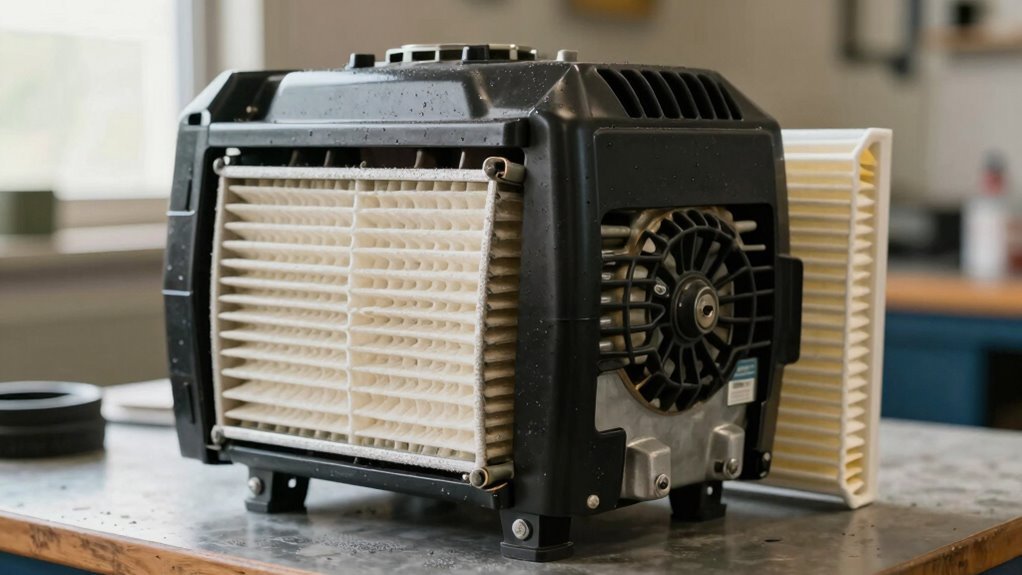
Explore into your generator’s air filter and give it some much-needed spa time—your machine will thank you with quieter, smoother runs.
Start by turning off the fuel valve and letting the engine cool—you don’t want to clean a hot engine any more than you’d wash a running car.
If your filter’s foam, rinse it in soapy water, gently scrub, then shake out the gunk over the trash (say goodbye to the grime!). For dirty filters, try the immersion soak at 100–140°F, but don’t exceed six cleanings—your filter’s not immortal.
Check it against light; if you can’t see through it, it’s time to replace it. Tears? Dark spots? Replace it.
A fresh filter costs about five bucks and keeps your engine from working too hard. Clean airflow means less noise and better performance—your generator (and your campsite neighbors) will thank you! A clogged filter restricts air intake, leading to incomplete combustion and engine misfires or misses.
Check the Exhaust System for Damage
You’ve given your generator’s air filter some well-earned TLC, and now it’s breathing easy—great job!
But if it’s still shouting instead of whispering, it’s time to check the exhaust system.
Leaks, cracks, or gunk in the pipes can turn your quiet power buddy into a noisy monster.
Plus, a damaged exhaust isn’t just loud—it’s a sneaky carbon monoxide risk.
Don’t let your generator throw a metal tantrum!
- Hissing or popping? That’s a sign of escaping gas from cracks or loose joints.
- Rattling or knocking? Likely a cracked manifold or corroded pipe waving a white flag.
- Puffing sounds or black smoke? Soot buildup or incomplete combustion’s throwing a party.
- Blue or white smoke? Oil or coolant’s crashing the exhaust show—fix it fast!
Grab a flashlight, run the generator safely, and hunt for damage. Your ears—and your safety—will thank you.
Use a Generator Silencing Box or Enclosure
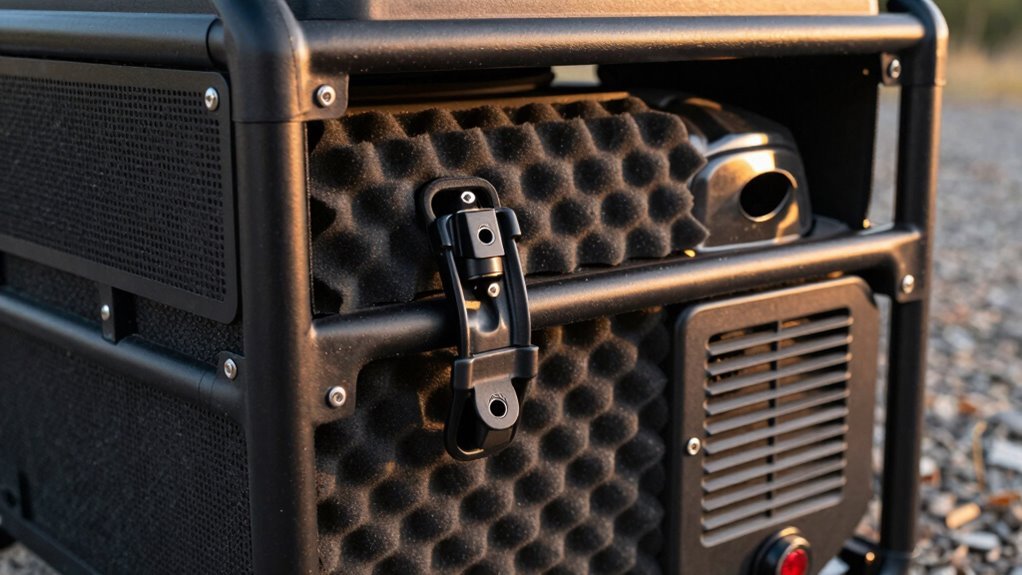
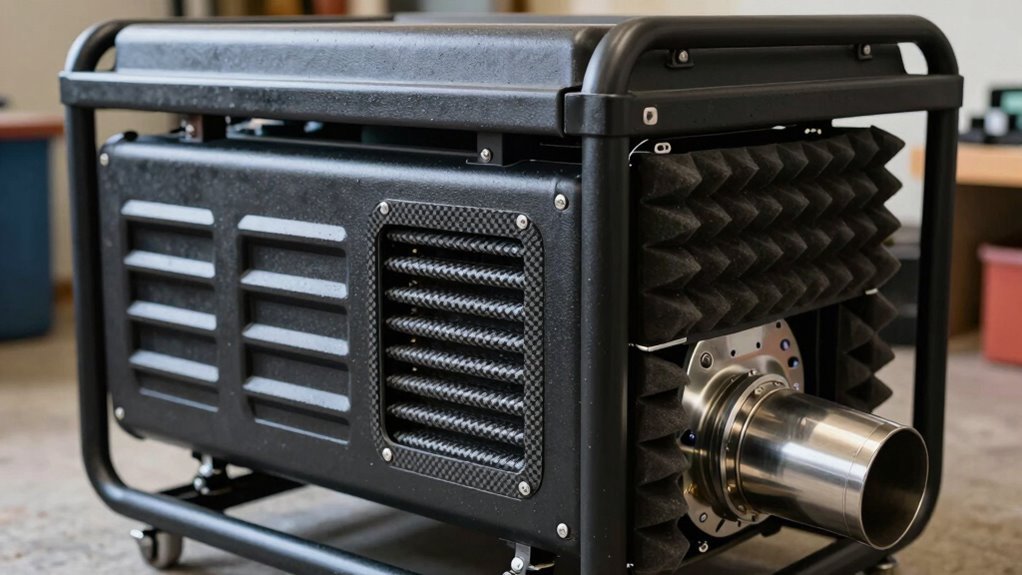
Slap a silencing box on that growling generator, and suddenly it’s not trying to audition for a monster truck rally.
You’ll cut noise by up to 75% with materials like marine-grade aluminum and Quiet Barrier® HD that block sound and stand up to rain or snow.
The thick insulation and acoustic foam inside soak up racket, while forced air fans keep your unit cool—no overheating surprises.
These enclosures are tough, portable, and assemble in minutes without tools, thanks to a collapsible design.
Just bolt it down or move it with ease using stainless steel hardware.
Need power? Run cords through built-in ports and vent exhaust safely outside.
They fit most portable generators and work great at campsites, festivals, or your favorite cabin spot.
Best part? No permits needed—just peace and quiet.
Just watch your warranty; poor airflow could void it.
But with smart design, you get silence, safety, and serious style.
You’ll wonder how you ever lived without one!
Build a DIY Sound Baffle Around the Generator
You don’t need a magic trick to quiet that chatty RV generator—just some smart materials and a little DIY elbow grease. Build your own sound baffle using MDF panels layered with mass-loaded vinyl and acoustic foam, all sealed tight with Green Glue and acoustical caulk. Cut vent holes, route a bent duct for airflow, and align everything neatly to trap noise without trapping heat. Keep the lid detachable for easy access, and don’t forget to seal every gap—sneaky sound loves to escape through tiny cracks. For lighter builds, swap in tile backer board and a wood frame, then give it a snazzy coat of high-heat paint. Add handles, and boom—you’ve got a portable quiet zone.
- Your generator deserves a cozy noise-blocking jacket
- Smart layers stop sound, not airflow
- Lightweight builds mean easy moves and big wins
- A well-baffled rig keeps campsite peace and sanity intact
Install Vibration Dampening Pads or Mats
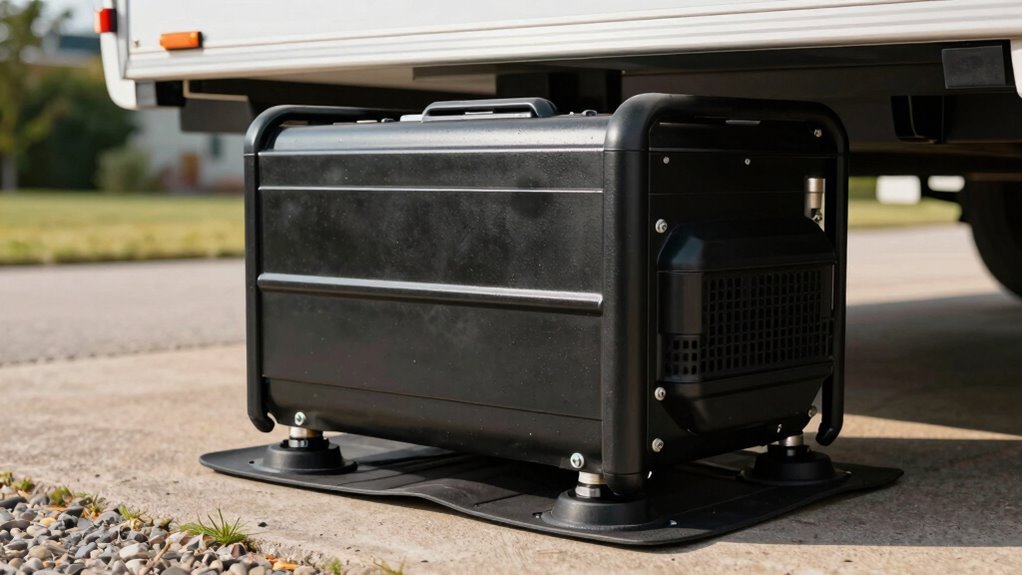
Taming that rumbling RV generator starts with stopping the shake before it spreads.
You know that annoying buzz that travels through your rig?
Vibration dampening pads or mats are your secret weapon.
Just pop them between the generator and its base—especially on concrete—to cut down noise fast.
Use rubber pads or air springs; they soak up shakes like a sponge!
Place them near the center of gravity and space evenly so everything stays balanced and stable.
Clean the surface first, maybe even build a little cradle to hold things in place while you work.
Elevate the generator on softer stands and skip hard surfaces like asphalt—they just bounce noise back at you.
Check for loose parts or worn pads before installing new ones.
It’s cheap, easy, and honestly kind of fun.
Soon, that angry growl turns into a polite purr.
Silence never felt so satisfying!
Schedule Regular Maintenance to Prevent Noise Buildup
Most of the time, a loud generator isn’t throwing a tantrum—it’s just begging for a little TLC.
You can keep it running smoothly and quietly by sticking to a regular maintenance schedule.
Fresh oil, clean filters, and sharp spark plugs make a huge difference—think of them as your generator’s daily vitamins.
Skip the upkeep, and you’ll invite noise, inefficiency, and grumpy mornings.
- Change oil and filters regularly to prevent sludge and reduce engine friction
- Inspect and replace air filters to guarantee clean airflow and quiet combustion
- Swap out fuel filters and check lines to avoid sputtering and unwanted rattles
- Service spark plugs and schedule annual professional checkups for peak performance
Treat your generator like a trusty campfire buddy, and it’ll whisper instead of shout.
Frequently Asked Questions
How Much Does a Professional Silencing Kit Cost?
You’re looking at $80 to $150 for a pro silencing kit, and honestly, it’s a steal for the peace and quiet you get.
GenSilencer runs around $100, Home Depot’s kit’s cheaper with a $50 discount, and those upgraded universal kits? Pricier, but knock noise down by over half—silence has never sounded so sweet!
Can I Run My Generator Indoors With a Silencer?
No, you can’t run your generator indoors—even with a silencer—because it still produces deadly carbon monoxide.
That sneaky, invisible gas doesn’t care how quiet your setup is; it’ll fill your space fast and knock you out cold.
Think of it like inviting a ninja assassin into your RV for coffee.
Keep it outside, 20 feet away, with exhaust pointed away.
Safety first, fun second!
Will Soundproofing Affect Generator Performance or Overheating?
You’re safe—soundproofing won’t tank your generator’s performance if you do it right.
Think of it like dressing for winter without wearing a snowsuit in July: balance is key.
You’ll use breathable barriers and smart vents so heat escapes like gossip at a family reunion.
Just keep airflow steady, avoid sealing it airtight, and your generator runs cool, quiet, and happy—no sweaty breakdowns or fried circuits here.
Are There Noise-Reducing Generators Designed for RVS?
Yes, there are!
You’ll love how inverter and electric RV generators are built to run quietly—some as hushed as a whisper.
They use smart tech like variable engine speeds and sound-absorbing materials, so you get power without the roar.
Plus, they don’t hog space or drain fuel.
Think of them as your campsite’s stealth mode—quiet, efficient, and definitely not your dad’s old clunky generator!
Does Insurance Cover Generator Damage From Noise Modifications?
Nope, insurance won’t cover generator damage from noise mods—think of it like popping the hood and voiding the warranty.
Tinkering with mufflers or DIY fixes?
That’s on you, not your policy.
Companies see it as altering the beast in ways they didn’t sign up for.
Stick to approved repairs, or you might get left holding the wrench—and the bill!
Play nice with your generator, and it’ll purr like a kitten.
Conclusion
You’ve tamed the growl, hushed the rumbles, and turned that roaring beast into a whisper. Now, your RV adventures come with chirping crickets, not clattering engines. Imagine sipping coffee under the stars, wrapped in peaceful hums, not noisy roars. With a few smart tweaks, silence never sounded so sweet. Sweet dreams, happy camping—and shhh, the woods are listening!
References
- https://generator-pro.co.uk/blog/understanding-generator-noise-level-regulations/
- https://800nonoise.com/tutorials/generator-set-noise-solutions/
- https://rvelectricity.com/the-abcs-of-generator-noise/
- https://www.mygrandrv.com/threads/generator-noise-mitigation.58677/
- https://rockymountaingeneratorsupply.com/blog/13337/Common-RV-Generator-Issues-and-How-to-Fix-Them
- https://myreliablepower.com/blog/why-is-my-generator-making-so-much-noise/
- https://www.ttprvrepair.com/blog/7-signs-your-rv-generator-needs-repair-now
- https://community.goodsam.com/discussions/motorhomesforum-board/generator-noise/708308
- https://www.sandiegorvcenter.com/news/how-to-tell-if-your-rv-generator-needs-replacement/
- https://www.bisongenerator.com/Blog/How-to-clean-generator-air-filter.html