How to Watch TV in Your RV (Antenna
Just pop an RV TV antenna on your roof to enjoy live TV on the road. These antennas are ideal for receiving over-the-air channels, especially in remote areas where cable or streaming isn’t reliable.
Go amplified for stronger signals up to 55 miles, particularly useful in rural or mountainous regions. The amplified RV TV antenna ensures better reception even far from broadcast towers.
Choose an omnidirectional model if you hate aiming and want effortless setup. For remote spots with weak signals, a directional antenna offers more precise targeting and improved performance.
Hook up the coax cable from the antenna to your TV and power the amplifier with a 12V source. Then scan for channels just like tuning a radio spaceship—simple and straightforward.
Bad weather might interfere, so rescan channels or slightly nudge the mast for optimal alignment. With a reliable RV TV antenna, staying connected to local broadcasts is easier than ever.
Understanding RV TV Antennas: Types and Features
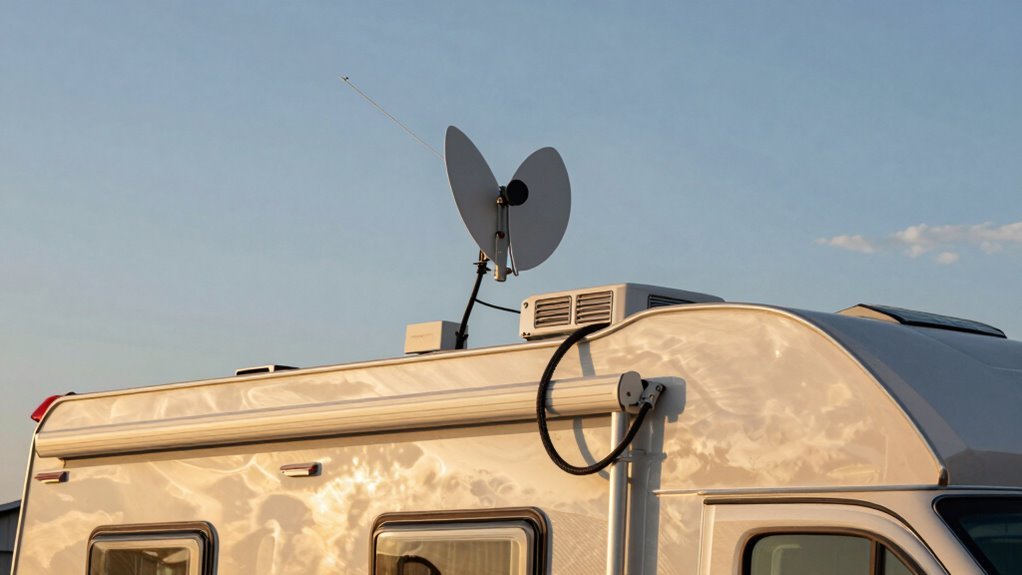
“You’ve hit the open road for adventure, but that doesn’t mean you have to miss your favorite shows—welcome to the world of RV TV antennas, where your mobile lifestyle meets homey entertainment.”
You’ve got options: go directional and aim it like a pro, or pick omnidirectional and skip the fuss—signals come in from all around!
Want more range? Amplified antennas boost signals up to 55 miles, great for remote stops.
Just remember, they need a little 12V power—about as much as a fancy flashlight.
Satellite dishes bring in tons of channels, while UHF/VHF combos catch local broadcasts.
Dual-band means you won’t miss a thing, and some even grab FM radio.
Masts rise with a crank or at the push of a button, retracting neatly for travel.
They’re built tough, 75-ohm standard, fighting signal hiccups so you can binge in peace—even if the closest town’s 30 miles away.
Some models, like the Winegard Sensar III, offer bidirectional operation for improved signal targeting.
Who said camping means roughing it?”
Choosing the Right Antenna for Your Travel Needs
While the great outdoors offers endless views, nothing beats kicking back with your favorite show after a long day of adventure.
If you’re always on the move, an omnidirectional antenna like the Winegard Sensar IV or Air 360 lets you catch signals from all around—no aiming needed, just plug and play.
But if you’re camping in remote spots, go directional: models like the Winegard Rayzar Automatic or KING Jack HDTV lock onto distant towers like a champ.
Prefer flexibility? Portable picks like the Luxtronic HDTV or Dish Playmaker are light, packable, and perfect for sneaky good reception without rooftop drama.
Think about where you’ll roam—rural zones call for amplifiers, like the one in the KING OA8500.
Just match your antenna to your travel style, and you’ll never miss your favorite drama (or the drama of chasing squirrels on nature TV).
Many RV antennas offer 360-degree reception, making them ideal for stationary setups where signal sources vary in direction.
Tools and Materials Needed for Installation
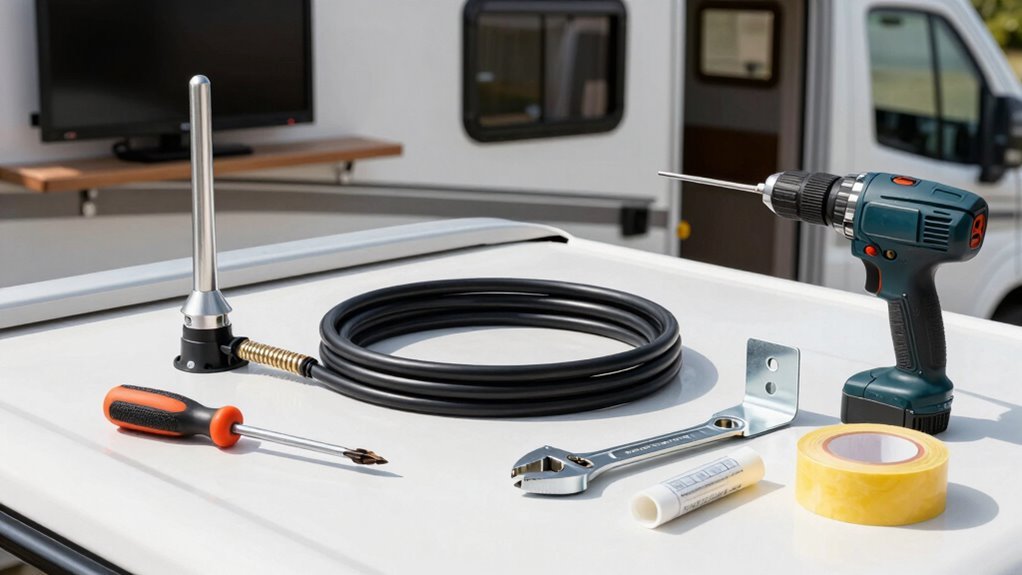
Getting your RV’s TV setup off the ground starts with gathering the right gear, and trust us, it’s more fun than assembling a puzzle with half the pieces missing.
You’ll need basic screwdrivers, pliers, and a plastic scraper to clean old sealant—because no one likes leftover goo.
Grab clippers for trimming coax cables clean, and a power drill to snug down mounting screws without a workout.
Don’t forget a ladder for roof access (safety first—no circus stunts).
Stock up on butyl tape and exterior sealant to keep rain out, and use rubber bumpers to position your sensor antenna just right.
You’ll also want a 12-volt connector kit, voltage tester, and coax tool for waterproof electrical joins.
A signal finder helps you hunt down broadcast towers like a pro, and yes, your TV’s channel scan will be your best friend later.
The Wingman unit extends ten inches from the side of the existing antenna to improve reception in obstructed areas.
With everything ready, you’re set to roll—literally and figuratively.
Step-by-Step Installation on Your RV Roof
Now that you’ve got all your tools lined up like a backyard BBQ before the big game, it’s time to get that shiny new antenna setup going right on your RV roof.
Start by removing the old antenna and, if needed, carefully enlarge the hole to fit the square shaft—drill a pilot hole first to dodge any wires hiding above.
Pick a clear roof spot away from racks and edges, and mark the front of the antenna toward the RV’s nose.
Slide in the base with butyl tape for grip and waterproofing, then secure it from inside.
Make sure the shaft spins freely—no rubbing!
Pop on the inside plate, test the turn, and seal around the base with Dicor.
Finish with a snug screw-down and slap on a protective cover.
It’s like giving your RV a hat that actually works.
With everything tight and true, you’re ready to aim—more on that next.
Connecting the Antenna to Your RV Television
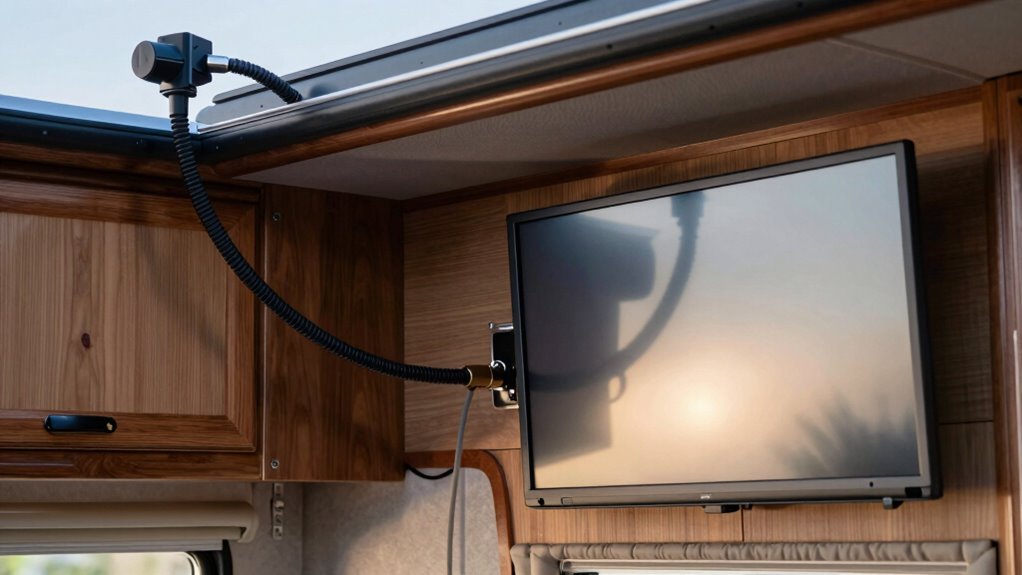
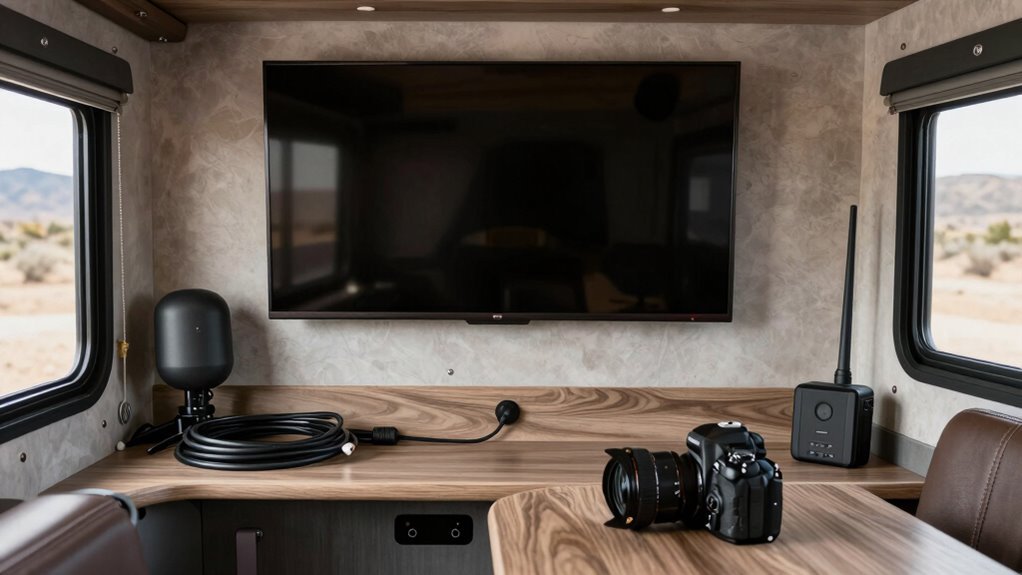
Grab that coaxial cable and let’s bring the shows to your screen—connecting your antenna to the TV is easier than setting up a campfire (and way more rewarding when your favorite series pops on).
Find the coax port on the back of your TV or check a nearby wall plate or distribution box if it’s not obvious.
Your RV might even have a control box that handles all the switching—fancy!
Just plug one end of the RG6 coax cable into the antenna output and the other into your TV’s “ANT IN” or “CATV” port.
Make sure it’s snug—loose connections love to ruin the fun.
If your setup’s already in place, sweet—you’re basically done.
No drilling, no drama.
Once it’s hooked up, power on the TV and get ready to scan for channels.
It’s like plugging in a campsite superpower.
Boom—entertainment, ready when you are.
Scanning for Channels and Troubleshooting Reception
Your RV’s antenna is hooked up and humming along—maybe even winking at you with a little light—so it’s time to see what shows Mother Broadcast has in store.
Grab your remote, pick the TV or ANT input, then dive into the menu and kick off an Auto Scan for air channels.
If you’re plugged into campground cable, switch the booster off, pick CABLE input, and scan again—yes, every TV needs its own scan.
Spin your antenna like a weather vane—90 degrees at a time—and rescan to catch the clearest signals.
Point those arrows true, and when things get fuzzy, crank up the mast or rescan after moving.
Use Antenna Point to spy nearby towers, keep coax cables under 25 feet, and don’t sweat it if you need streaming to fill the gaps.
Happy watching—your mobile living room deserves great reception!
Frequently Asked Questions
Can I Use My RV Antenna at Home?
Yeah, you can use your RV antenna at home—but only if it’s the right type.
TV antennas built for RVs usually work great on houses, no problem.
Just make sure it grabs both UHF and VHF signals for the best reception.
If it’s a cell signal booster or satellite dish meant *only* for RVs, though, you might break rules or void a warranty.
Check the manual, mount it securely, and boom—hello, free HD channels!
Do RV Antennas Work in Tunnels or Parking Garages?
No, your RV antenna won’t work in tunnels or parking garages—those metal roofs and concrete walls block signals like a champ.
You can’t catch channels without line-of-sight to towers, and underground spots kill that chance.
Amplifiers won’t save you, and fancy antenna moves just waste time.
But hey, at least your snack stash still works!
Try streaming or satellite instead—they’ve got your back when the antenna taps out.
How Often Should I Replace My RV TV Antenna?
You should replace your RV TV antenna every 5 to 7 years, or sooner if you’re losing channels, seeing pixelation, or living full-time on the road.
Coastal? Swap it earlier—salt air eats metal fast.
If your amplifier’s weak or seals are cracked, don’t wait.
Clean it yearly, grease moving parts, and power down the amp when not in use.
Treat it right, and it’ll keep your favorite shows crystal clear—because nobody likes a snowy finale!
Will a TV Antenna Interfere With My Wi-Fi Signal?
You won’t believe this, but your TV antenna won’t mess with your Wi-Fi—one’s low-band, the other’s high-band, so they’re basically ignoring each other.
Phew!
But hey, your microwave? That sneaky little guy can cause chaos.
Keep your router away from metal walls and gadgets, and turn off appliances when streaming.
Pro tip: boost your signal with a repeater by the window.
You’ll be binge-watching like a champ in no time!
Can I Watch Cable Channels With an RV Antenna?
Nope, you can’t watch cable channels with an RV antenna—those shiny little towers only grab free over-the-air shows, not ESPN or HBO.
Think of it like catching fireflies, not ordering pizza.
For cable, you’ll need a hookup at the campground.
But hey, with a good antenna and a booster, you’ll still catch your local news, weather, and maybe even *Jeopardy!*—no subscription required.
Cha-ching!
Conclusion
You’re cruising down the open road, mountains glowing in the sunset, when your favorite show flickers to life—yes, really! With your shiny new antenna, TV time just got way more fun. No more missing episodes because you’re off-grid. Snuggle up, grab popcorn, and laugh as static turns into crystal-clear shows. Who knew rooftop gadgets could feel this magical? Mission accomplished, couch potato—welcome to sky-high streaming, RV style!
References
- https://www.pplmotorhomes.com/parts/entertainment-comfort-camping/tv-antennas-tv-satellites-electronics/antennas/rv-antennas-winegard_22-1274
- https://rvshare.com/blog/rv-antenna/
- https://store.antennasdirect.com/clearstream-2-rv-hdtv-antenna.html
- https://winegard.com/air-360-hdtv-antenna/
- https://www.signalboosters.com/blog/best-rv-antennas-for-cellular-internet-tv/
- https://www.rvupgradestore.com/RV-TV-Antennas-s/959.htm
- https://www.youtube.com/watch?v=_4P8xykHL3M
- https://unitedrvparts.com/blogs/the-united-rv-advantage/how-to-choose-the-right-rv-antenna-a-step-by-step-guide
- https://www.taoglas.com/products/product-series/antenna-and-routers-for-rv/
- https://info.hookhub.co/blog/best-rv-antenna/