Solar Vs Generator: Off-Grid Power for RVS
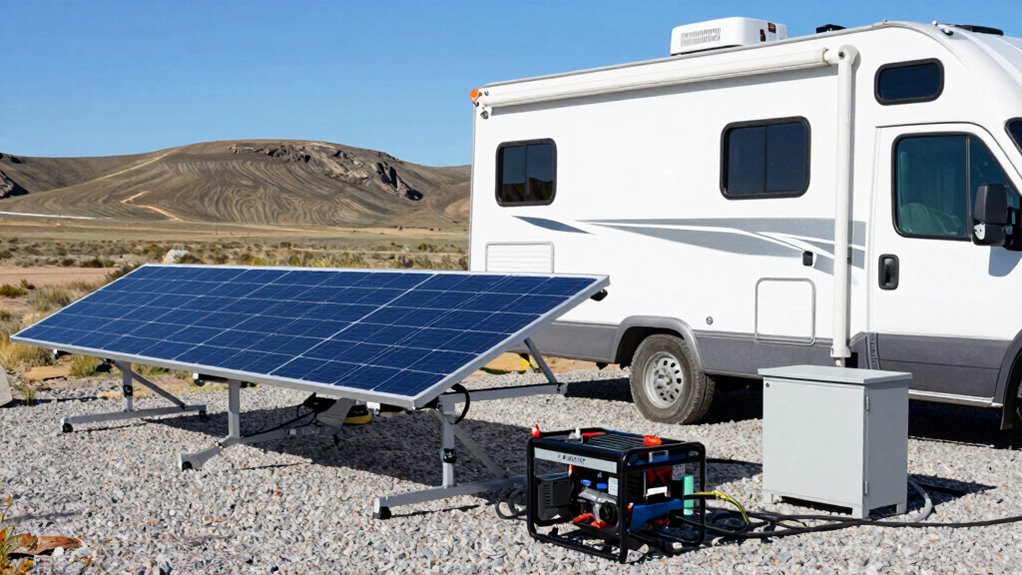
You’re cruising off-grid, and your power pick comes down to sunshine or gas. Solar panels quietly soak up rays, turning them into clean energy with no noise or fumes—perfect for boondocking in peace.
Generators roar to life, giving you instant, reliable juice for heavy loads. They’re loud and thirsty, but great when skies are gray.
When comparing solar vs generator for off-grid power in RVs, each has strengths that suit different adventures. Want to know which really powers your journeys longer, cleaner, and smarter? The full story’s just getting started.
How Solar Power Works for RVs
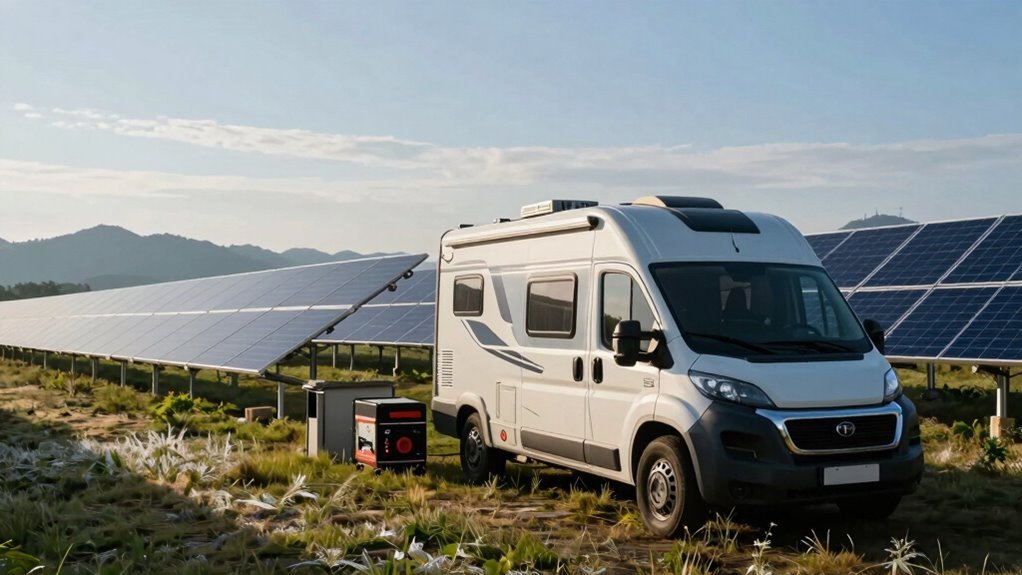
Ever wonder how you can run your coffee maker, lights, and phone charger in the middle of a forest without plugging into anything?
You’ve got solar panels on your RV roof, soaking up sunlight like tiny energy vampires—except way friendlier.
They convert sunshine into DC electricity, with monocrystalline panels being the sleek, efficient models (15–22% efficiency) perfect for tight spaces, while polycrystalline ones are budget-savvy and great if you’ve got room.
That power flows to a charge controller—MPPT is your best buddy—keeping your batteries from overcharging.
Deep-cycle batteries store the juice for rainy days or nighttime Netflix binges.
Then your inverter flips DC into AC so your fridge and outlets actually work.
With busbars, fuses, and a solid setup, everything stays safe and tidy.
It’s like magic, but better—it’s science, and you’re the wizard.
And because monocrystalline panels are more efficient and durable, they’re ideal for maximizing power in limited RV roof space.
How Generators Power Your RV Off-Grid
Fire up the generator, and suddenly your off-grid RV feels like a mobile apartment with power to spare.
You’re burning diesel to spin an alternator, which cranks out 120V or 240V AC—hello, instant electricity!
That juice zips through your electrical panel, powering AC units, microwaves, and even your late-night snack runs in the microwave.
Need lights or water? The generator also feeds your converter, which turns AC into 12V DC to charge house batteries.
A transfer switch keeps things drama-free by blocking dual power sources.
Bigger rigs might run 10,000 watts and split-phase power, so you can toast bread and blast the A/C at once—no tripped breakers.
Just remember, it’s loud, it guzzles fuel, and yes, you’ll sound like a construction site at dawn.
But hey, when the coffee maker and TV are both happy? Totally worth it.
Automatic transfer switch ensures seamless switching between generator and shore power without backfeeding.
Comparing Energy Output and Reliability
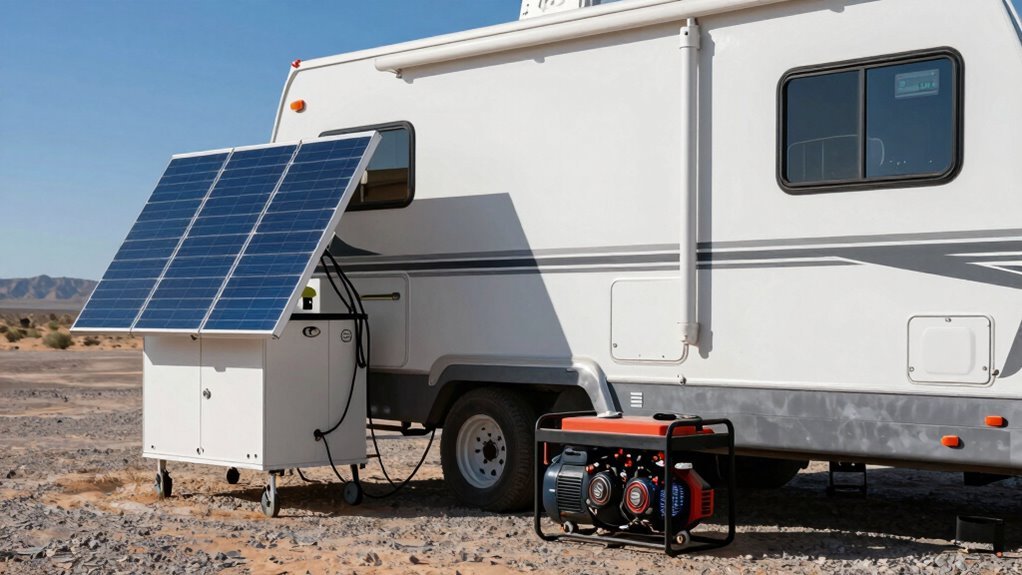
So, how do you keep the lights on and your coffee brewing when you’re miles from the nearest outlet? With solar, you’re harnessing the sun’s power—5 to 7 panels can fuel your fridge, lights, and laptop daily.
A 100W panel gives you 400–600Wh a day, but shade or clouds can cut that fast, so sunny spots are key.
Generators like the EcoFlow DELTA Pro deliver steady 3,600Wh and handle heavy loads without breaking a sweat.
Solar’s great on bright days, but if it’s cloudy for days, you’ll want serious battery backup—like 8kWh for three-day freedom.
And while solar sips energy all day, generators give you full power anytime, rain or shine. It’s like comparing a slow-cook meal to instant ramen—both fill you up, but one’s way more reliable when you’re hangry.
Longest Lasting models offer extended cycle life for dependable off-grid use.
Maintenance Requirements for Solar and Generators
You’ll actually enjoy keeping your gear in top shape—solar panels need just a bit of tender loving care to shine bright.
Clean them twice a year (or more if dusty or bird-prone) with soapy water and a soft cloth—think Dawn and elbow grease, not a pressure washer!
Check monthly for cracks, loose wires, or shady debris blocking the sun.
Don’t forget to inspect seals and mounts, especially after bumpy trips.
Tighten bolts now and then—heat and travel love to loosen things up.
Peek at your batteries every few months: clean terminals, top off fluid with distilled water, and check connections.
Generators? They’re thirstier: change oil every season, swap air filters, and run them monthly to keep gunk at bay.
Spark plugs need occasional tune-ups, and stale fuel’s a no-go.
With solar, you’ll spend weekends sipping coffee—not elbow-deep in engine parts.
Less mess, more chill!
Noise Levels and Environmental Impact
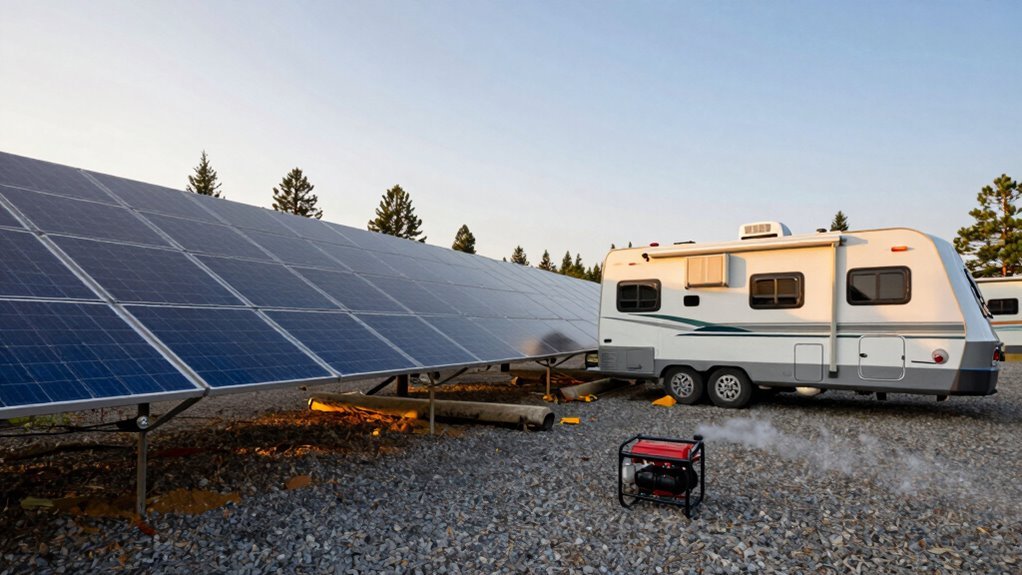
Now that you’ve got the lowdown on keeping your power sources happy and humming, let’s turn up the volume—well, actually, let’s talk about keeping it *down*.
With solar, you’re looking at a whisper-quiet 25-45 dB—like a fridge hum or a quiet library. No roaring engines, just peace.
Generators? Even the quieter inverter types hit 50-66 dB, and traditional ones can get as loud as a lawnmower.
Plus, here’s how solar wins the eco-game:
- Silent operation: No noise, no fuss—just power that doesn’t ruin the serenity.
- Zero emissions: Solar skips the fumes and fuel, keeping air and nature clean.
- Wildlife-friendly: Quiet and clean means you won’t scare off the squirrels—or your camping neighbors!
You’ll sleep better, talk easier, and feel good about your footprint.
Cost Comparison Over Time
Over time, your wallet will thank you for going solar.
Sure, you might spend $300–$8,000 upfront, depending on your setup, but think of it like buying a coffee machine—you’ll skip the daily fuel run (and those sky-high gas prices).
Generators cost $300–$10,000 too, but then there’s fuel—hello, $1,500 a year just to keep the lights on!
Solar runs on sunshine, which, last we checked, is still free.
In 3 years, you’ll break even, and by year 10? You could save $15,000.
Generators wear out after 10,000–30,000 hours, but solar panels power your adventures for decades.
No oil changes, no fumes, no noise—just quiet, clean energy that keeps on giving.
Who knew the sun could be your cheapest, happiest power buddy?
Installation and Space Considerations
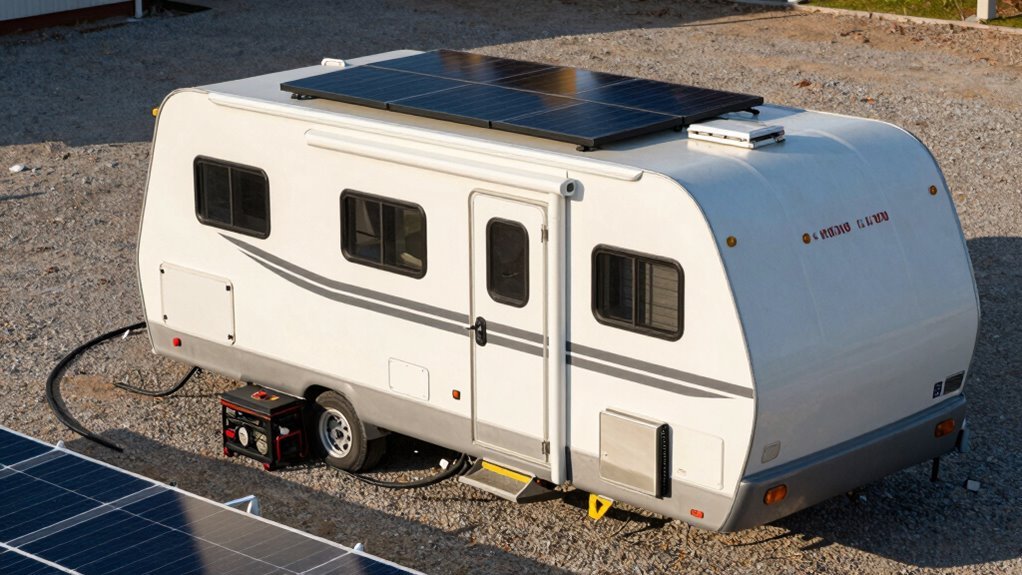
Ever wonder how much of your RV roof is actually prime real estate for solar panels?
You’ve got vents, AC units, and who knows what else eating up space—so measure carefully.
A 19-foot roof can still fit three 400W panels, and flexible panels let you squeeze in over 500W creatively.
Avoid shading like the plague; even a small shadow kills output fast.
Use colored tape to map it out before drilling anything!
Here’s how to nail your setup:
- Maximize sun exposure by placing panels in unshaded zones and leaving a 20 mm gap between them.
- Pick panel size smart—use compact 60-cell types for tight roofs, or go portable if roof space is tight.
- Leave room to walk and access gear—nobody wants to waltz across their investment mid-repair.
Mounts need airflow, gear needs space, and you need peace of mind—plan it all now.
Real-World Performance in Different Conditions
When the sun’s blazing overhead, your solar panels are practically throwing energy at you—5 to 9 hours of direct sunlight can push 30Ah of charge from every 100W panel, making days like this pure gold for off-grid freedom.
On cloudy days, though, things slow down; shade keeps your RV cool but starves your panels, so advanced MPPT controllers step in like little energy ninjas, squeezing out every drop.
You’ll want a bigger battery bank for those gloomy stretches—think of it as power saved for a rainy day.
Need to run the AC all night? Grab at least 700Ah and sunlight won’t cut it—generators shine here, with instant high-watt juice.
But for lights, phones, and your morning coffee, 300W solar’s got you covered, silently and without a single puff of fume.
Solar’s quiet magic meets generator muscle when you go hybrid—best of both worlds, no drama.
Frequently Asked Questions
Can I Run My Air Conditioner Solely on Solar Power?
Yeah, you can run your air conditioner on solar power, but it’s no small setup.
You’ll need a beefy solar array—think 1,800 watts or more—and a serious battery bank to keep it going at night.
Roof space? Limited.
Real-world sun? Tricky.
It’s doable, sure, but expect to invest big time.
Think of it like powering a mini fridge with sunlight—it’s cool, but you’ve gotta earn it!
Do Solar Panels Work When Covered in Snow or Dust?
Back in the horse-and-buggy days, folks thought snow stopped everything—but not your solar panels!
You’ll see zero output if they’re buried, sure, but light dusting or snow? It often slides right off, especially on a tilt.
And hey, a little snow around the panels boosts reflection, giving you a sneaky power boost.
Dust drags efficiency down, but a good rain or wipe fixes that fast.
You’re good!
How Long Do RV Solar Batteries Last Before Needing Replacement?
Your RV solar batteries typically last 10–15 years, but it really depends on what type you use.
Lithium ones? Superstars—lasting up to 20 years and handling thousands of charge cycles.
Lead-acid batteries won’t last nearly as long, especially if you drain them all the way often.
Treat them right—don’t overheat them, keep them charged, and check them now and then—and they’ll keep your adventures powered longer.
Think of them like pets: feed ’em right, and they’ll stick around!
Can I Use a Generator to Charge Solar Batteries?
Yeah, you can totally use a generator to charge your solar batteries—no, it won’t fry them!
Modern systems like the EG4 ChargeVerter make it safe and super efficient.
Just fire up your generator, let it run at 1,900W, and watch your batteries charge in about 3 hours.
It’s like giving your RV a power snack when the sun’s taking a nap.
Just don’t forget to connect everything right—nobody likes a “oops, I blew a fuse” moment!
Are Portable Solar Panels Worth It for RV Travel?
Yeah, portable solar panels are totally worth it for RV travel—you save cash long-term since the sun’s free, no more noisy generator fuss.
They’re light, fold up small, and you can angle them for max power, even when parked in the shade.
No roof drilling, no fuel runs.
Plus, you’ll keep your batteries happy and green, which is way cooler than smelling like diesel.
Win-win.
Conclusion
You’ve got choices, and that’s power! Solar keeps you quiet and green—did you know one 200-watt panel can run your fridge for 8 hours? Gener单职业
References
- https://www.renogy.com/blogs/general-solar/what-are-the-main-components-of-a-solar-power-system
- https://www.litime.com/blogs/lifestyle/basic-components-for-diy-rv-camper-solar-system
- https://www.lazydays.com/rv-lifestyle/what-rv-solar-power/
- https://gopowersolar.com/how-rv-solar-works/
- https://outrig.com/rv-solar-power-systems-101-what-is-it-and-why-you-need-it/
- https://www.youtube.com/watch?v=xuZg4NasCVw
- https://www.gorving.com/tips-inspiration/expert-advice/getting-started-rv-solar-power-beginners-guide-grid-freedom
- https://richsolar.com/collections/system-components
- https://www.nirvc.com/blog/rv-electricity-101-part-2-an-rv-owners-guide-to-rv-electrical-systems/
- https://leisurecw.com/rv_repairs/the-basics-of-rv-electrical-systems/