GPS Vs Smartphone Maps: What’s Best for RV Navigation
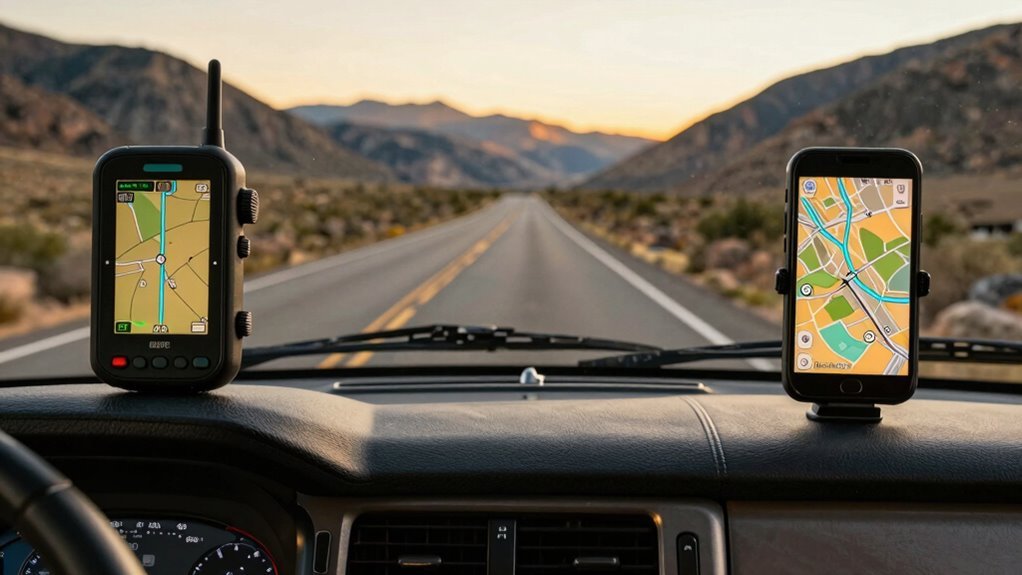
You’re driving a beast, not a sedan—so why risk a low bridge with a smartphone that doesn’t know your RV’s height? A dedicated RV GPS is built to handle your rig’s unique dimensions, automatically avoiding low clearances, narrow roads, and other hazards.
Smartphones are great for coffee runs, but they’re not designed for serious RV navigation. They often fail when signals drop or update routes without considering your vehicle’s size.
With an RV GPS, you get reliable, offline-ready routing that keeps you safe and on track. Let your smartphone handle music and messaging while the real navigation work goes to a system that knows your needs.
Understanding the Unique Challenges of RV Navigation
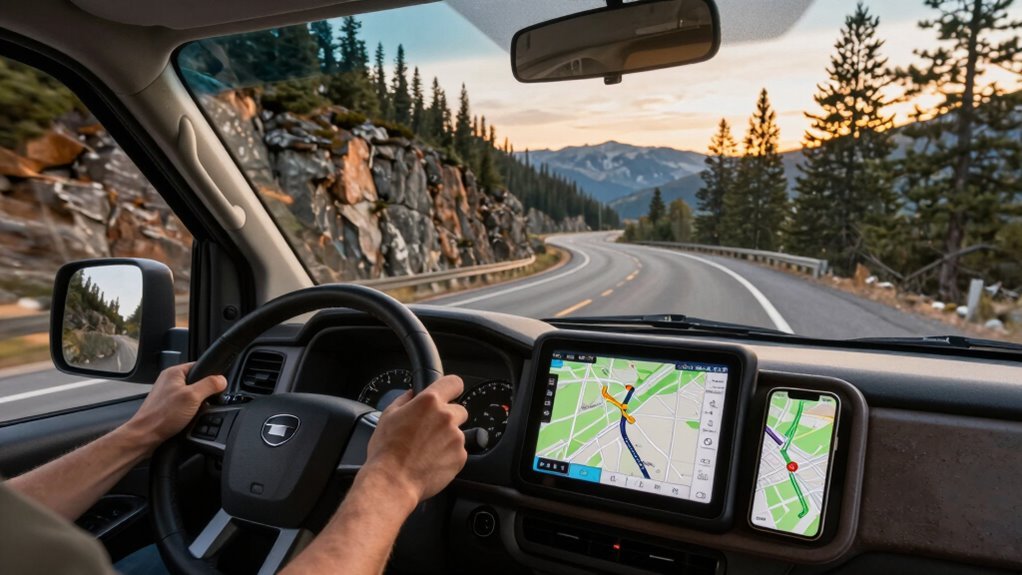
While your smartphone map might think you’re ready to take on any road, maneuvering an RV is a whole different adventure—one that comes with quirks and challenges regular GPS just doesn’t get.
You’re not just driving—you’re piloting a giant that won’t fit under low bridges, squeeze down gravel paths, or reverse out of a dead-end road that ends in a lake (yes, really).
Your 40-foot rig laughs at weight limits and ignores tree branches that haven’t heard of tall vehicles.
Ever tried explaining to a map app that your “quick detour” isn’t happening on a one-lane mountain curve?
Standard tools don’t know about RV height, width, or your growing panic when the road gets dark and twisty.
And good luck finding a campsite—half the time they’re booked, crowded, or farther than your gas tank dares.
It’s not just navigation; it’s survival—with style and a fridge full of snacks.
Millions of trips and billions of miles have been made safer thanks to RVer-powered data shaping smarter routes, highlighting where community insights make all the difference hundreds of thousands of real-time data points contributed.
How Dedicated GPS Devices Cater to RV-Specific Needs
You’re not just hitting the road—you’re commanding a mini motorhome mansion, and regular GPS just doesn’t get your lifestyle.
Dedicated RV GPS devices do.
They know your rig’s height, weight, and length, rerouting you around low bridges and narrow roads before disaster strikes.
No more white-knuckle turns or “will-it-fit?” stress—smart algorithms handle steep grades, sharp curves, and bad roads like a pro.
You’ll get alerts for hazards ahead, plus lane guidance that keeps you calm in chaotic interchanges.
Need a pit stop? Pull up millions of RV parks, dump stations, and big-rig-friendly fuel spots with ease.
Crisp, glove-friendly screens shine bright in sunlight, and preloaded scenic routes make adventure a click away.
This isn’t just navigation—it’s your RV’s co-pilot, minus the backseat driving.
These devices offer custom routing based on size and weight, ensuring your journey is tailored to your RV’s unique dimensions and capabilities.
The Role of Real-Time Data and Connectivity in Smartphone Maps
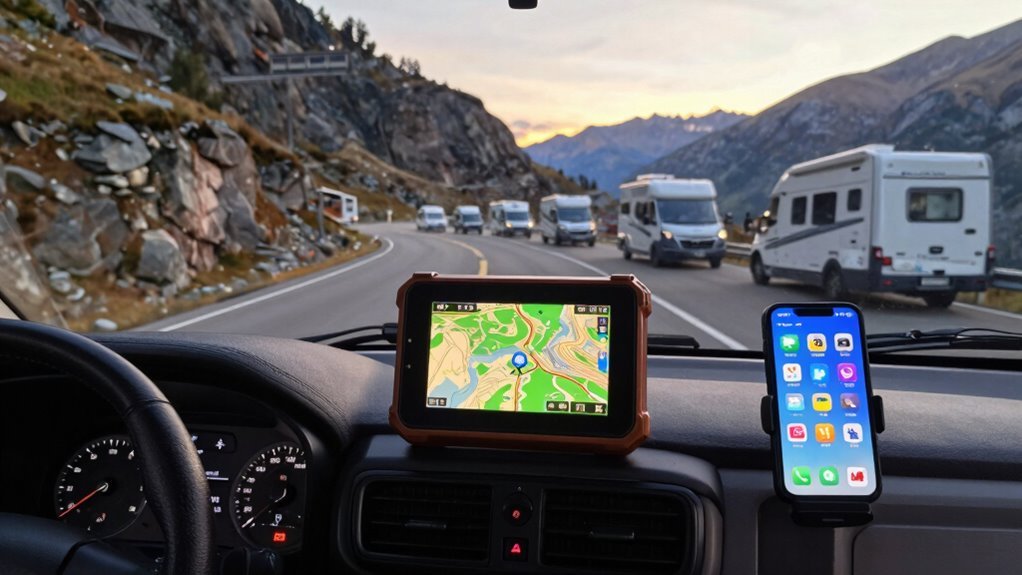
Out on the open road, your smartphone’s got a serious superpower: real-time smarts.
With Google Maps, you’re not just maneuvering—you’re dodging traffic jams like a pro, thanks to live updates pulled from other drivers on the road.
It recalculates routes on the fly if traffic backs up or roads close, keeping your RV rolling smoothly.
Turn-by-turn navigation stays connected, constantly downloading fresh data so you never miss a detour.
Sure, it uses about 5 MB per hour—more with traffic on—but you can switch to low data mode to save some juice.
Just remember, all those slick updates need a steady connection.
Your phone’s pinging networks, rejoining when signals hiccup, all so you don’t end up lost near a cow pasture.
Real-time magic’s awesome, but it’s a team effort between you, your phone, and the invisible web of data keeping you on track—no cape needed.
Google Maps uses 3–5 MB per hour of data during typical use, balancing functionality with moderate consumption.
Comparing Reliability in Remote and Rural Areas
When you’re winding through the backcountry where cell bars vanish like yesterday’s snacks, your trusty RV GPS starts to shine. It locks onto satellites directly, so you’re never left guessing in dead zones.
Unlike your smartphone, which stumbles without Wi-Fi or cell signals, a dedicated GPS keeps cruising—no connectivity needed.
Under thick trees or beside canyon walls, your phone might think you’re floating in a lake, but your RV GPS stays accurate within a few meters. It stores maps right on the device, so updates aren’t a constant worry.
Sure, smartphones are clever when the network cooperates, but out here, they’re like city drivers in a mud race—out of their element. Plus, your GPS guzzles way less battery, so you won’t panic when the sun sets and power’s scarce.
In the great wide nowhere, your old-school GPS isn’t just reliable—it’s your backcountry buddy, ready when tech fails.
Balancing Convenience and Safety While on the Road
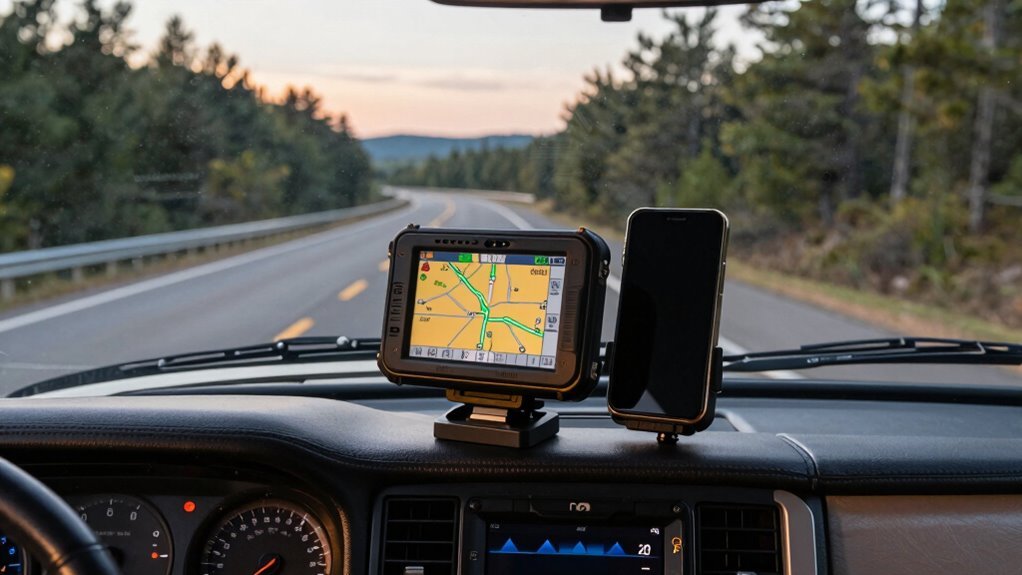
While your smartphone might be the go-to for finding the nearest coffee shop or live-tracking your pizza delivery, it’s not always the co-pilot you need once you’re behind the wheel of a hulking RV.
Sure, your phone updates maps automatically and finds the fastest route in seconds—but does it know your RV can’t fit under that 10-foot bridge? Probably not.
Dedicated GPS units, like Garmin RV, are built with your rig in mind, warning you about low bridges, steep grades, and tight turns.
Smartphones struggle in dead zones, while GPS keeps going when cell service disappears.
For real peace of mind, use both: let your RV GPS lead the way and double-check routes with Google Maps’ satellite view.
It’s like having a navigator *and* a lookout—smart, safe, and a little bit fun.
Safety never looked so easy.
Frequently Asked Questions
Can I Use a Regular Car GPS for RV Navigation?
You *can* use a regular car GPS for RV navigation, but you shouldn’t—it’s like bringing a skateboard to a monster truck rally.
It won’t account for your height, weight, or wide turns, and might send you under a low bridge.
Yikes!
You’ll miss RV-friendly campgrounds, proper rest stops, and fuel spots too.
For safety and sanity, skip the guesswork and get a real RV-specific GPS.
Trust us, your rig will thank you!
Are There Subscription Fees for Rv-Specific Map Updates?
Yes, you’ll often pay for RV-specific map updates, but it’s usually worth it.
Devices like Garmin charge yearly fees for fresh maps and features tailored to your RV’s size and weight.
Skip the stress of surprise bridges or steep hills—those alerts keep you safe.
Some systems even update over Wi-Fi, so you’re not fussing with SD cards.
Think of it as paying for peace of mind, not just maps.
Your rig, your rules—just with better directions!
How Often Should I Update My Smartphone’s Navigation App?
You should update your smartphone’s navigation app every few weeks, like clockwork, right when a new version pops up.
It’s like giving your RV a GPS tune-up!
These little fixes boost speed, accuracy, and keep you from getting lost near corn mazes or scenic detours.
Don’t skip them—auto-update to stay on track, save data, and avoid “rerouting” drama on the open road.
Smooth travels!
Do RV GPS Devices Work Outside the United States?
Yes, your RV GPS works outside the U.S.—it’ll find you anywhere satellites reach, no cell needed.
But here’s the twist: maps might not.
Most come with just North America, so you could end up in France with no directions and a very confused accent.
Want global brain power? Grab a tracker like Tracki or Invoxia—they’ve got your back worldwide, and hey, at least your GPS won’t ghost you in Greenland!
Can Smartphone Maps Handle Multiple RV Size Profiles?
No, you can’t set multiple RV size profiles on smartphone maps—they don’t support height, length, or weight inputs at all.
Google and Apple Maps stick to cars, so they’ll cheerfully route your 30-foot rig under a 9-foot bridge.
Oops!
Want real safety?
Dedicated RV apps let you save different vehicle profiles and avoid disastrous turns.
Trust us, your GPS shouldn’t gamble with overpasses.
Save your smartphone for finding taco stands, not tight squeezes.
Conclusion
You’re barreling down a backroad, mountains looming, cell signal fading—so which one do you trust? Your RV-specific GPS knows your height, weight, and route limits, but your smartphone sees traffic like magic. One promises safety in silence, the other winks with real-time updates. Both have strengths, but when the path twists and your heart skips? Well, wouldn’t you hate to guess wrong at 40 feet tall? Choose wisely—your next turn depends on it.
References
- https://rvbusiness.com/rv-life-achieves-significant-milestone-with-3-million-members/
- https://www.youtube.com/watch?v=tyih5wmWzvg
- https://www.bishs.com/blog/future-of-the-rv-industry-trends-industry-update/
- https://www.progressive.com/resources/insights/living-in-an-rv/
- https://www.emergencyassistanceplus.com/resources/rv-statistics/
- https://www.marketreportanalytics.com/reports/rv-gps-devices-72114
- https://magazine.rventhusiast.com/preview/march-2021/overcoming-the-next-big-connectivity-challenge-in-rving/
- https://www.iconcox.com/news/a-hitchhikers-guide-to-rv-adventures-how-gps-tracking-enhances-travel-safety-and-convenience.html
- https://www.technavio.com/report/caravan-and-motorhome-market-analysis
- https://blog.petra.com/blog/garmin-gps-for-cars-rvs-and-off-roading