Tips for Driving a Motorhome for the First Time
Know your motorhome’s size—measure height, length, and width, including AC units and slideouts. This is crucial for safe driving, especially when navigating tight spaces or low-clearance areas.
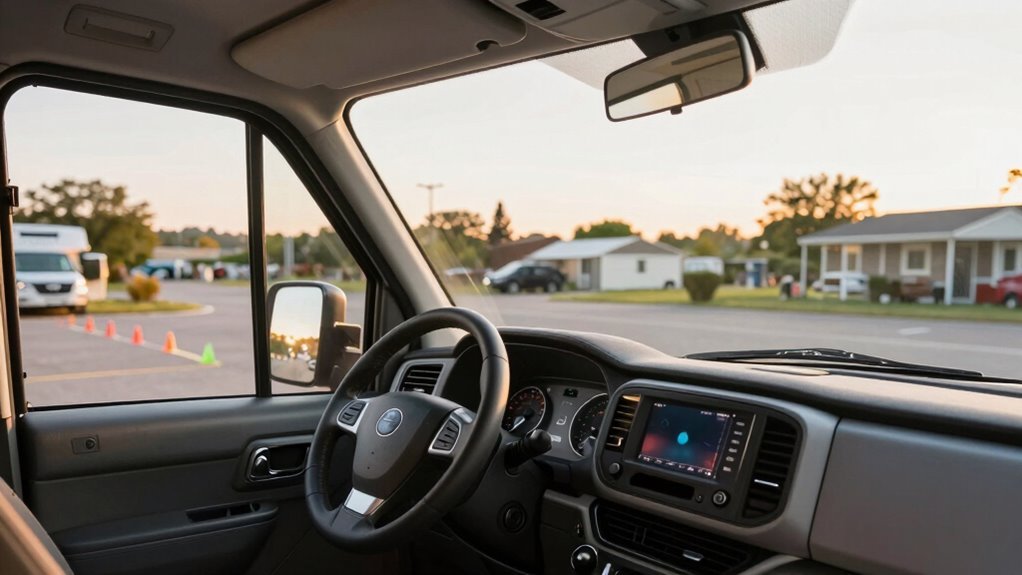
Use big mirrors and a backup camera to beat blind spots. Practice backing up in empty lots to build confidence and improve control.
Take wide turns and plan routes with RV-friendly GPS to avoid obstacles. Keep extra space to stop safely, especially when roads are wet.
Watch for low bridges and tight corners as you drive. You’re handling a motorhome with the spirit of adventure—drive with care and confidence, and enjoy the journey ahead.
Understand Your Motorhome’s Dimensions
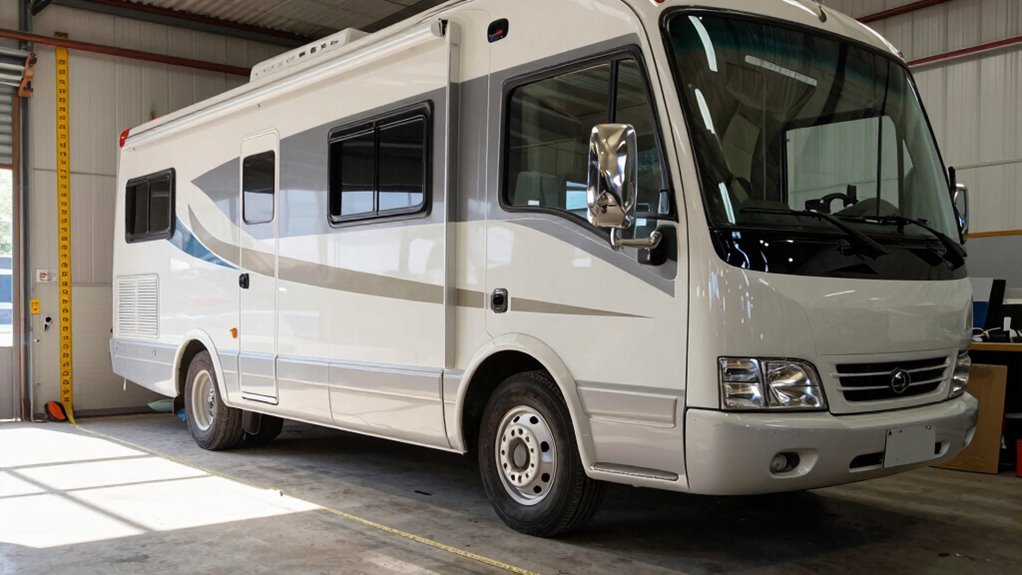
Ever wondered why that gas station sign says “RVs under 13 feet only”? Well, your motorhome’s height could be the reason—some Class A models hit 13 feet 6 inches tall, especially with roof AC units or antennas! You’ve gotta measure from the ground to the highest point, not just glance and guess.
Length matters too—your bumper-to-bumper can stretch to 45 feet, like the Entegra Cornerstone. That’s longer than most garages!
Most RVs are about 8.5 feet wide, fitting snugly in standard lanes, but slideouts pop out and eat up extra space. States let you roll with up to 102 inches wide, sometimes more.
California says 45 feet max for motorhomes; Montana’s cool with 55.
Know your numbers—length, width, height, weight—so you dodge trouble, overpasses, and awkward “I can’t fit” moments.
Measure it yourself with a tape, twice if needed.
Be the RV boss you were born to be!
Class B motorhomes offer easier handling and garage fit, with typical lengths between 17 and 23 feet (17–23 feet long).
Adjust to Increased Blind Spots
How’s your rearview looking when you’re behind the wheel of a motorhome?
Not so great, huh?
Those blind spots are no joke—they can hide cars, bikes, or even a curious deer.
But don’t sweat it!
You’ve got tools.
Use extended mirrors and convex spots on the sides to catch what your standard mirrors miss.
Mount spot mirrors on the A-pillars and doors to watch the zones right beside you.
Add a backup camera with a wide 170° view, especially one with night vision, so you’re not fumbling in the dark.
Check your blind spots by turning your head—yes, really!
Look left, right, and behind before you move.
Keep it slow when visibility drops, and give yourself extra space.
With the right mirrors, cameras, and a quick head check, you’ll see everything—and avoid backing into someone’s picnic lunch.
Thicker A-pillars, designed for crash safety, now mask about three square feet of forward view at 12 feet, significantly narrowing your line of sight.
Practice Maneuvering in Open Areas
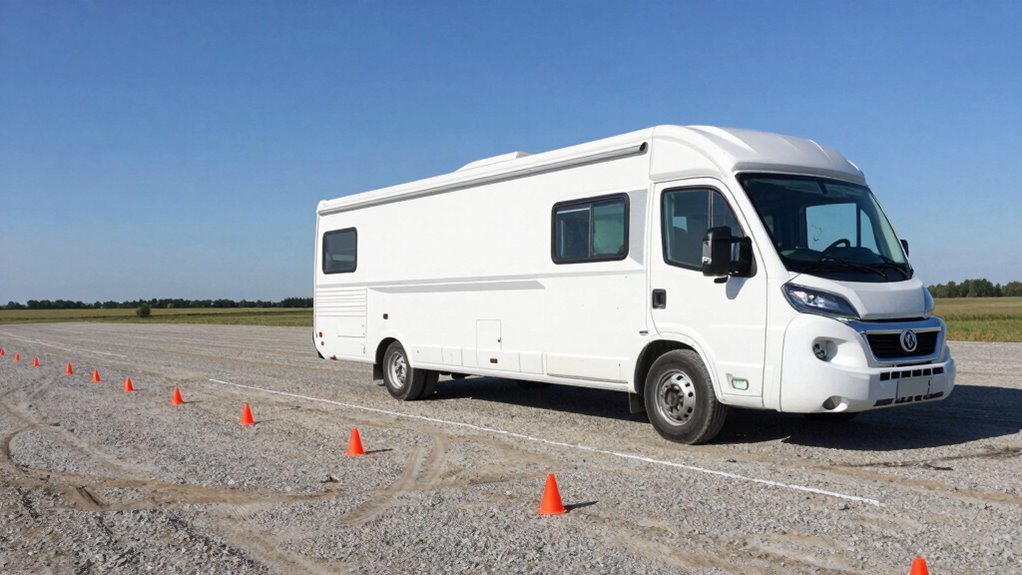
Getting behind the wheel of a motorhome and actually steering it where you want? It’s not like driving your car, but with practice, you’ll get the hang of it—no white-knuckle stress required.
Head to an empty parking lot and start slow.
Build confidence by mastering straight backing, then ease into tighter turns.
Your motorhome swings wider than you think, especially on right turns, so give yourself room and time.
Use your mirrors—they’re your best friends—and make small, controlled steering moves.
- Back up straight, then curve gently into a 45-degree angle like you’re sliding into a picnic spot at the campground.
- Turn sharply in an open space to see how the rear swings—don’t worry, no mailboxes are in danger here!
- Practice stopping and repositioning mid-move, just like you’d do when aiming for a tight campsite.
Visualize strategy ahead of time to improve precision and reduce mistakes during real-world maneuvers.
You’ve got this!
Plan Routes With Clearance and Weight Limits
One wrong turn can mean a too-tight squeeze under a bridge or an unexpected detour thanks to a weight-restricted road—so don’t leave your route to chance.
You’ve got a big rig, and that means planning ahead with smarts and a little humor—because no one wants a “meet the bridge” moment.
Check your RV’s real height, including AC units and solar panels, then subtract six inches from posted clearances just to be safe.
Most states add 3–6 inches as a buffer, but treat the sign as your hard limit.
Use RV-specific GPS apps like TruckMap to dodge low bridges and weight-restricted roads.
Remember, older roads might only have 13’6” clearance—and resurfacing eats into that over time.
Plan primary and backup routes, especially where spring thaw or tourism limits load limits.
You’ll drive easier, laugh more, and keep your roof (and pride) intact.
Allow for Longer Stopping Distances
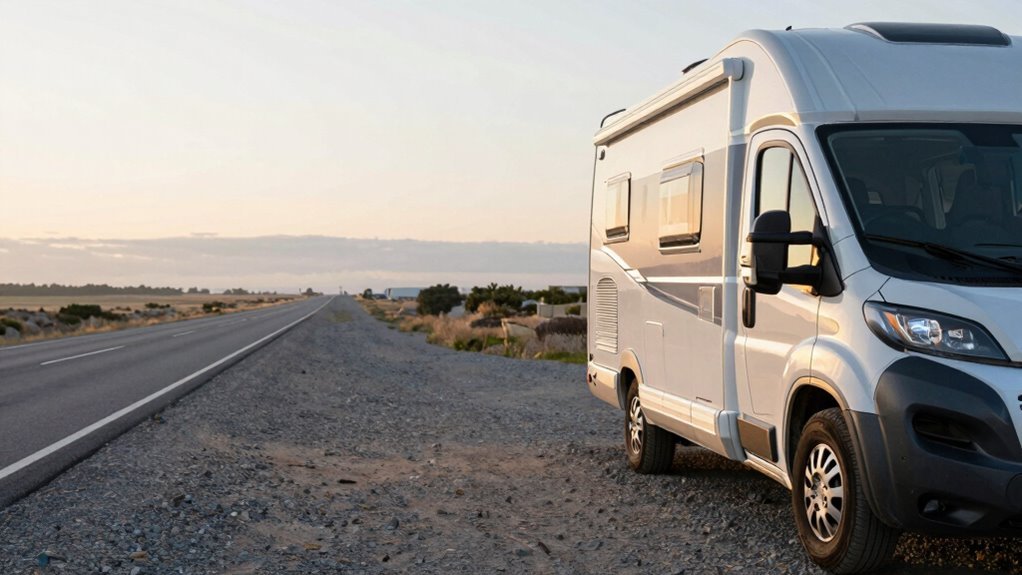
When you’re behind the wheel of a motorhome, hitting the brakes isn’t quite the same as in your everyday car—those extra tons of steel, gear, and supplies mean you’ll need plenty of runway to come to a smooth stop. You’re not just driving, you’re commanding a mini-house on wheels, and it won’t dart to a halt like your sedan. Think of it like stopping a shopping cart full of cinder blocks—slowing down takes time, space, and a little extra planning.
To keep things safe and smooth:
- Leave at least 6 seconds between you and the car ahead—more if you’re over 40 mph.
- Remember, a fully loaded motorhome can take over 300 feet to stop at highway speeds.
- Wet roads? Windy day? Add extra seconds—nature’s got zero respect for schedules.
Stay alert, stay back, and enjoy the ride—your brakes will thank you!
Master Wide Turns and Cornering
Ever wonder why that motorhome in front of you seems to drift halfway into the next lane before turning right? That’s you soon—so let’s make it smooth.
Your motorhome pivots on its rear axle, swinging the back end outward, especially in tighter turns.
To nail wide turns, start deeper into the intersection—wait until your hips pass the corner—then swing wide.
This keeps your rear wheels from climbing curbs.
On right turns, cheat slightly left first (don’t worry, you won’t hit anything—yet).
Take up both lanes if needed; better safe than sorry.
Diesel pushers? Lucky you—they turn tighter.
Practice in empty lots to learn your rig’s sweet spot.
And hey, gentle turns beat panic moves.
Treat it like a dance: slow, steady, and confident.
Soon, cornering will feel like second nature—just don’t forget to wave at curious drivers.
Use Spotter Assistance When Needed
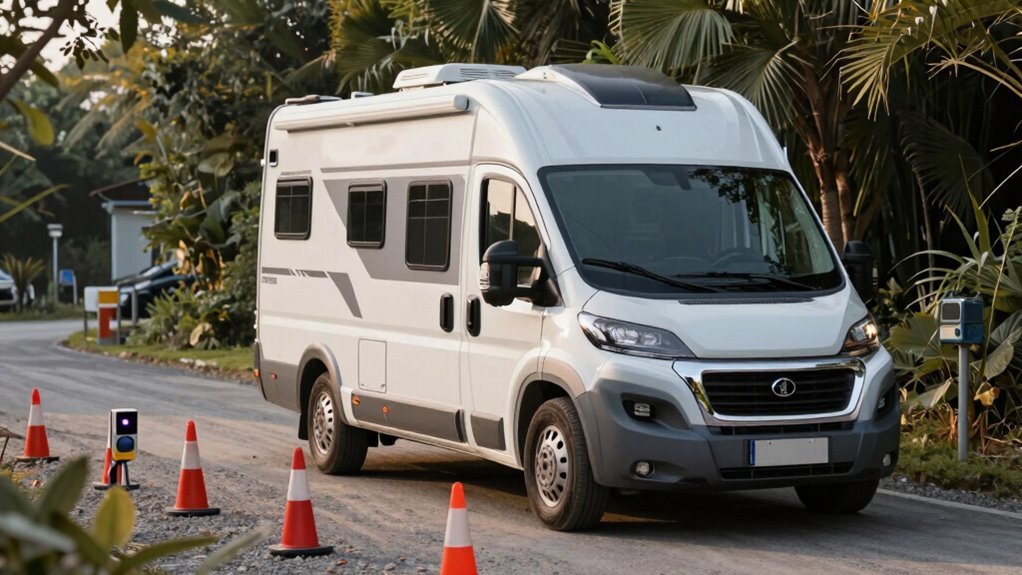
While you’re the one behind the wheel, letting someone else take the spotlight—literally—can save your motorhome from scrapes and your pride from dents.
A spotter’s your co-pilot for tight spaces, calling out obstacles you just can’t see. Whether it’s your spouse, a friendly neighbor, or helpful campground staff, grab a spotter whenever you’re backing up—it’s like having a guardian angel with great eyesight.
Before you roll, chat about hand signals and maybe grab walkie-talkies so you’re both on the same page (and channel). Keep them visible in your mirror, and stop if they duck out of sight.
- Spotter stands at driver’s side, arms out, signaling with clear, agreed-upon hand motions
- You creep backward, responding to taps, palms down, and the universal “STOP” fist
- They call out distances like “three feet left,” eyes scanning for tree limbs, curbs, and sneaky fire pits
Frequently Asked Questions
Can I Drive a Motorhome With a Standard Driver’s License?
Yes, you can drive most motorhomes with a standard driver’s license if they’re under 26,000 pounds—good news for your road trip dreams!
Class B and C motorhomes usually fit this rule, so you’re set to hit the road without extra paperwork.
Just check your state’s DMV rules, ’cause some spots get picky about length or weight.
When in doubt, double-check GVWR—you’ve got this, Captain Cruise!
Are Pets Allowed Inside the Motorhome While Driving?
Yes, you can bring pets in the motorhome while driving, but they’ve gotta be secured.
You wouldn’t let them ride loose on your lap—imagine Fido hitting the gas mid-turn!
Use a harness, carrier, or crate to keep them safe and obey laws in places like Pennsylvania or Hawaii.
It’s safer, smarter, and keeps your furry co-pilot from becoming an accidental race car driver.
Sweet road trips start with happy, restrained pets!
Do I Need Special Insurance for Renting a Motorhome?
Yes, you need special insurance when renting a motorhome—your regular car policy usually won’t cover it.
Imagine cruising into Yellowstone, feeling proud, then accidentally backing into a tree; without proper coverage, that “oops” could cost thousands.
Rental companies offer plans from $15/day, and platforms like Outdoorsy include up to $1M liability.
Just confirm the details, grab the right plan, and hit the road worry-free—it’s adventure time, not stress time!
How Often Should I Check Tire Pressure on Long Trips?
You should check your tire pressure before every long trip—no exceptions.
Do it cold, first thing in the morning.
During travel, peek at it at least every few days, especially if temps swing or you’re climbing mountains.
Heat, sun, and load changes mess with pressure, and nobody wants a surprise flat.
Throw in a quick glance weekly, and trust me, your tires will thank you—happy tires mean happy trails!
Is It Safe to Use Propane Appliances While Driving?
You’re right to wonder—coincidentally, fire and propane love each other a little too much.
It’s not safe to use propane appliances while driving, so don’t tempt fate.
Turn them off and skip the drama.
Use electric instead, or pre-cool your fridge with ice.
It’s smarter, safer, and keeps your adventures fun—not fiery.
You’ve got this!
Conclusion
You’ve got this! Think of your motorhome like a gentle giant—big, but full of charm and ready to roll. Take it slow, turn wide, and use your spotter like a co-pilot in a buddy comedy. Every switchback and parking space is just another adventure. So wave goodbye to worry, grab the wheel, and hit the open road with a grin. The journey’s about to get unforgettable.
References
- https://www.neighbor.com/storage-blog/rv-dimensions-length-width-and-height-explained/
- https://rvshare.com/blog/rv-dimensions-explained/
- https://www.rvlifemag.com/class-a-motorhome-buyers-guide/
- https://www.cruiseamerica.com/rv-rentals/our-vehicles/standard
- https://traxdolly.com/rv-regulations-and-safety-requirements-by-state/
- https://www.airskirts.com/how-to-measure-rv-length/
- https://www.jayco.com/blog/RV-Class-Chart/
- https://www.dontgethittwice.com/blog/2025/july/vehicle-blind-spots-are-getting-dangerously-larg/
- https://www.carriermanagement.com/news/2025/07/02/276959.htm
- https://www.iihs.org/news/detail/new-iihs-measurement-technique-points-to-growth-in-vehicle-blind-zones