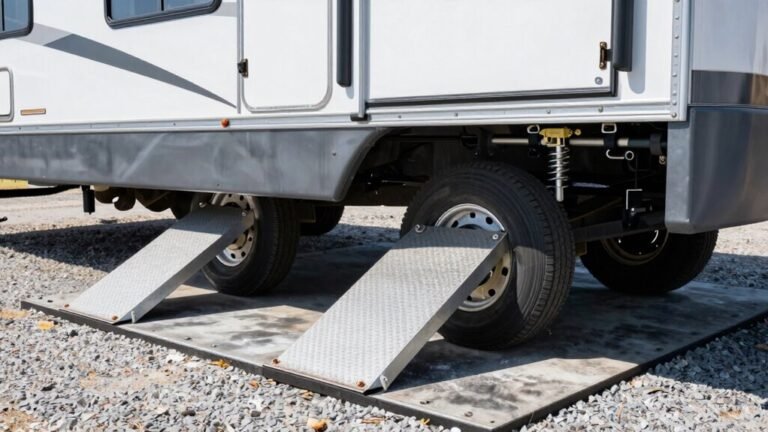
Pros and Cons of Full-Time RV Living
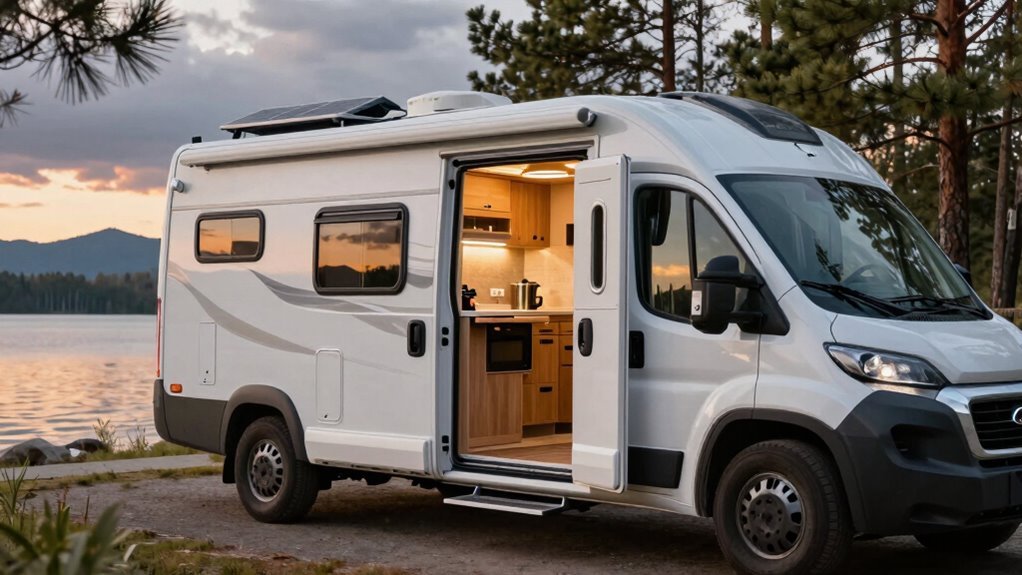
Full-time RV living means trading rent for sunsets in new spots every few days, embracing a lifestyle that swaps traditional housing for endless adventure. You slash bills by dodging landlords and live light with just what you need, all while hiking, biking, and chasing seasons like a pro adventurer.
Sure, full-time RV living comes with challenges like wrestling spotty Wi-Fi, cozying up in tight spaces, and babysitting pipes in winter. But who needs closet space when your backyard is the entire country?
Stick around and you’ll see how full-time RV living really works.
Freedom to Travel and Explore New Places
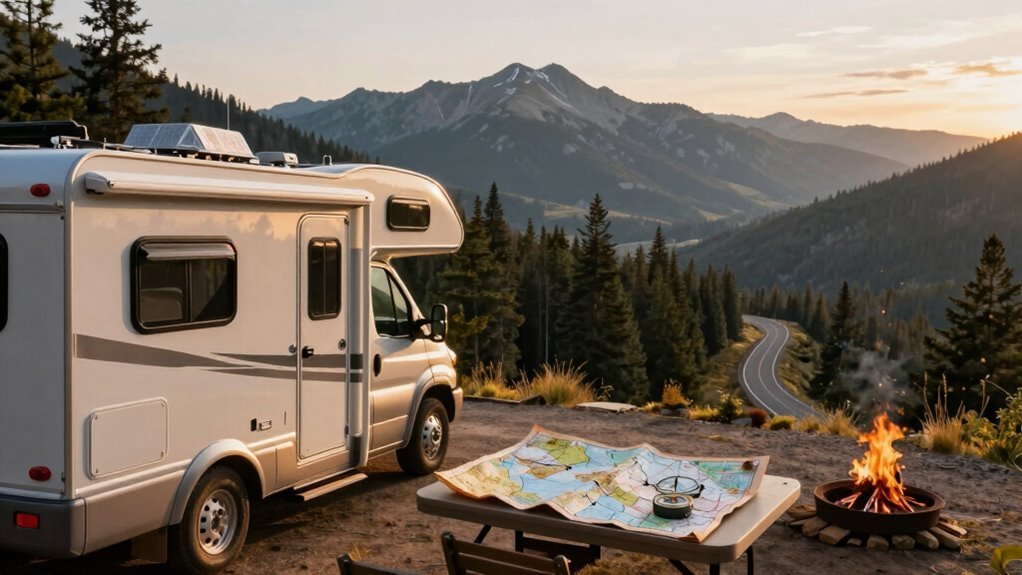
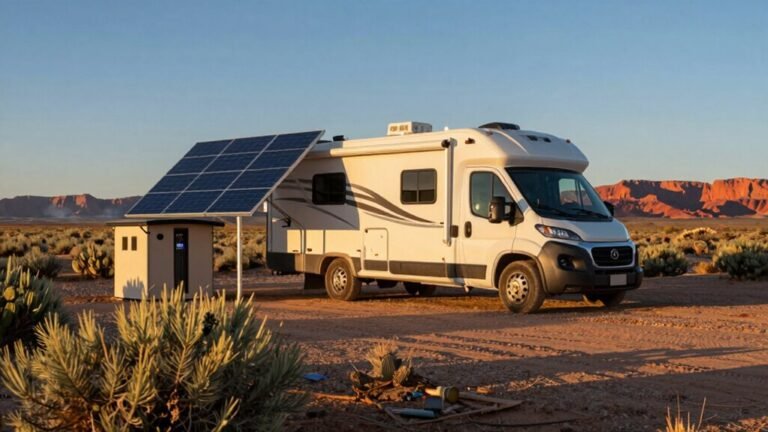
Waking up to a new view every few days—maybe a misty mountain ridge, a sunlit desert canyon, or a quiet lakeside spot—is all part of the magic when you’re living the RV life.
You’re not stuck in one place—you *move* with the mood, the season, or just a whim.
Fancy buffalo burgers in South Dakota? You go.
Sudden urge to chase sunsets in Arizona? You’re already packing.
With your home on wheels, you plunge into hikes, swims, and stargazing without packing a plane.
You hit festivals, national parks, and tiny towns no one’s heard of—each stop a new story.
Best part? No rigid schedules.
Skip the crowds, stay longer where you love, or bail when the weather turns weird.
You’re the boss of your itinerary, free to explore at your own pace—kind of like a nomadic tourist, but with snacks always in the fridge.
Over 40 million Americans regularly go RVing, so the lifestyle is more common—and supported—than ever.
Lower Housing and Living Expenses
While you’re trading in square footage for freedom, you’ll also be slashing the kind of bills that used to eat your paycheck—full-time RV living can seriously trim your housing and day-to-day costs.
You’ll dodge sky-high rents and stiff mortgages, especially if you sold your house, pocketing major monthly savings.
Campground rates drop when you stay long-term, sometimes under $1,000 a month, and boondocking on public lands can make it free—nature’s happy hour!
Sure, you’ve got RV insurance ($150–$300/month) and registration, but it’s often less than homeownership’s endless to-do list of repairs and bills.
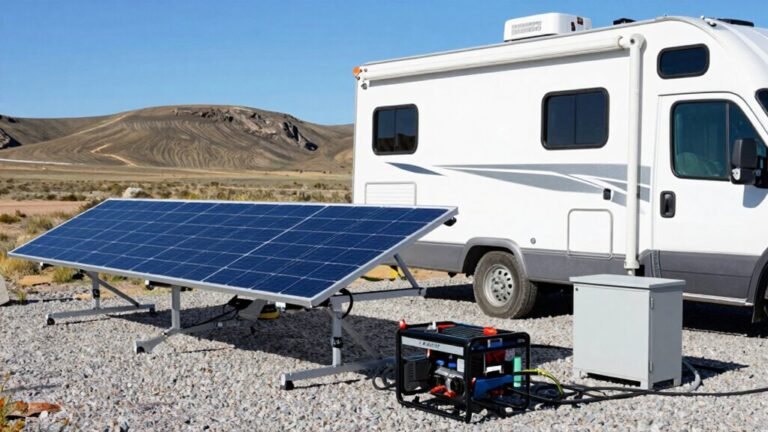
Your tiny space guzzles less power and water, and with solar, you might just outsmart the electric company.
Maintenance happens, but you’re not fixing a roof or furnace every other Tuesday.
With smart choices, you’re not just saving—you’re upgrading to a leaner, lighter financial life.
Who knew cheap could feel this liberating?
Average maintenance/repair costs run lower than traditional homeownership, where upkeep typically consumes 1%–4% of a home’s value annually.
Simplified Lifestyle With Minimal Possessions
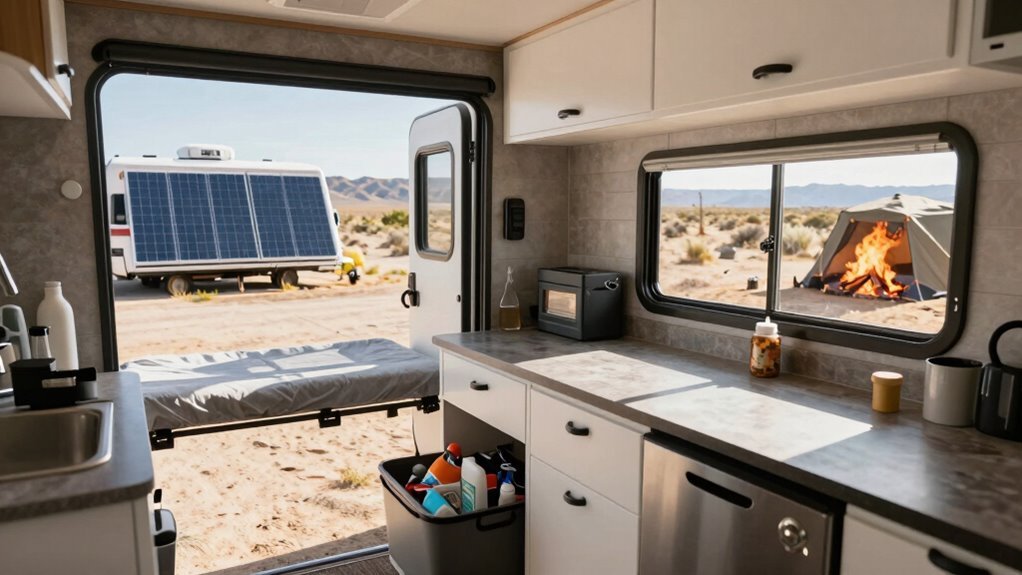
Paring down your life to the essentials isn’t just a necessity in an RV—it’s a full-blown adventure in freedom. You’ll squeeze into 100 to 400 square feet, so say goodbye to junk drawers nobody needs anyway. Every item earns its keep, whether it’s a dinette that becomes a bed or a fridge that’s cozy but *just* big enough. You’ll master under-bed bins and overhead nooks, and every few months, you’ll purge like a pro—no hoarding allowed! Your wallet will thank you: less shopping, no storage units, fewer replacement headaches. You’ll think twice before buying “stuff,” freeing up cash for adventures instead. Less clutter means less stress, more mental space, and honestly, fewer socks to lose. And with RVing serving as a home away from home for 91% satisfaction, the shift to minimal possessions isn’t just practical—it’s deeply fulfilling. Sure, doing laundry at a laundromat isn’t glamorous, and parting with Grandma’s vase stings, but hey—you’re trading square footage for soul space. Who knew happiness could fit in a tote?
Stronger Connections to Nature and Outdoors
Ever wonder how to turn every day into a nature walk with bonus views?
When you live full-time in an RV, you’re not just visiting nature—you’re living in it.
You hike more, fish often, and wake up to trees instead of traffic.
Need breakfast? You’ll probably cook outside, soaking in the sunshine and birdsong.
With remote work, you can park near trails and explore whenever you want.
Shaded campsites keep you cool and comfy, so you spend even more time outdoors.
- You roll straight from your door into national parks, deserts, or mountain trails
- You chase seasons like a pro—fall colors, spring blooms, it’s all on your schedule
- You stash kayaks and bikes in your rig and hit the water or trails in minutes
- You feel less stressed, sleep better, and move your body more, thanks to daily nature
- You start caring more about nature too—clean campsites, quiet nights, and clearer skies
Challenges of Limited Space and Storage

Living in 100 to 300 square feet means every inch counts, and you’ll quickly become a space-saving ninja.
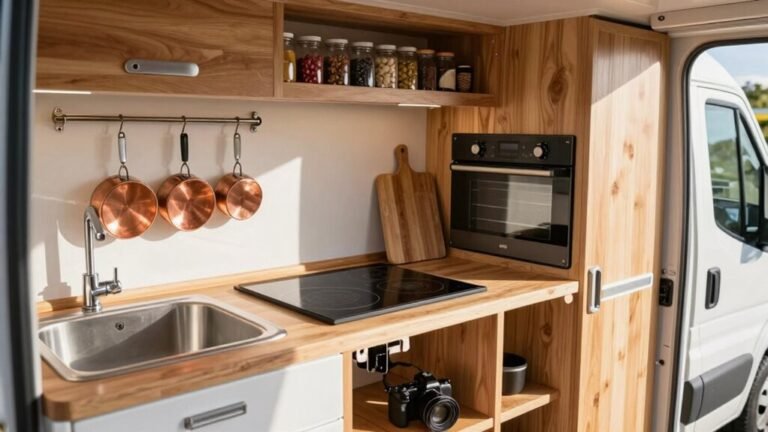
Your kitchen’s tiny, the bathroom’s snug (hello, shower-toilet combo!), and your bed might fold out of the couch—talk about multitasking!
Daily resets add up, and with everything stacked together, it’s easy to feel like you’re living in a game of Tetris.
Storage? Yeah, it’s tight. You’ll ditch half your stuff, rotate clothes like a pro, and master under-bed bins like a storage wizard.
Even your tools must earn their keep—no room for that third spatula.
And don’t forget weight limits; your RV isn’t a moving warehouse.
You’ll laugh when your bike stash pushes you near max GVWR… again.
Downsizing stings at first, but hey, fewer things mean more freedom, right? Mostly.
It’s a quirky, cozy life—like adult dollhouse living, but with better views.
Unreliable Internet and Remote Work Difficulties
You’ve nailed the art of packing your whole life into a space smaller than most walk-in closets, but now comes the real test: trying to log on without losing your mind.
Working remotely on the road sounds dreamy—until your Zoom call cuts out during a thunderstorm in rural New Hampshire.
Even full-timers who love the freedom admit: reliable internet isn’t a luxury, it’s a lifeline.
- Public Wi-Fi’s often slow, spotty, or shared with 50 other campers streaming cat videos
- Your phone hotspot’s handy, but 56% of RVers drain data fast outside cities
- Starlink works wonders—if you’ve got clear skies and patience for setup
- Heavy streamers need 500GB+, but most work setups thrive on 100–250GB monthly
- Bonded routers boost signals by combining carriers, turning weak bars into steady work sessions
Ongoing Maintenance and Repair Costs

Keeping your home-on-wheels in top shape means playing part-time mechanic, full-time optimist, and occasional detective when strange noises pop up in the middle of nowhere.
You’ll likely spend $100 to $300 a month on upkeep, with real-world averages around $240.
Experts suggest setting aside $100–$200 monthly—or $1,500 yearly—to stay safe.
Pro checks run $250–$500 annually, but they can save you big later.
Unexpected fixes? A fuel pump might hit $600, a toilet seat $115, and AC parts under $60—but engine or brake repairs can cost thousands.
Older rigs or rough driving means more trips to the shop.
If you’re under warranty, you’re golden.
Otherwise, keep a stash—$5K is smart for surprise breakdowns.
Budgeting now keeps you rolling later, laughter included when the sink starts singing off-key.
Dealing With Extreme Weather and Seasonal Limitations
Even with your monthly maintenance budget tucked away, Mother Nature doesn’t care how well-oiled your axle is when a thunderstorm rolls in faster than your morning coffee kicks in.
Living full-time in an RV means you’ve got to stay sharp when storms hit—or snow piles up faster than your laundry on lazy Sundays.
- Storm shelters are rare, so knowing evacuation routes is a must when tornadoes or hurricanes pop up
- Your rig’s lightweight frame can’t handle extreme winds like a house, making repositioning or leaving early smarter moves
- Air conditioners and heaters work overtime, draining power fast—especially off-grid in scorching heat or icy cold
- Winter camping? You’ll need heated hoses and skirting unless you enjoy chipping ice from your pipes
- Weather apps are your best friend; ignoring alerts could leave you stranded like a confused tumbleweed
Frequently Asked Questions
Can I Vote or Register My Vehicle While Living in an RV?
Yes, you can vote and register your vehicle while living in an RV—you’ve totally got this!
Just pick one state as your legal home, get your driver’s license and vehicle registered there, and use a physical address (like a campground or friend’s place) for voting.
Sign up for mail-forwarding to stay on top of ballots, and don’t forget to mark deadlines—you’re on the road, not off the grid!
How Do I Handle Mail and Receive Packages on the Road?
You’ve got options, and 68% of RVers say mail stress disappears once they pick a system.
Use General Delivery for small towns—just show ID and grab your package.
Try Escapees or MyRVmail to scan, sort, and forward mail ahead of you.
Tap a trusted friend for backup.
Snap a photo of your license plate as a joke ID while you’re at it—keeps the postmaster laughing!
What’s the Best Way to Manage Trash and Recycling in an RV?
You tackle RV trash and recycling smart by using compact bins with liners, so spills don’t turn into science experiments.
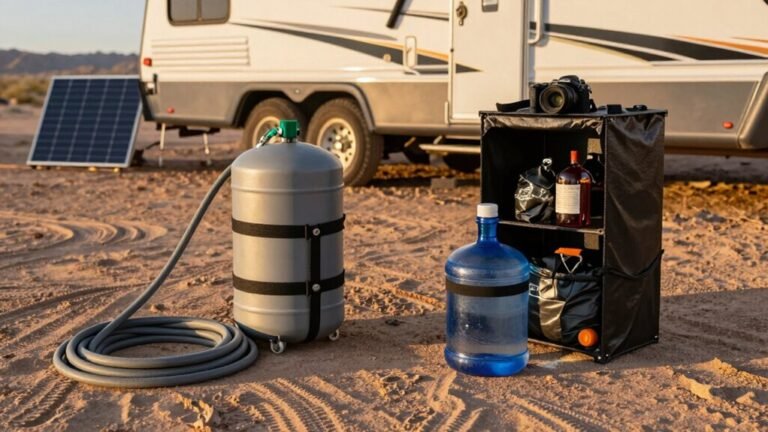
You stash portable waste tanks for black water dumps and rinse hoses with gray water—clever, right?
You sort recyclables in collapsible crates, crush cans, and label everything like a pro.
You’ll laugh your way to cleaner, greener travels—because nobody wants a rogue banana peel uprising in their storage bay!
Are Pets Allowed in Most RV Parks and Campgrounds?
Yes, you’ll usually find pets are welcome at most RV parks and campgrounds—many even roll out the red carpet!
Take Max, a golden retriever, and his humans who snagged a spot at a KOA with a dog park, waste stations, and even puppy treats at check-in.
You’ll often see leashes, breed rules, and quiet hours, but with half of campers bringing pets, you’re definitely not alone hitting the road with your furry co-pilot!
How Do I Maintain a Consistent Healthcare Provider While Traveling?
You keep your healthcare consistent by picking one primary clinic that offers virtual visits and accepts your insurance nationwide—think of it as your medical home base.
You’ll use telehealth for check-ins, refill prescriptions online, and stash digital copies of records.
You stay connected with a hotspot, sync test results through patient portals, and keep docs in the loop while exploring new spots.
It’s like having a doctor in your backpack—minus the awkward small talk.
Conclusion
You trade square footage for freedom, Wi-Fi headaches for mountain views, and a closet full of clothes for a closet that’s *literally* just a closet. Sure, you’ll wrestle with potholes, patchy internet, and winterizing like a pro—but hey, who needs central air when you’ve got a breeze off the lake? You’re broke, cramped, and freezing half the year, yet somehow richer, freer, and more alive than ever. Irony? Absolutely. Magical? Without a doubt.
References
- https://www.condorferries.co.uk/rv-statistics
- https://www.progressive.com/resources/insights/living-in-an-rv/
- https://www.rvia.org/news-insights/young-families-and-rv-lifestyle-growing-trend
- https://www.bookcleango.com/blog/rv-industry-statistics
- https://www.emergencyassistanceplus.com/resources/rv-statistics/
- https://arroyovalle.com/blog/facts-about-how-rv-living-has-changed
- https://www.harvesthosts.com/blog/rv-travel-trends-of-2025-are-live-now
- https://mylifesite.net/blog/post/open-road-navigating-the-rving-trend-among-older-adults
- https://www.ecoflow.com/us/blog/is-it-cheaper-in-an-rv-than-a-house-in-the-us
- https://www.youtube.com/watch?v=nZW8mU9i1-c