Driving an RV in Mountains: Safety Tips
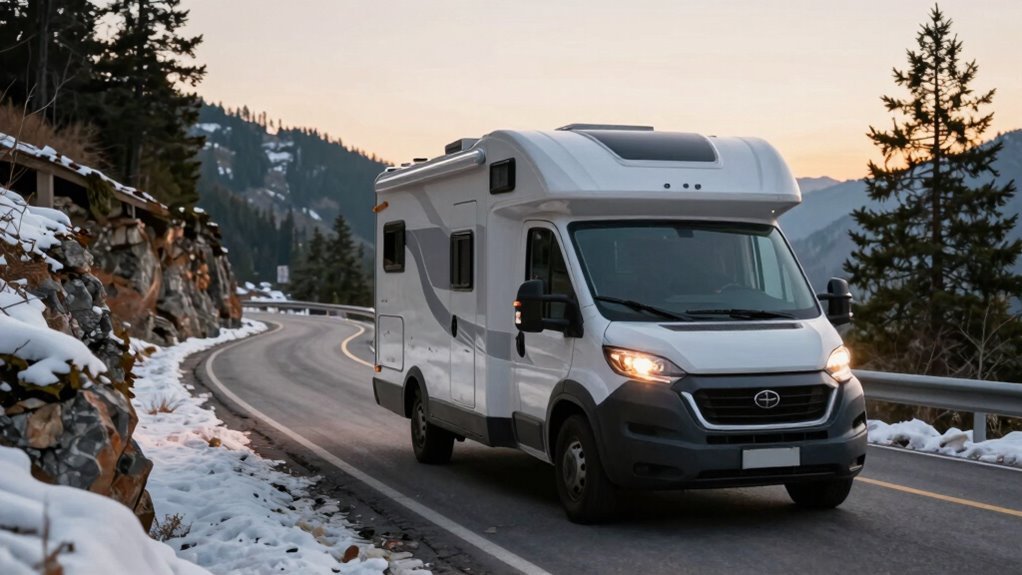
Driving an RV in mountains requires extra preparation and caution. Check your RV’s tires, brakes, and fluids before hitting the mountains—you’ll need everything in top shape.
Watch for warning signs like sharp curves or wildlife crossings, and always slow down before turns. Use lower gears to let your engine do the braking on steep drops.
Keep extra space between you and other vehicles, especially uphill. Weather changes fast up high, so pack layers.
Pick smart, well-lit spots to stop. There’s even more smart moves to make your trip safer and smoother.
Check Your RV’s Mechanical Condition Before the Trip
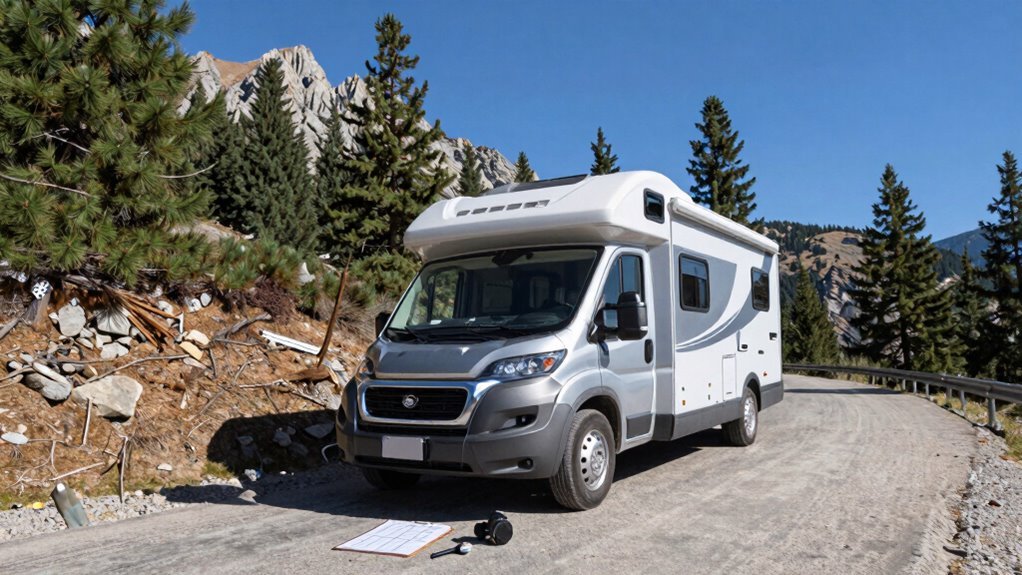
Getting your RV ready for mountain roads starts with a good once-over—think of it as giving your home-on-wheels a pre-adventure pep talk.
You’ll want to check tire pressure with a reliable gauge and pump them to the PSI listed on the placard—soft tires aren’t just sluggish, they’re danger magnets.
Inspect tread depth too; if it’s below 4/32 inch, it’s time for new rubber.
Don’t forget to scan sidewalls for cracks or bulges—your tires shouldn’t look like they’ve seen better decades.
Tighten lug nuts, since vibrations love to loosen things up.
While you’re down there, peek at your brakes, suspension, and axles—no rust, leaks, or wobbles allowed.
Check fluids, belts, and hoses—top off what’s low and replace anything frayed.
And don’t ignore your battery, lights, or jacks; they’ve got jobs to do.
Treat your rig right, and it’ll haul you through the high country with confidence—and maybe a little sass.
Have the RV and tow vehicle inspected by a certified technician at least annually to catch hidden issues before they become roadside emergencies (certified technician).
Understand Mountain Road Warning Signs and Symbols
You’re cruising through the mountains, wind in your hair and freedom in your bones—until you spot a bright yellow diamond sign popping up ahead.
Don’t panic—those signs are your mountain GPS for survival!
Most warnings are yellow diamonds with black symbols, shouting “Hey, watch out!” before curves, drops, or deer parties.
Orange means construction zones, and cute little pentagons mean kids or crosswalks nearby.
In the peaks, winding road signs mean twists galore, while chevrons nudge you to steer sharp.
And yeah, that “Slippery When Wet” sign? Take it seriously—your RV won’t appreciate a slide-off picnic.
- That curly cue arrow? It’s not modern art—it means *slow down for sharp curves*.
- See a deer silhouette? Don’t wait for a hoof-signed RSVP—animals bolt fast.
- Narrow road ahead? Your RV’s width matters—don’t cut corners like a rally car!
These signs are diamond-shaped with a yellow background to ensure maximum visibility and immediate recognition.
Master the Use of Engine Braking on Descents
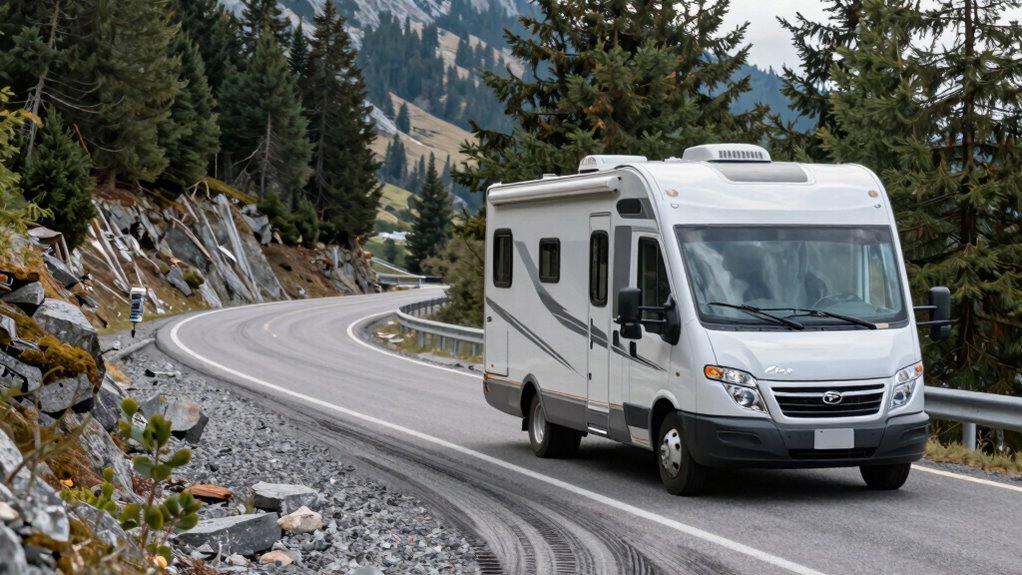
Ever wonder how seasoned RVers keep their cool—literally—while barreling down steep mountain passes? You can too, by mastering engine braking.
Shift into a lower gear—like second or third—before the descent starts, so your engine does the heavy braking.
Aim for 4,000 to 5,200 RPM; your rig’s built to handle it, and no, you won’t blow anything up—trust the machine!
This saves your brakes from frying.
When speed creeps up, give the brake pedal a quick three-second press, then let off as the transmission downshifts.
Drop 5 mph below your safe speed, then coast back up—rinse and repeat.
With this rhythm, you’ll sail down even a 14-mile hill using the pedal fewer than ten times.
Seven brake applications are typically all that’s needed, including the final stop, with most lasting under five seconds.
Set your safe speed early, based on grade, load, and road conditions, and let engine braking do the hard work.
Your brakes will thank you—and so will your nerves!
Adjust Speed for Curves and Switchbacks
When the road starts bending like a rollercoaster through the pines, it’s time to slow down and tap into your inner mountain goat—graceful, steady, and sure-footed.
Sharp curves and switchbacks demand respect, especially with your RV’s size.
Tight radii of 40–50 meters can drop speeds to under 25 km/h, and steep downhill grades only make it trickier.
Your Class C or A RV handles better when you ease off the gas early, reducing sway and roll.
- Slow before the turn, not during—momentum is your enemy
- Watch for advisory signs warning of 6–10% grades and sharp curves ahead
- Trust the feedback signs—they’ve been proven to cut speeds and boost safety
You’ve got the power to tackle those winding roads with confidence—just take it cool, corner by corner.
Maintain a Safe Following Distance on Inclines
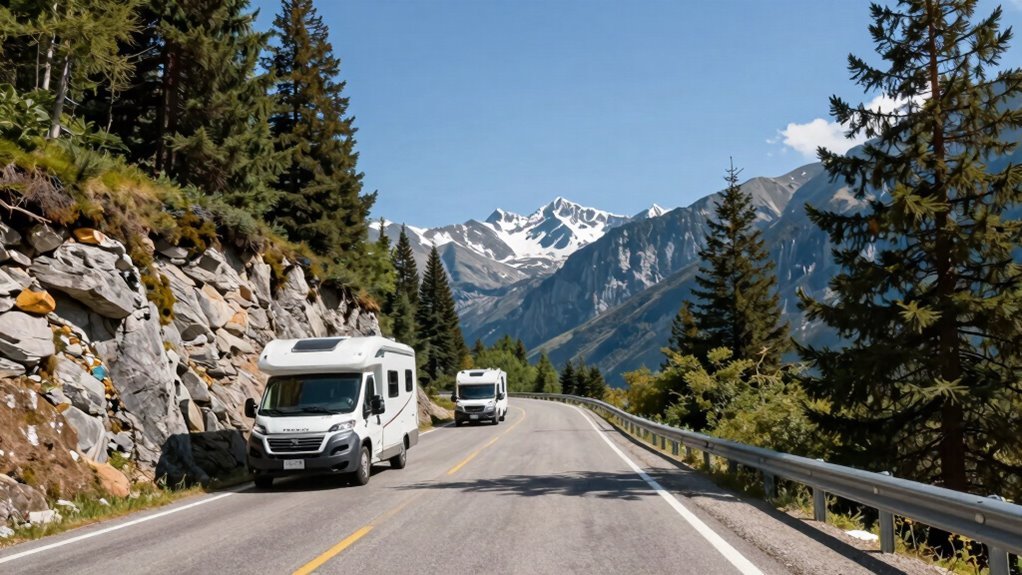
How much space should you leave between your RV and the vehicle ahead when heading downhill on a mountain pass? A lot more than you think—like, three to four times your normal distance.
Gravity turns your RV into a reluctant freight train, making stopping way harder.
The heavier you are, the longer it takes, and brake fade can sneak up faster than a squirrel in a campground.
Give yourself a big ol’ cushion so you can use engine braking and avoid riding the brakes like they’re a rodeo bull.
If you’ve got a manual, downshift early and let the engine help out.
Watch for fog, ice, or surprise elk—weather changes fast up high.
And hey, no one wants to become a mountain legend for the wrong reasons.
Stay spaced out, stay safe, and enjoy the ride without the panic.
Plan Routes to Avoid Low Clearances and Narrow Roads
- Use Google Maps to scout for switchbacks and steep grades—your transmission will thank you
- Pick wider interstates or gentler routes, even if they take a little longer
- Ask seasoned RVers about tricky mountain passes—they’ve probably learned the hard way
A little prep means you’ll cruise with confidence, not white-knuckle every curve.
And hey, no one’s impressed by a shortcut that ends in a scrape—or worse.
Choose wisely, drive smoothly, and keep that roof intact.
Prepare for Rapid Weather and Temperature Changes
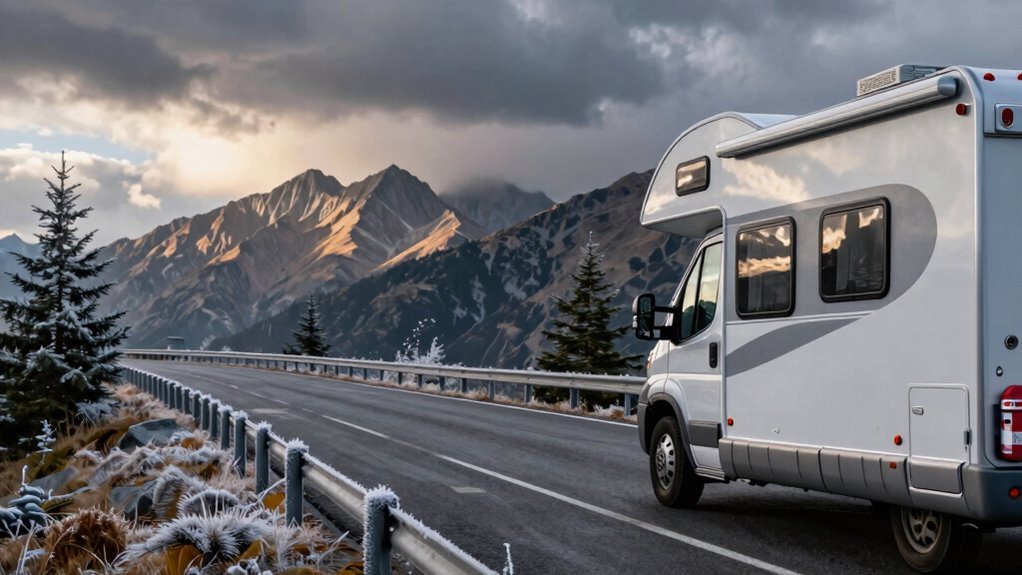
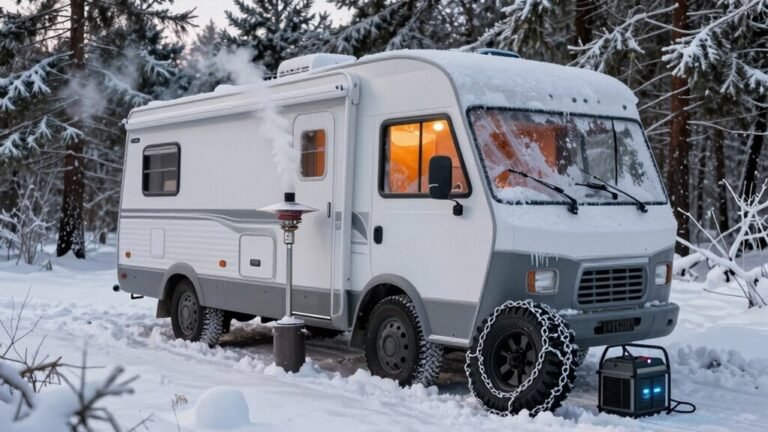
Though you might roll out under clear skies and sunshine, don’t let that fool you—mountain weather’s got a mind of its own, and it changes faster than your playlist on shuffle. Climb just 5,000 feet, and that cozy 60° F day can turn icy real quick—especially when temps drop 3.5° to over 5° each thousand feet.
Pack warm layers, a scraper, and waterproof gear, because snow can sneak up, even in summer. Check forecasts with apps like AccuWeather or a weather radio, and watch for red flags like thunderstorms or sudden leaf changes. Your RV’s engine works harder up high, so service the cooling system before you go and use lower gears uphill to keep things chill.
If things heat up, turn on the heater—yes, even in summer—to help cool the engine. Stay alert, stay ready, and remember: in the mountains, Mother Nature doesn’t do reruns.
Know Where to Stop and Rest Safely
Where should you pull over when mountain roads leave you needing a breather?
Pick well-lit spots near main buildings or other vehicles—skip the shadowy corners and picnic tables deep in the wild.
Park nose-out so you can jet quickly, and never block multiple spots or fire lanes.
Avoid truck-only zones unless staff waves you in. Check signs or call the number posted to nail down local rules—some places let you stay 12 hours, others just 2.
Keep it low-key: stash gear, lock doors, and don’t unfold your whole RV living room. If it feels sketchy? Trust that gut—and leave.
- Sleep like a squirrel: Burrow in tight, stash the nuts (and keys!), and stay unseen.
- Be a ninja neighbor: Quiet moves, minimal light, no generator raves.
- Think safety, not scenery: Skip the wooded hideouts—go where security patrols or lights glow.
Frequently Asked Questions
Can I Use Cruise Control on Mountain Highways?
No, you can’t rely on cruise control on mountain highways—it’ll quit on steep drops, and that’s no fun.
Instead, you’ve got to stay alert and in control.
Turn it off and let your engine do the work by downshifting.
Use tow/haul mode, grab a lower gear early, and let engine braking keep your speed steady.
That way, your brakes stay cool, and you stay safe, especially on those twisty, hairpin turns.
Are Tire Chains Required for RVS in Mountain Areas?
Yes, you’ll often need tire chains on your RV in mountain areas—think of them as winter seatbelts for your tires.
If your RV weighs over 6,500 pounds, you’re hooking up chains when controls are up, snow tires or not.
Even if you’re a nimble four-wheel drive under the limit, carry chains—you never know when Mother Nature’ll throw a snowball.
Checkpoints don’t play jokes, so be ready.
How Do I Handle Altitude Sickness While Driving?
You feel headache and dizziness?
That’s altitude sickness talking—don’t ignore it.
Pull over safely, sip water, and rest.
You’ve been driving up fast, and your body’s shouting, “Hey, I need time!”
Pop ibuprofen, breathe slow, and if you’re feeling wobbly or sick, head down to lower elevation.
Your RV’s tough, but you’re not a mountain goat—descend, recover, and laugh about it later with a warm drink.
What Should I Do if My RV Overheats Uphill?
You’re not just cooking dinner—your RV’s overheating, and you’re the chef nobody wanted!
Pull over safely, but keep the engine running.
Turn off the AC, crank the heater—yes, really—and let it help pull heat away.
Check the temp gauge, downshift early, and idle five minutes.
Coolant levels? Peek under.
Got leaks? Fix ’em.
Next climb, you’ll laugh—because now you’re the mountain boss, not the exhaust fumes.
Is It Safe to Drive an RV in Mountain Fog?
No, it’s not super safe, but you can handle it with care.
Fog rolls in fast, cuts visibility, and makes mountain roads tricky—especially in a big RV.
You’ve got longer stopping distances and sketchy passing moves from other drivers.
But slow down, stay focused, and leave plenty of space.
Avoid dawn and dusk fog peaks, keep both hands on the wheel, and hey, maybe save the podcast for later.
Stay sharp, and you’ll glide through like a pro.
Conclusion
Remember that time your coffee spilled on a steep downhill? Yeah, mountains turn calm moments wild fast. Last year, over 3,000 RVers got stuck or delayed in the Rockies—many just unprepared. But you’ve got this. Check your brakes, slow it down, and use engine braking like a secret shield. Take breaks, laugh at the windy roads, and enjoy the view. You’re not just driving—you’re adventuring, one smart, safe turn at a time.
References
- https://blog.campingworld.com/learn-to-rv/an-rv-checklist-for-before-your-trip/
- https://bb-rv.com/free-rv-maintenance-checklist/
- https://outrig.com/rv-inspection-checklist/
- https://lifelanes.progressive.com/rv-camping-checklist/
- https://roadside.goodsam.com/resources/pre-trip-inspection-checklist-for-rv-owners
- https://www.millsupply.com/blog/a-comprehensive-rv-pre-trip-inspection-guide/
- https://americasrvwarranty.com/rv-maintenance-checklist
- https://www.owi.com/retail/brands/peak-auto/peak-news/rv-ready-spring-road-trips
- https://rvdepottx.com/blog/rv-driving-safety-tips-safe-travel/
- https://mutcd.fhwa.dot.gov/htm/2009/part2/part2c.htm