How to Choose the Right Tires for Your RV or Trailer

Choosing the right tires for your RV or trailer is essential for safety and performance. Always match your tires to your rig’s GVWR and payload—start by checking the weight rating sticker located near the tongue.
Pick the correct tire size and maintain a tongue weight of10–15% for proper towing balance. Never use car tires on an RV or trailer, as they’re not built for the load or duration of trailer use.
Radial tires offer longer tread life and a smoother ride, making them ideal for long highway trips. Bias-ply tires are better suited for off-road adventures and rugged conditions.
Ensure your tires match the speed and load ratings needed for your travel plans. Keep tire pressure optimal with a reliable TPMS to stay safe on every journey.
Understanding Your Trailer’s Weight and Load Capacity

Ever wonder why your trailer feels bouncy on the highway or why your tow vehicle seems to struggle uphill? It might be overloaded—and you’re not alone.
Your trailer’s GVWR (that’s Gross Vehicle Weight Rating) is the max safe weight, including everything: gear, fluids, even you and your dog. Find it on the sticker near the tongue or in the manual.
Say your trailer’s GVWR is 2,995 lbs and it weighs 988 lbs empty—that’s over 2,000 lbs of payload.
Sweet! But pack wisely.
Overloading stresses axles, tires, and frames—no fun at 70 mph.
Use a public scale to check real weight, because “feels about right” isn’t a measurement.
Tongue weight should be 10–15% of total weight for smooth sailing.
CCC = GVWR − UVW helps you calculate how much gear and water you can safely carry.
Skip the guesswork, stay safe, and keep your rig rolling like a pro—because nobody wants a wobbly spaghetti noodle behind their truck.
Matching Tire Size to Your Trailer Specifications
When it comes to keeping your trailer rolling smoothly down the open road, picking the right tire size isn’t just smart—it’s essential. You’ve gotta match the size exactly to your trailer’s specs, or you’ll risk a bumpy—or broken—journey. Check the sidewall or your manual: sizes come in metric (like ST205/75-15), numeric (4.80X8), or alpha-numeric (B78X13 C). Each tells you width, aspect ratio, and rim diameter. Stick to the recommended rim width—your tire will thank you. Always ensure the tire has an ST designation, as these tires are specifically designed for trailer use and should not be substituted with passenger or light truck tires. And hey, don’t guess—measure your current tires or axle info to be sure. Cross-reference with charts; ST205/75-15 and ST225/75-15 aren’t twins, just cousins with different builds. Matching the bolt pattern? Non-negotiable. Get it right, and you’re set for smooth sailing—or should we say, smooth towing!
Choosing Between Bias-Ply and Radial Tires
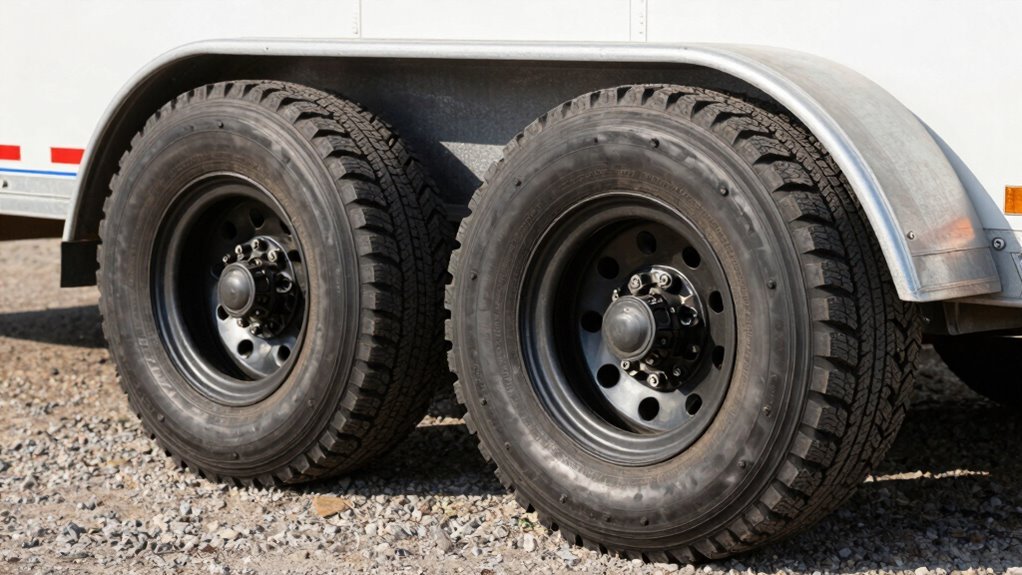
So, you’re stuck choosing between bias-ply and radial tires for your rig—no need to sweat it, because once you know the differences, it’s a total game-changer.
Radial tires have steel belts running straight across, giving you a wider footprint, cooler runs, and a smoother, quieter ride.
They last longer and handle highways like champs—perfect for long hauls and heavy loads.
Think of them as your road-trip superheroes.
Bias-ply tires? They’ve got crisscrossed layers that make tough sidewalls, resist damage off-road, and shine on rough, slow terrain.
They’re budget-friendly and great for weekend warriors or farm duty.
Just don’t expect a cloud-like ride.
If you’re cruising often and far, go radial.
If you’re backing into gravel or storing for months, bias might be your buddy.
Match your pick to your lifestyle—and keep rolling with confidence (and a little swagger).
The main feature separating radial from bias ply trailer tires is the angle and material of the internal belts, which directly impacts performance and durability.
Evaluating Tread Patterns for Different Driving Conditions
What kind of roads are you really rolling on—smooth highways, rocky backtracks, or a mix of both?
If it’s mostly pavement, go for ST trailer tires with simple treads—they cut rolling resistance, stay cooler, and boost fuel economy.
Shallow grooves and even air spacing keep things stable and smooth at speed.
But if you’re chasing adventure beyond the blacktop, grab a tire with deeper grooves and jagged ribs—those all-terrain treads bite into dirt and shed water like a pro.
LT tires give you that rugged flexibility, while reinforced sidewalls shrug off potholes and rocks.
Just remember, aggressive treads mean more noise on the highway—your ears might stage a mutiny!
For mixed terrain, you’re balancing comfort, grip, and durability.
Pick a tread that matches your journey, not just your dream map.
After all, no tire laughs at mud puddles quite like it should!
Checking Speed and Load Ratings for Safety
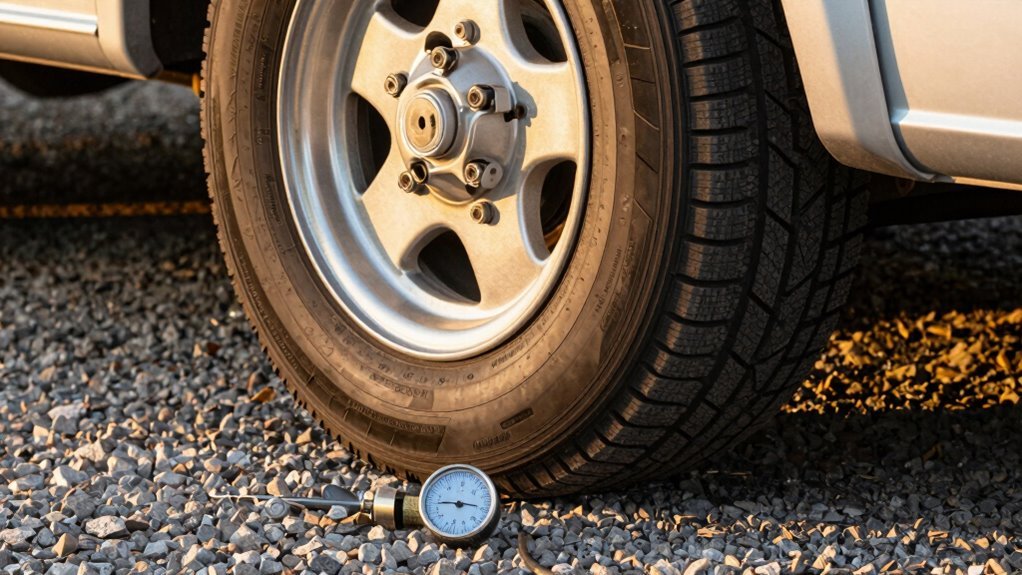
Check that sidewall—your RV’s safety game starts with knowing exactly what your tires can handle.
You’ll see a letter—like L or M—that’s your speed rating, telling you the max safe speed: L means 75 mph, M hits 81.
Don’t speed past that, or you’ll flirt with danger (and heat).
Load rating’s just as essential—it’s the max weight each tire carries when properly inflated.
ST trailer tires? They’re built tougher than LT ones, so don’t swap them without checking capacity.
Your tires should match your RV’s weight *per axle*, not just guesswork.
Oh, and never mix types—keeping ratings uniform keeps rides smooth and sway-free.
Think of it like shoes: you wouldn’t run a marathon in dance slippers.
Same logic!
Always match speed and load to your real-world trips—because no one likes roadside surprises.
Maintaining Proper Tire Inflation and Inspection Habits
Ever wonder why your RV’s tires seem to have a mind of their own after a long drive? It’s likely because they’re begging for proper care!
You’ve got to check cold tire pressure before each trip—yes, before you roll more than a mile.
Weigh your rig to know the real load per tire, then use the manufacturer’s chart to set the right PSI.
Keep pressure even across each axle, using the heavier-loaded side as your guide.
Temperature swings? They change pressure by 1 PSI per 10°F!
Altitude hikes and heavy loads matter too.
Underinflated tires overheat and can blow out—no fun on the highway.
Overinflated beats under every time, but don’t top the max PSI on the sidewall.
Grab a TPMS, inspect monthly, and watch for uneven wear.
Your tires aren’t drama queens—they just want attention!
Frequently Asked Questions
How Often Should I Replace RV Tires Even if They Look Good?
You should replace your RV tires every 5 to 7 years—even if they look great—because tires age like milk, not wine.
Sun, temperature swings, and time wreck them from the inside, and you can’t see the damage.
Cracks or bulges? Replace them ASAP.
Check that date code on the sidewall like it’s an expiration date.
And hey, no one wants a blowout picnic on the highway!
Can I Mix Different Tire Brands on My Trailer?
You can mix different tire brands on your trailer, no need to sweat that detail.
Just keep sizes identical—tread-to-tread, inch for inch.
Think of it like socks: mismatched patterns? Fine.
Mismatched sizes? That’s asking for trouble.
Stick to the same type (radial or bias), avoid wild tread gaps, and you’ll roll smoothly.
Your trailer’ll thank you, probably with a wink.
Do Trailer Tires Need Balancing Like Vehicle Tires?
Yeah, trailer tires don’t *need* balancing like your car’s, but you’ll want it if you’re hitting highways.
Without it, you might feel shakes, weird bounces, or see uneven wear—kind of like wearing boots with one thicker sole.
Balancing smooths things out, protects your rig, and makes the ride comfier.
Think of it as a spa day for your trailer—totally worth it when speed’s involved!
Are Tire Covers Necessary for UV Protection?
Yeah, tire covers are a must if you want to beat the sun’s sneaky UV zaps—think of them as sunglasses for your tires, shielding them from crispy cracks and dry rot.
You’d wear sunscreen, right?
So wrap those rubbers in UV-resistant covers, especially in sunny spots.
They’re cheap, easy to toss on, and keep your tires happy, flexible, and ready for the road—way better than replacing them early!
Should I Use Tire Sealant in My Trailer Tires?
No, you shouldn’t use tire sealant in your trailer tires—it’s more trouble than it’s worth.
It might plug small holes fast, but it’ll dry out, gunk up your sensors, and can even void the warranty.
Plus, nobody wants a surprise explosion from overheating goop!
Skip the slimy shortcut.
Stick with solid tires and regular checks.
Your trailer—and your peace of mind—will thank you!
Conclusion
You might think picking tires is boring, but it’s actually the secret to stress-free adventures. Get the right size, type, and pressure, and your RV or trailer will thank you with smoother rides and fewer headaches. Don’t wait for a blowout to act—smart tires mean safer, happier trips. So go ahead, give your wheels some love; they’re literally carrying your getaway!
References
- https://www.daisyrv.com/how-to-calculate-rv-towing-capacity-and-payload-the-right-way-rv-weight-ratings-explained/
- https://www.psltrailers.com/faq/how-do-you-calculate-payload-capacityo-gvwr-and-trailer-weight-tips|dkc.html
- https://www.nctrailers.com/blog/trailer-payload-capacity-a-quick-guide-to-determining-the-maximum-weight-your-trailer-can-carry/
- https://www.efleets.com/en/proof-and-insights/white-papers/payload-towing-capacity-measurement-guide.html
- https://www.carry-ontrailer.com/how-to-determine-your-trailer-tow-limit/
- https://triwich.com/blog/how-to-calculate-towing-capacity/
- https://www.youtube.com/watch?v=TvJJon8MDXc
- https://www.curtmfg.com/towing-capacity
- https://recstuff.com/trailer-parts-bloga-guide-to-understanding-trailer-tire-sidewall-information/
- https://maxbuilttrailers.com/resource-center/trailer-tires-guide/