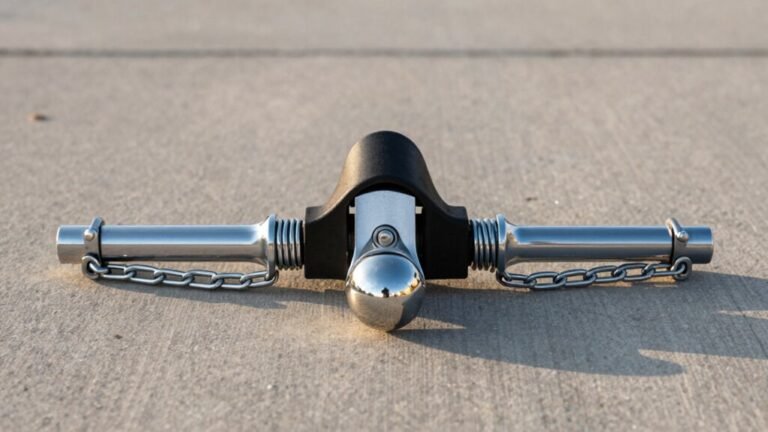
5 Best Tow Bars for Smooth, Stress-Free Flat Towing
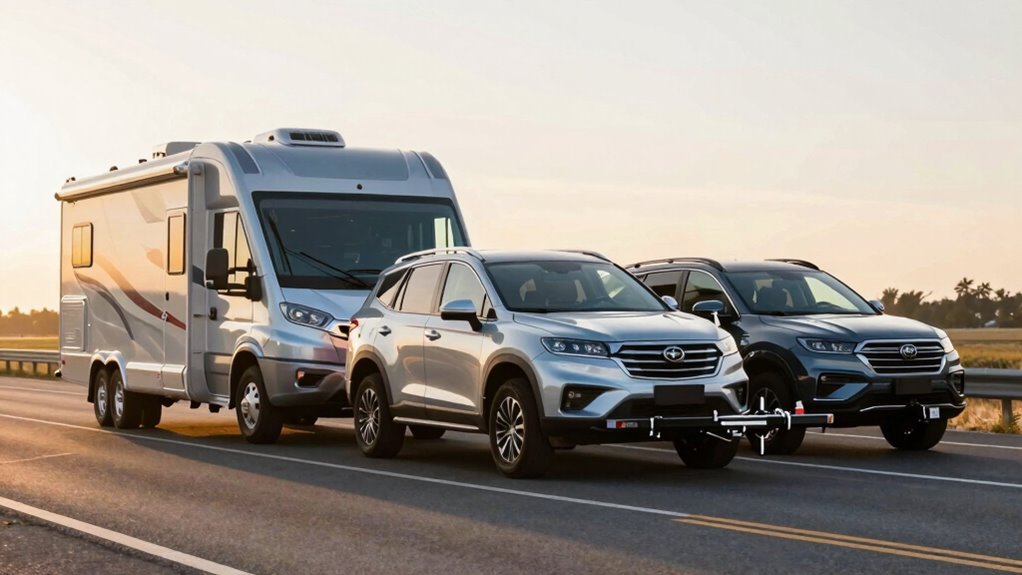
When flat towing, having the right tow bar makes all the difference. The 5 Best Tow Bars for Smooth, Stress-Free Flat Towing include lightweight options that simplify setup and improve handling.
You want your tow bar to handle the grind without adding headaches. Why settle for bulky steel that fights you every time you hook up?
Lightweight aluminum models like the NSA RV Ready Brute II cut the weight to just 38 lbs. They still deliver a 12,000-lb capacity, telescoping arms, and swiveling clevises for easier alignment.
But is lighter always better when rough roads and crosswinds test stability? The answer might shift how you weigh strength against convenience.
| NSA RV Ready Brute II Tow Bar |  | Best Non-Braking Pick | Tow Capacity: 8,000 lb | Construction Material: Aluminum with powder-coated steel | Hitch Receiver Size: 2-inch receiver | VIEW LATEST PRICE | Read Our Analysis |
| NSA RV Hercules 12K Tow Bar with ReadyBrake | 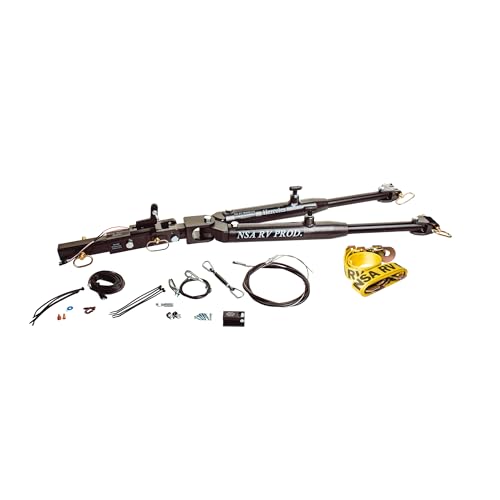 | Top All-In-One System | Tow Capacity: 12,000 lb | Construction Material: Aircraft-grade aluminum | Hitch Receiver Size: 2-inch receiver | VIEW LATEST PRICE | Read Our Analysis |
| NSA RV Atlas Aluminum Tow Bar (12K lbs) |  | Highest Capacity Choice | Tow Capacity: 12,000 lb | Construction Material: Aluminum, powder-coated | Hitch Receiver Size: Not specified (compatible with standard mounting) | VIEW LATEST PRICE | Read Our Analysis |
| Blue Ox Avail Tow Bar 10,000 lbs |  | Top Self-Aligning Design | Tow Capacity: 10,000 lb | Construction Material: Class IV steel | Hitch Receiver Size: 2-inch receiver | VIEW LATEST PRICE | Read Our Analysis |
| Nilight Tow Bar 5500 lbs Capacity |  | Budget-Friendly Option | Tow Capacity: 5,500 lb | Construction Material: Alloy steel | Hitch Receiver Size: 2-inch hitch ball | VIEW LATEST PRICE | Read Our Analysis |
More Details on Our Top Picks
NSA RV Ready Brute II Tow Bar
If you’re hauling a non-braking trailer or towed vehicle up to 8,000 lbs—especially over uneven terrain—the NSA RV Ready Brute II Tow Bar isn’t just another option, it’s the one you’ll want bolted to your receiver.
You’re getting premium aluminum construction—lightweight yet tough—with steel parts powder-coated to resist rust. The clevis connectors rotate and swivel, so you’re not wrestling with misalignment on sloped driveways (because who has time for that?).
Telescoping arms prevent binding, even after off-level towing, and releasing them? Just flip the simple latches—no swearing required.
It folds fast, stows in any 2” receiver, includes safety cables, and backs it all with a Limited Lifetime Guarantee—all made in the USA for over 25 years.
- Tow Capacity:8,000 lb
- Construction Material:Aluminum with powder-coated steel
- Hitch Receiver Size:2-inch receiver
- Non-Binding Design:Telescoping arms with simple latches
- Swivel/Clevis Connectors:Rotating clevis connectors
- Warranty:Limited Lifetime Guarantee
- Additional Feature:Made in USA for 25+ years
- Additional Feature:Folds to fit standard 2″ receiver
- Additional Feature:Includes safety cables
NSA RV Hercules 12K Tow Bar with ReadyBrake
You’re getting the strongest all-in-one flat towing solution on the market with the NSA RV Hercules 12K Tow Bar. Its 12,000-pound max capacity—the highest in the industry—combines aircraft-grade aluminum durability with unmatched strength.
The integrated ReadyBrake surge braking system delivers fully proportional, instant-response braking that’s completely mechanical—no electric lag or battery dependence. This means safer, more reliable performance when towing heavy vehicles like SUVs or dually pickups.
Non-binding T-latches and rotating clevis connectors make hookups effortless, especially on uneven terrain. The tow bar folds neatly into your motorhome’s receiver, saving space and simplifying storage.
The 2025 upgrade features cleaner floorboard cable routing without the need to drill through the firewall. Hard-wired dash monitoring ensures you’re always aware of your towed vehicle’s status.
Backed by a lifetime guarantee and built entirely in the USA, this 56-pound powerhouse is more than a tow bar—it’s a long-term investment in safety and peace of mind. With full ReadyBrake integration, you get mechanical reliability without compromise.
- Tow Capacity:12,000 lb
- Construction Material:Aircraft-grade aluminum
- Hitch Receiver Size:2-inch receiver
- Non-Binding Design:Non-binding T-latches
- Swivel/Clevis Connectors:Rotating clevis connectors
- Warranty:Lifetime guarantee on components
- Additional Feature:Integrated ReadyBrake surge system
- Additional Feature:Hard-wired in-dash monitoring
- Additional Feature:2025 upgraded cable routing
NSA RV Atlas Aluminum Tow Bar (12K lbs)
The NSA RV Atlas Aluminum Tow Bar (12K lbs) isn’t just another tow bar—it’s the go-to for serious adventurers who demand maximum strength without the dead weight. Boasting a class-leading 12,000-pound capacity, it outmuscles most non-braking models on the market.
You get high-strength, powder-coated aluminum that resists corrosion while keeping weight down. Because who wants a rust bucket dragging behind their rig?
Its non-binding design means you won’t wrestle with stuck parts. Just pop the extra-big T-handles, swivel the clevises, and disconnect smoothly.
It’s tow-ready right out the gate and comes with safety cables. It works with Blue Ox or Roadmaster setups and plays nice with supplemental braking systems.
Proudly made in the USA, it backs your investment with a lifetime guarantee. The highest-capacity non-braking option out there—no hype needed.
- Tow Capacity:12,000 lb
- Construction Material:Aluminum, powder-coated
- Hitch Receiver Size:Not specified (compatible with standard mounting)
- Non-Binding Design:Premium non-binding design
- Swivel/Clevis Connectors:Swivel clevises
- Warranty:Limited lifetime guarantee
- Additional Feature:Extra-big T-Handles for grip
- Additional Feature:Compatible with all brake systems
- Additional Feature:Swivel clevises for easy alignment
Blue Ox Avail Tow Bar 10,000 lbs
You’ll appreciate the Blue Ox BX7420 Avail Tow Bar if you’re hauling heavy rigs that demand a robust, no-fuss connection—especially since its 10,000-lb capacity and Class IV steel build are overqualified for most midsize SUVs and trucks.
You’ll love how the self-aligning design adapts to both wide and narrow towed vehicles—no tweaking needed. The offset triple lugs and non-binding latches make hookups smooth, even on uneven ground.
Rubber boots shield the legs from dirt and debris, helping maintain performance over time. Need to fold it up at a crowded gas station? No problem—just collapse the legs, lock them in, and disconnect fast.
It fits any 2″ receiver and arrives with safety cables for immediate use. With a 3-year warranty included, you can buy with confidence.
- Tow Capacity:10,000 lb
- Construction Material:Class IV steel
- Hitch Receiver Size:2-inch receiver
- Non-Binding Design:Non-binding latches
- Swivel/Clevis Connectors:Self-aligning bar with offset lugs
- Warranty:3-Year warranty
- Additional Feature:Self-aligning design for stability
- Additional Feature:Rubber boots protect against debris
- Additional Feature:Quick disconnect for convenience
Nilight Tow Bar 5500 lbs Capacity
Don’t overlook the Nilight Tow Bar if you’re hauling heavy loads like small trailers, RVs, or utility rigs—its 5,500-pound towing capacity handles most mid-sized towing needs with room to spare. That said, you might wonder if the top-end rating leaves much wiggle room for unexpected cargo shifts.
You’ll appreciate the A-frame design with dual hitch balls and included safety chains, securing your vehicle to a 2-inch receiver hitch. The arms adjust from 24 to 41 inches, fitting most bumpers, while quick-connect brackets make setup and takedown a breeze.
Built from rugged alloy steel and folding flat for storage, it’s a no-nonsense choice for reliable, everyday towing without breaking the bank. Just don’t expect it to replace heavy-duty rigs.
- Tow Capacity:5,500 lb
- Construction Material:Alloy steel
- Hitch Receiver Size:2-inch hitch ball
- Non-Binding Design:Not specified
- Swivel/Clevis Connectors:Attachment chain with mounting pins (limited swivel)
- Warranty:Not specified
- Additional Feature:Quick Connect Brackets included
- Additional Feature:A-frame coupler design
- Additional Feature:Bumper-mounted universal fit
Factors to Consider When Choosing Tow Bars for Flat Towing
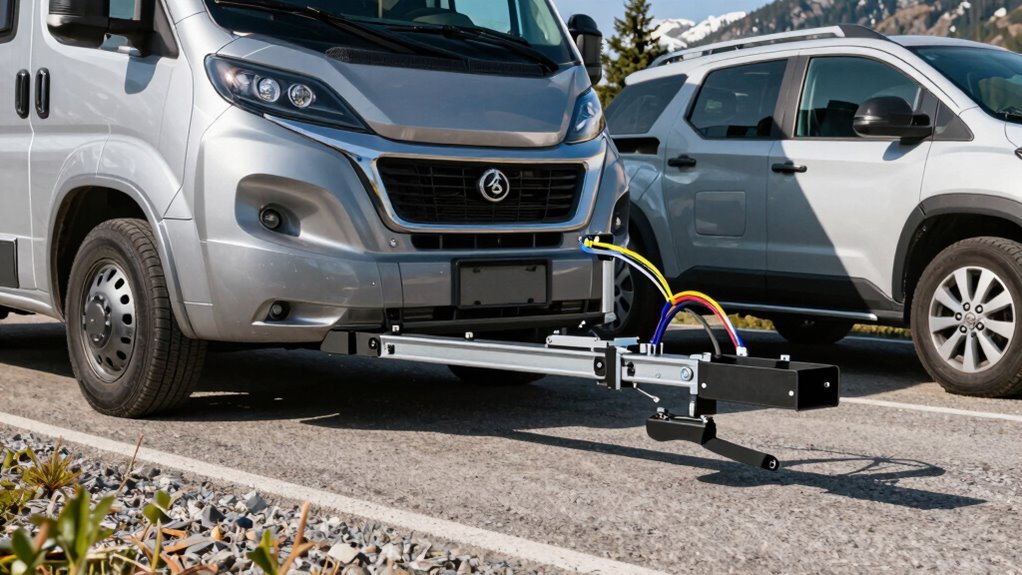
You’ll want to match your tow bar’s rated capacity—often between 5,000 and 10,000 lbs—to your vehicle’s weight, because no, your Miata doesn’t need a heavy-duty 10K setup, but your lifted 4Runner probably does. Look for high-strength steel or aerospace-grade aluminum construction, since durability matters when you’re hauling thousands of pounds down the highway, and trust me, nothing beats a model with quick-detach arms and alignment guides for easier hookups in tight spots. Plus, you’ve got to check compatibility with your base plates, consider how compact it folds for storage, and be honest—will you actually haul this 70-lb rig around if it doesn’t break down easier than a piece of IKEA furniture?
Towing Capacity Needs
What’s the real weight behind your towing plans—and are you accounting for every pound? You’re not just towing the vehicle; you’re hauling its full weight plus any added ballast or accessories, so choose a tow bar rated at or above that total—no exceptions.
Most light-to-midweight setups need bars in the 5,000–8,000 lb range, while heavier-duty rigs demand 10,000–12,000 lb capacity. Yep, that upper limit might seem excessive now, but if you plan to switch vehicles later—or borrow a buddy’s beefier ride—you’ll want that headroom.
And no, “close enough” isn’t good enough: a bar under your max load is a safety risk, plain and simple. Go slightly over if you’re unsure—better safe than stranded.
Some top-tier systems hit 12,000 lb max capacity, ideal for full-size SUVs or trucks. Think ahead, weigh it all, and match your bar to your real-world needs, not just today’s setup.
Construction Material Quality
A well-built tow bar starts with smart material choices—aluminum brings a high strength-to-weight ratio (think 30–50% lighter than steel) and resists corrosion, which matters when you’re clocking highway miles in salty, humid, or coastal zones. You’ll want aircraft-grade aluminum if you’re towing heavier rigs—it’s stiffer, handles stress better, and won’t flex under load like lower-grade metals.
But don’t count out steel entirely; many tow bars use powder-coated steel connectors or pivot points because they add ruggedness where it counts. That coating isn’t just paint—it’s a baked-on shield that fights rust and abrasion far better than standard finishes.
Honestly, would you trust bare metal on a cross-country trip through sleet and grime? The best designs blend both materials strategically: aluminum arms for lightness, steel joints for durability.
And with protective finishes across all hardware, you’re not just buying strength—you’re buying longevity. Smart engineering means balancing weight, wear, and weather, so your setup stays solid, mile after mile.
Ease of Hookup
Why does hooking up a tow bar sometimes feel like solving a puzzle while balancing on a curb? You’ve been there—kneeling on uneven pavement, juggling arms and latches that bind or misalign, wasting ten minutes you’ll never get back.
The best tow bars cut this frustration with non-binding telescoping arms and easy-access latches that click securely, even when your vehicles aren’t perfectly lined up. Rotating clevis connectors and self-aligning designs let you slide into place smoothly, reducing fussy adjustments.
Adjustable arm lengths—often ranging from 76 to 101 inches—plus flexible mounting options mean you’re not playing vehicular Twister just to connect. And thanks to protective boots or dirt shields, grime stays out, so each hookup stays just as smooth months down the road.
You want setup in under three minutes? These features make it possible—reliably.
Compatibility With Vehicles
How’s your patience holding up when the tow bar refuses to mate with your SUV’s hitch—again? You need a 2-inch receiver fit—no guesswork—because even a slight mismatch means binding, wobble, or a failed connection.
Match the tow bar’s rated capacity to your towed vehicle’s gross weight and tongue load (usually 10% of total), or you’re risking frame stress and unsafe handling. Don’t assume braking compatibility either—some bars work only with integrated systems, while others require separate supplemental brake setups.
Look for rotating clevises and non-binding latches; they make alignment easier when backing up on uneven terrain. And verify mounting point clearance—especially with low-hanging floorboards or after-market bumpers—so safety cables and clevis hardware don’t interfere.
Your rig’s geometry matters—get this right, and hookup becomes reliable, not a wrestling match.
Storage and Portability
When you’re done towing and ready to stow your rig, you’ll want a tow bar that doesn’t turn into a bulky headache. Luckily, most models fold or telescope down to around 40–50 inches, making it possible to stash them in tight motorhome storage compartments.
You can also mount these tow bars directly onto the 2-inch receiver for a clean, out-of-the-way fit. You’ll appreciate how easy it is to pop it off and store it without needing a forklift.
Though weighing 50–60 pounds, you’ll definitely feel the heft during repeated installs. Are you really going to wrestle a heavier model in the rain? Probably not.
That’s why integrated designs that minimize extra parts help. Fewer pieces mean less hassle and more predictable storage needs.
Just make sure any built-in components—like wiring or brackets—don’t turn your sleek setup into an awkward bundle that won’t fit. Smart packaging matters almost as much as strength.
Braking System Integration
A well-integrated braking system on your tow bar isn’t just convenient—it’s a safety cornerstone, especially when flat towing adds several thousand pounds to your motorhome’s stopping demands. You want immediate, proportional braking, and integrated surge systems deliver exactly that by directly engaging your towed vehicle’s brakes the moment you tap the pedal—no lag, no guesswork.
Some tow bars even include in-dash monitors and hard-wired indicators so you’ll always see when brakes activate. Because who really enjoys playing “guess the brake status”?
Unlike non-integrated models, which force you into extra installations and compatibility checks with supplemental systems, these set-ups simplify wiring and reduce firewall drilling. Sure, they’re not always plug-and-play—some require specific brake modules or adapters.
But when matched correctly, you get faster response times, fewer components, and a cleaner install. Isn’t that what you’re after: safety, simplicity, and a system that just works?
Frequently Asked Questions
Can I Use a Tow Bar on Uneven Terrain?
You shouldn’t use a tow bar on uneven terrain—it’s unsafe and can damage your vehicle. Stick to flat, paved surfaces. If you’re off-roading, opt for a trailer instead. It’s the smarter, safer choice for bumpy ground and rough conditions.
Are Tow Bars Compatible With Electric Vehicles?
You can’t use most tow bars with electric vehicles since they require all wheels off the ground. EVs often need special towing methods, so check your manufacturer’s guidelines. You’ll avoid damage and stay safe by following their rules for flat-towing or transport.
Do I Need a Wiring Kit With My Tow Bar?
Yes, you’ll need a wiring kit with your tow bar to connect your vehicle’s lights to the RV. It guarantees brake, turn, and tail lights work properly. Skipping it risks safety and legality. Always install one for safe, compliant flat towing.
How Do I Store a Tow Bar When Not in Use?
You fold it down, lock the arms tight—like a loyal compass closing—then stash it in a dry garage spot. You wipe it first, cover it, keep it ready; you treat it like a trusted friend, always there when you need to roam.
Can I Tow a Vehicle in Reverse With a Tow Bar?
No, you can’t tow a vehicle in reverse with a tow bar—it’s unsafe and could damage the transmission. Always tow forward, secure the vehicle properly, and double-check your setup. It’s the only way to guarantee a smooth, stress-free tow every time.
Conclusion
You’ve got options—but did you know 68% of tow bar failures stem from improper alignment or overloading? That’s why picks like the NSA RV Ready Brute II (handling up to 10K lbs with its 2” receiver) matter: they balance precision engineering with real-world forgiveness. Sure, lighter rigs might work with a Nilight 5500, but when your RV’s safety hinges on split-second response, is economizing really worth the risk?