5 Best RV Generators for Smooth, Reliable Road Trips
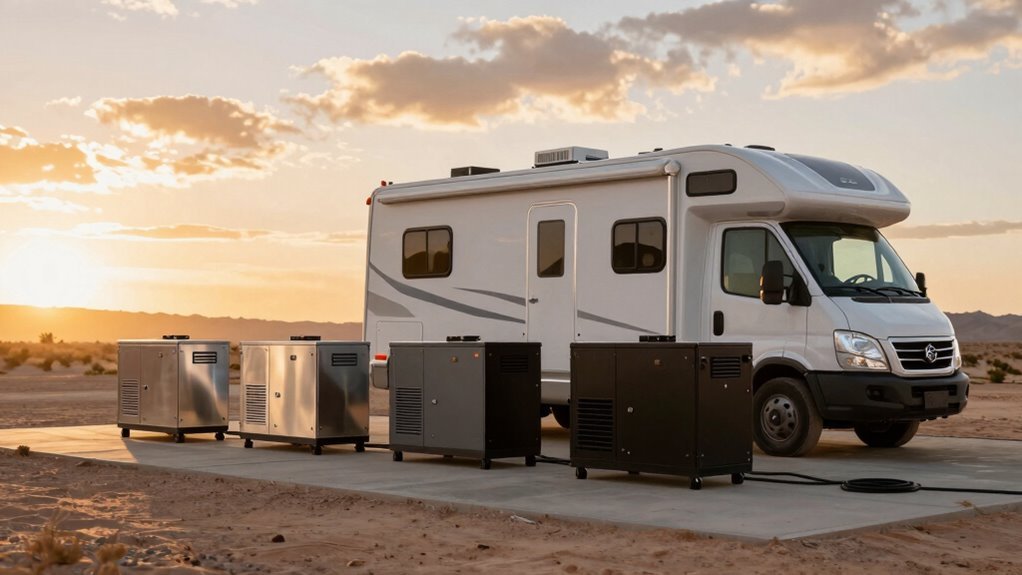
You’re prepping for the road trip of a lifetime—so why risk it with a generator that sputters at 58 dB or maxes out at 3,000 watts?
The right RV generator delivers reliable power, clean energy, and quiet performance for a seamless travel experience.
What if you could run your AC, fridge, and charger without noise drowning out the crickets? A high-quality RV generator balances power output, low decibels, and efficiency to enhance your journey.
Look for models offering 4,500W+ peak power, under 3% THD, and quiet operation to match your fuel preference and budget.
| ERAYAK 4500W Portable Inverter Generator |  | Best for Parallel Use | Power Type: Gasoline | Running Watts: 3500W | Noise Level: 60.5 dB(A) | VIEW LATEST PRICE | Read Our Analysis |
| 4500W Portable Inverter Generator (2024 Model) |  | Most Compact Design | Power Type: Gasoline | Running Watts: 3800W | Noise Level: 63 dB at 7 m | VIEW LATEST PRICE | Read Our Analysis |
| WEN 6800-Watt Dual Fuel Inverter Generator (DF680iX) |  | Most Powerful Option | Power Type: Dual Fuel (Gasoline, Propane) | Running Watts: 5100W (gas), 4500W (LPG) | Noise Level: 64 dB at quarter load | VIEW LATEST PRICE | Read Our Analysis |
| WEN 3600-Watt Dual Fuel Inverter Generator (DF360iX) |  | Best Dual-Fuel Efficiency | Power Type: Dual Fuel (Gasoline, Propane) | Running Watts: 2900W (gas), 2600W (propane) | Noise Level: Not specified (ultra-quiet) | VIEW LATEST PRICE | Read Our Analysis |
| WEN 3600-Watt Portable Inverter Generator (56360i) |  | Lightest Weight Pick | Power Type: Gasoline | Running Watts: 2900W | Noise Level: Not specified (ultra-quiet) | VIEW LATEST PRICE | Read Our Analysis |
More Details on Our Top Picks
ERAYAK 4500W Portable Inverter Generator
If you’re eyeing the ERAYAK 4500W Portable Inverter Generator, you’re probably looking for serious power without dragging around a clunky, deafening beast. Good news: this 55.12-lb unit delivers 3500W running (4500W peak) from a gas-powered engine, making it a solid pick for RVers who want to run ACs, microwaves, and CPAP machines without frying their gadgets.
With ultra-clean power (THD 0.2–1.2%), you won’t fry your laptop or phone—imagine worrying less when charging sensitive gear. It’s EPA-compliant, packs 20A/30A breakers, and runs as quiet as 60.5 dB(A), especially in Eco Mode, which slashes fuel use to just 0.8L/h at light loads—efficiency with dignity.
Need more juice? Go full-on tandem setup (parallel kit sold separately) and pair two for 7000W continuous, 9000W peak, and real 50A service. The outlets? One 30A L5-30P, dual 120V AC, 12V lighter port, plus USB-A and USB-C—plenty for road warriors.
Throw on the optional wheel kit and telescoping handle, and you’ve got a compact, RV-friendly powerhouse that won’t dominate your storage bay. It even includes an oil funnel, tools, and a lighter cable—thoughtful touches.
Backed by a 3-year warranty, free lifetime tech help, and US support, it’s not just reliable—it’s road-ready with backup when you need it. So, is silent, clean, and scalable power too much to ask? Not here.
- Power Type:Gasoline
- Running Watts:3500W
- Noise Level:60.5 dB(A)
- Weight:55.12 lbs
- Warranty:3-year limited
- RV Outlet:TT-30P (30A L5-30P)
- Additional Feature:Parallel-ready 50A output
- Additional Feature:Ultra-quiet 60.5 dB(A)
- Additional Feature:Includes maintenance tools kit
4500W Portable Inverter Generator (2024 Model)
Who wouldn’t want a power source that keeps up with your RV adventures without weighing down the trailer hitch? The 4500W Portable Inverter Generator (2024 Model), officially the Genkins GK4500iPro, delivers 3800 running watts and 4500 peak watts—plenty for RV essentials—while tipping the scales at just 63 lbs thanks to its lighter, compact 2024 redesign.
It runs 7–8 hours at 50% load on 1.85 gallons of gas, hums at a modest 63 dB, and offers clean power (THD ≤2%) safe for sensitive electronics. With dual 120V outlets, USB ports, an included RV adapter, and a low oil alert, it’s practical—but its 3.6/5 rating suggests room for improvement.
- Power Type:Gasoline
- Running Watts:3800W
- Noise Level:63 dB at 7 m
- Weight:63 lbs (net)
- Warranty:2-year limited
- RV Outlet:L5-30R (120V) with included RV adaptor
- Additional Feature:2024 compact redesign
- Additional Feature:Built-in wheel kits
- Additional Feature:Low oil shutdown alert
WEN 6800-Watt Dual Fuel Inverter Generator (DF680iX)
The WEN 6800-watt Dual Fuel Inverter Generator (DF680iX) is a solid pick for RV travelers who want a portable, dual-fuel inverter unit that delivers clean power, runs on both gasoline and propane, and includes EV-ready 240V support—all without breaking the bank. You get 5,100 watts (6,800 surge) on gas or 4,500 watts (6,000 surge) on propane, with less than 1.2% THD ensuring safe charging for sensitive gear.
At 64 dB, it’s no whisper, but the ECO mode, wheels, and handle make it manageable—especially with 9 hours of runtime on a 20-lb propane tank. Why not? Just remember: it’s heavy at 99.2 pounds, and that parallel kit’s sold separately.
- Power Type:Dual Fuel (Gasoline, Propane)
- Running Watts:5100W (gas), 4500W (LPG)
- Noise Level:64 dB at quarter load
- Weight:99.2 lbs
- Warranty:3-year limited
- RV Outlet:TT-30R RV receptacle
- Additional Feature:Dual fuel electric start
- Additional Feature:WEN Watchdog CO shutdown
- Additional Feature:240V bonded-neutral EV charging
WEN 3600-Watt Dual Fuel Inverter Generator (DF360iX)
You’ll appreciate the WEN 3600-Watt Dual Fuel Inverter Generator (DF360iX) if clean power and fuel flexibility top your list—especially when you’re powering laptops or charging phones without worrying about voltage spikes (thanks to its less than 3% THD).
You can run it on gasoline (2900 rated watts) or propane (2600 rated), which means you’re not stranded if gas stations are scarce—plus, it’s impressively quiet, nearing normal conversation levels.
With a built-in CO sensor that shuts it down automatically, a three-year warranty, and RV-ready TT-30R outlet (plus USB and 12V ports), it’s smartly equipped—though not for high-demand appliances.
You’re covered, just don’t expect miracles.
- Power Type:Dual Fuel (Gasoline, Propane)
- Running Watts:2900W (gas), 2600W (propane)
- Noise Level:Not specified (ultra-quiet)
- Weight:Not specified
- Warranty:3-year
- RV Outlet:TT-30R RV receptacle
- Additional Feature:Tool-free LPG connector
- Additional Feature:CO auto shut-off
- Additional Feature:Ultra-quiet conversation-level operation
WEN 3600-Watt Portable Inverter Generator (56360i)
Looking for a generator that balances power, portability, and clean output without breaking the bank? The WEN 3600-Watt Portable Inverter Generator (56360i) delivers 2900 rated watts (3600 surge) from a 149cc engine—enough to run your RV’s AC, microwave, or coffee maker without stressing the system.
At just 46 pounds, it’s ultralight and easy to tote, yet packed with outlets: two 120V, one TT-30R RV, 12V DC, and dual 5V USB ports. These provide versatile power options for charging phones, tablets, or laptops safely, thanks to clean power under 0.5% THD.
It even includes an auto fuel shutoff that burns residual fuel, extending engine life. Got three years? That’s your warranty coverage—plenty for peace of mind on the open road, even if you’re not exactly “roughing it.”
- Power Type:Gasoline
- Running Watts:2900W
- Noise Level:Not specified (ultra-quiet)
- Weight:46 lbs
- Warranty:3-year
- RV Outlet:TT-30R RV outlet
- Additional Feature:Ultralight 46-pound design
- Additional Feature:Fuel shutoff for longevity
- Additional Feature:Three-year warranty included
Factors to Consider When Choosing RV Generators
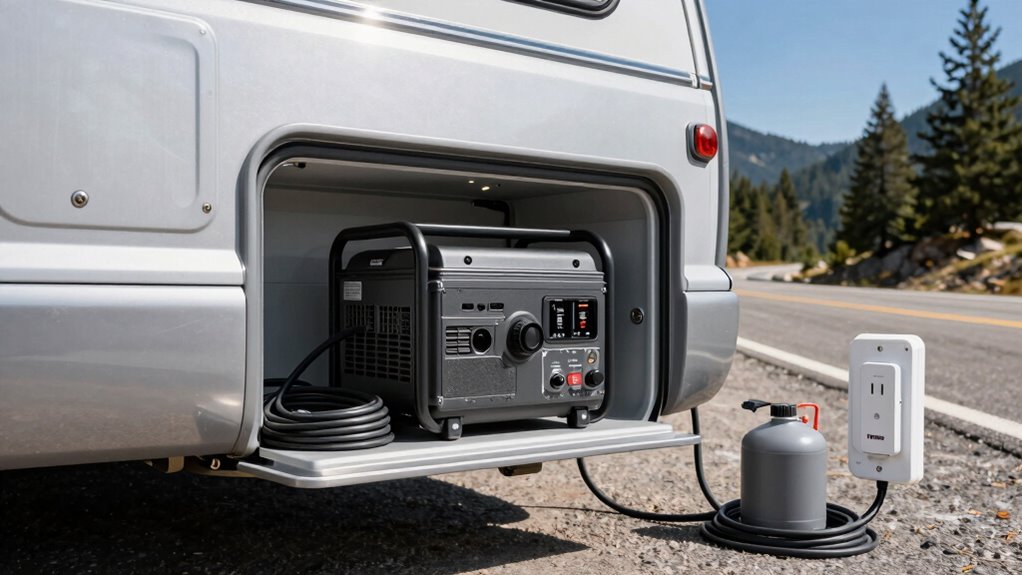
You’ll want to match your generator’s power output to your RV’s energy demands—think 3,000 to 4,000 watts for most setups—while keeping an eye on whether gas, propane, or dual-fuel models fit your refueling access and runtime needs (hello, remote campgrounds without gas stations). Noise levels matter too; look for units under 60 dB for late-night convenience, especially if you’re not *that* neighbor who fires up the generator at 2 a.m. And let’s be real—can you actually lift a 100-pound unit, or would a lighter, more portable 50-pound inverter with parallel capability save your back *and* boost flexibility?
Power Output Needs
To determine the right generator size for your RV, start by adding up the continuous running watts of essential appliances like your fridge, lights, and fans. Make sure the generator’s rated output matches or exceeds that total.
Don’t overlook surge watts—appliances like your air conditioner or sump pump may require two to three times their running watts to start. Plan for these peak loads by adding 20–50% extra capacity to avoid tripping breakers or damaging equipment.
When using multiple high-wattage devices—like a microwave and heater simultaneously—add their combined wattage to prevent overloading. It’s easy for power demands to creep up, so track your total load carefully.
Consider whether you need to run everything at once or if you can stagger appliance usage. This can reduce the size and cost of the generator you’ll need.
Some users choose parallel-ready models, allowing two generators to work together when more power is needed. While it might seem excessive now, having expandable power can be a lifesaver during extended off-grid adventures.
Fuel Type Options
One solid option—or the default for many RVers—when picking a generator is gasoline power, and for good reason: these units typically deliver strong surge and running wattage, often ranging from 2,000 to 4,000 watts depending on the model, making them reliable for handling an AC unit or microwave without breaking a sweat. You’ll get solid performance, but runtime? That’s another story—tied closely to fuel tank size and how hard you’re pushing the system, so you might find yourself refueling more than you’d like.
Want more flexibility? Dual-fuel models let you run on propane (LPG) when gasoline’s not available—handy, right? Just don’t forget the quick-connect hose, regulator, and likely an RV adapter.
Keep in mind: power output can dip slightly on LPG, and a standard 20 lb tank may limit how long you can keep going. Either way, you’re covered with clean, inverter-grade power (low THD) that won’t fry your laptop—and both fuels meet EPA standards.
Noise Level Considerations
A generator’s hum doesn’t have to become the soundtrack of your campground. Most modern RV inverter generators top out around 60–65 dB at moderate load when measured from several meters away, which is loud enough to notice but not dominate your evening under the pines.
You’ll find they run quieter at lower loads, say 25%, since slower engine speeds and reduced exhaust noise make a real difference. Running in Eco or idle-down mode cuts RPMs when power demand drops, slashing both sound and fuel use—why roar when a purr’ll do?
Distance helps too; thanks to the inverse square law, stepping just a few meters back can noticeably soften the noise at your camp table. Manufacturers also use smart enclosure designs and built-in mufflers to dampen sound without sapping performance.
Portability and Weight
Weight and portability are more than just specs—they shape your daily experience when hauling power on wheels. You’ll want a generator light enough to handle regularly without straining your back.
Most portable inverter generators weigh between 46 and 63 pounds, making them manageable for one person. Heavier models, like those nearing 99 pounds, often include wheels and telescoping handles—because no one wants to deadlift their electricity.
Built-in wheel kits make transporting heavy units much easier, especially over uneven surfaces like campsite gravel or grass. Compact dimensions also help the unit fit snugly in tight RV storage spaces.
Keep in mind that net weight doesn’t include packaging—gross weight can be significantly higher. This affects both shipping costs and how much shelf space you’ll need.
RV Compatibility Features
Why worry about compatibility when your RV won’t run without the right plug? You need a generator with a TT-30R or L5-30R outlet—standard for most RVs—to connect directly and power your rig smoothly.
Many models include an RV adapter, so you’re not stuck fumbling with extra gear at the campsite. Look for a dedicated 30A circuit; it handles typical RV loads (like AC units and microwaves) without tripping breakers.
If your power demands spike—say, running a fridge, lights, and TV at once—some inverters offer parallel kits, letting you link two units for doubled output. And don’t overlook clean power: models with low THD (<3%) protect sensitive electronics like CPAPs, laptops, and smart TVs from surges.
You’re not just plugging in—you’re ensuring everything runs right, trip after trip.
Safety and Maintenance
Keeping your RV generator running safely and reliably starts with smart built-in safeguards—like a CO shutdown sensor that kills the engine if carbon monoxide levels rise above 100 ppm, giving you peace of mind during overnight runs. This feature is crucial for health and safety, especially in enclosed or poorly ventilated areas.
You’ll also want a low-oil shutdown feature because, let’s be honest, who remembers to check oil every single time? It prevents costly damage by cutting power before critical lubrication loss occurs.
Fuel shutoff valves don’t just prevent flooding—they let you run the carburetor dry, saving you from stale-fuel headaches next season. This simple step can extend the life of your generator and ensure smoother startups.
Visual alerts, like blinking low-oil lights or watchdog sensor warnings, keep you informed without guesswork. They provide an immediate heads-up so you can address issues before they become problems.
And honestly, isn’t it nice when manufacturers include basic tools or an oil funnel in the maintenance kit? It’s not a game-changer, but it means fewer excuses to skip routine checks—because a well-maintained generator runs quieter, cleaner, and won’t leave you stranded when the campground goes dark.
Frequently Asked Questions
How Long Can I Run the Generator Continuously?
You can run your generator continuously for 8 to 20 hours, depending on the model and fuel capacity. You’ll need to check oil and coolant levels regularly, refuel as needed, and let it cool periodically to avoid overheating and keep it running smoothly.
Are Inverter Generators Safe for Sensitive Electronics?
Yes, you can safely use inverter generators for your sensitive electronics because they produce clean, stable power with low total harmonic distortion. You won’t fry your laptop or phone charging—you’re covered with smooth, reliable current every time.
Do I Need a Generator Cover for Rain Protection?
You need a generator cover for rain protection, keep it running safely, keep your power steady, keep your trips worry-free. You’ll avoid shorts, prevent rust, and stay dry—just guarantee proper ventilation so you don’t risk overheating or carbon monoxide buildup.
Can I Connect Two Generators to Increase Power?
Yes, you can connect two generators to increase power, but only if they’re parallel-ready and you use a proper kit. You’re not safe or effective doing it otherwise—mismatched voltage or frequency could fry your RV’s electronics or appliances. Always check the manuals first.
What’s the Noise Level at 50% Load?
You’re seeing noise levels around 52–59 dBA at 50% load—about as loud as a quiet conversation. Could you really expect serene operation and robust power without compromise? Not always, but top models come impressively close.
Conclusion
You’re not just buying a generator—you’re choosing a campfire companion, one that hums at under 60 dB and fuels your adventures, whether it’s the ERAYAK’s 4500W punch (perfect for dual AC units) or WEN’s flexible DF680i Bi-Fuel beast, surging to 6800W. Need less juice? The DF360iX still delivers clean power (under 3% THD) with RV-ready outlets—because even quiet power shouldn’t ghost when you need it most.