What to Do If Your RV Breaks Down on the Road
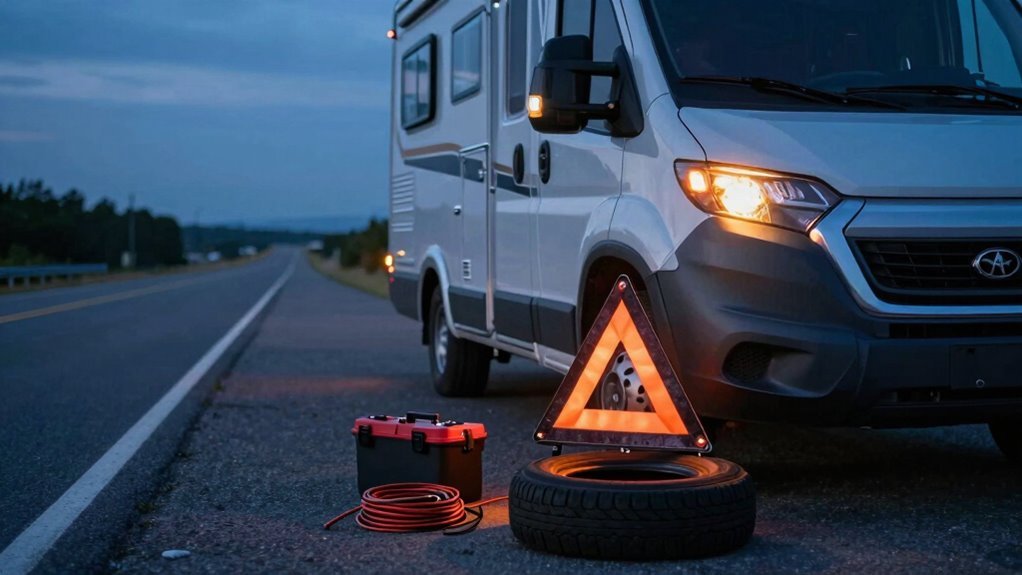
If your RV breaks down on the road, pull over smoothly to the widest, safest spot—like a shoulder or rest area—and turn on your hazard lights right away. Stay calm, take a deep breath, and ensure everyone inside remains buckled up with doors locked for safety.
Check for smoke, leaks, or strange noises to assess the situation quickly. Call roadside assistance immediately and have your RV’s details ready, including the make, model, and location.
Snap a few photos of the issue to share with the service provider. Let the professionals handle repairs—avoid risky DIY fixes when your RV breaks down on the road.
Pull Over Safely and Turn on Hazard Lights
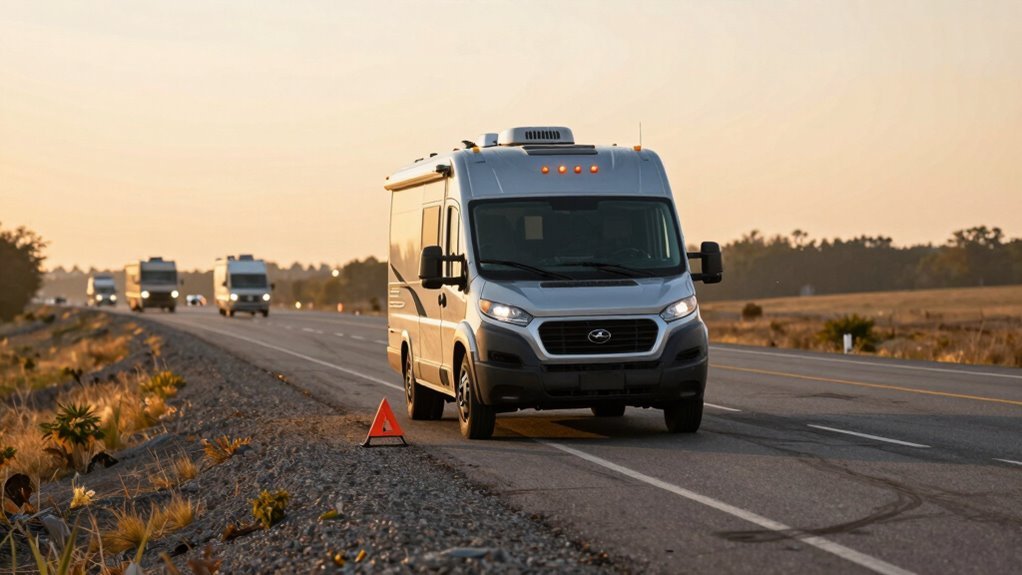
Okay, you’re barreling down the highway when—uh-oh—your RV starts acting funny.
Don’t panic—start slowing down smoothly, so you don’t skid or flip out.
Keep both hands on the wheel like you kind of are).
Now, steer toward the safest spot—maybe a wide shoulder or rest area—and get as far off the road as you can without tumbling into a ditch.
Safety first, circus stunts second.
Once you’re stable, slap on those hazard lights right away—boom, you’re glowing like a party on wheels.
It’s not just smart, it’s the law.
Flashers warn others to slow down or move over, so use ’em even in daylight.
Keep your lights on, but don’t drain the battery.
You’re not camping yet—just playing it safe and looking fabulous while doing it.
Also, make sure all passengers stay inside the vehicle until help arrives or the situation is clearly under control.
Assess the Situation and Identify the Problem
Now that you’re safely parked and glowing like a disco ball with your hazard lights on, it’s time to play RV detective.
Pop the hood, check for smoke or leaks, and listen closely—does something sound off?
Think ticking, grinding, or a hiss that wasn’t there before?
Grab your flashlight and inspect tires, belts, and fluids—low oil or coolant could be the culprit.
Did the engine stall, or did the brakes act weird?
Jot down any warning lights on the dash; they’re clues, not just annoyances.
If it’s electrical, test lights and outlets—maybe it’s just a blown fuse.
Don’t guess; use your owner’s manual as your sidekick.
Quick, smart checks now mean faster fixes later.
You’ve got this—Sherlock on wheels!
Ensure your tire chocks are in place to prevent unwanted movement while inspecting the vehicle.
Stay Calm and Keep Everyone in the Vehicle
Even if your RV decides to throw a tantrum in the middle of nowhere, the best place for everyone—yes, even Fido—is snug inside the vehicle, where you’re safe from speeding cars and curious critters alike.
Stay calm, take a deep breath, and keep your cool—panicking only muddles your thinking and makes small problems feel bigger.
A clear head helps you make smarter choices, especially if something needs fixing.
Keep seatbelts fastened, lock the doors, and crack windows just a bit for fresh air.
Turn on the hazard lights right away and keep interior lights on so others can see you.
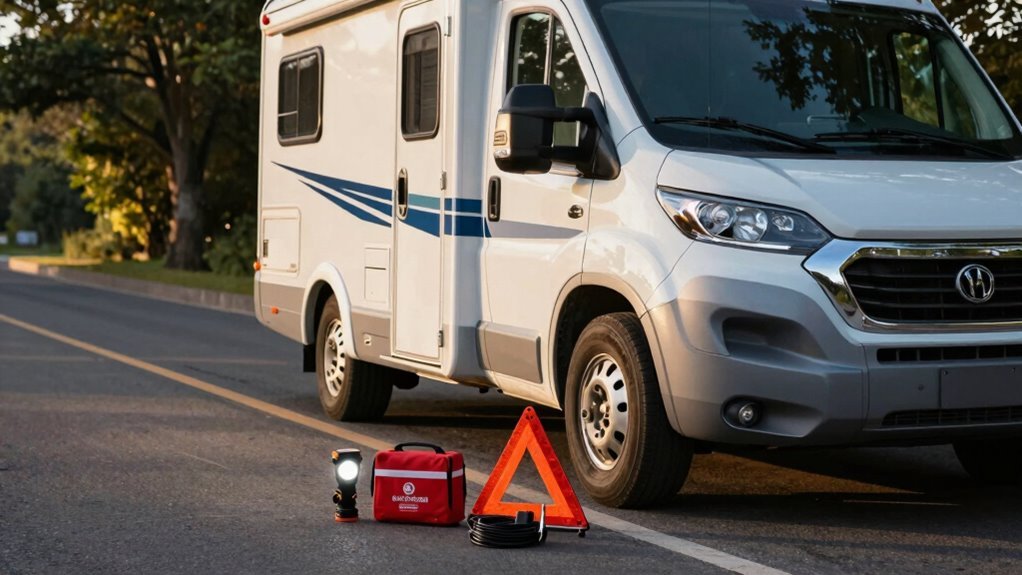
If it’s dark or foggy, toss out reflective triangles behind the RV—but only if it’s safe.
Stay put, stay comfy with water and blankets, and let the RV be your cozy fortress on wheels.
You’ve got this—and your calm vibe keeps everyone else relaxed too.
Once safely parked, pull RV to safe location to avoid obstructing traffic and reduce risk of secondary accidents.
Call for Roadside Assistance Immediately
Don’t let a sputtering engine or a dead battery turn your adventure into a roadside waiting game—hit that emergency button and call for roadside assistance right away.
Whether you’re with Good Sam, Coach-Net, or AAA, help’s just a phone call away—no need to play hero.
Most plans cover tire changes, jump-starts, fuel delivery, and even locksmiths if you lock yourself out (*oops!*).
Winching, towing, and mobile mechanics? Yep, they’ve got you.
Coverage usually stretches across the U.S., Canada, and Mexico, so you’re protected no matter where the road wanders.
With unlimited or multiple annual calls, you won’t sweat using it.
Just dial, relax, and let the pros handle the messy stuff.
Some plans even toss in rental cars or trip interruption cash—because nobody wants to eat gas station snacks for dinner.
Get help fast, stay safe, and keep that vacation vibe alive!
Gather and Have Critical Information Ready
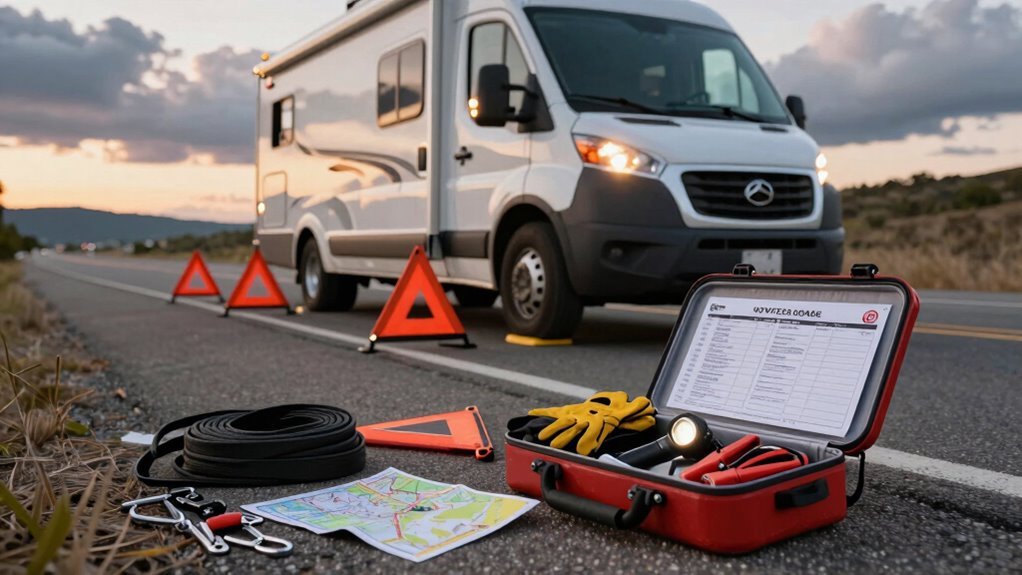
Where on the map did your RV decide to take an unscheduled nap? Grab your phone and note the GPS coordinates or nearest mile marker—precision helps rescuers find you fast.
Jot down the highway exit, nearby landmarks, and which way you’re facing.
Check your signal strength and weather—you might need to text someone fast.
Now, pull out your RV’s essentials: make, model, year, license plate, and VIN.
Don’t forget current mileage, fuel level, and any quirky mechanical issues.
Know how many folks are with you, especially if someone has medical needs.
Keep contacts handy—roadside assistance, insurer, emergency numbers—and have your policy ID ready.
Flip open your owner’s manual, confirm slide-outs are in, and check tire pressures.
Snap quick photos of the odometer and undercarriage.
You’re not just waiting—you’re prepping for a smooth save.
Use Warning Devices to Alert Other Drivers
Now that you’ve got all your info lined up and your people accounted for, it’s time to make sure other drivers see you—because nothing says “I’m stuck, please don’t hit me” like a glowing triangle party around your RV.
Turn on your hazard lights right away, and keep them flashing until you’ve set your warning devices.
Grab your three reflective triangles—required by law—and place them within 10 minutes.
Put one 10 feet from your RV, one 100 feet back, and another 100 feet ahead on two-lane roads.
On divided highways, space them 10, 100, and 200 feet behind.
Always face oncoming traffic, wear your bright vest, and hold devices in front.
If a curve or hill’s near, move one flare 100–500 feet in that direction so drivers get the heads-up.
Triangles are key—flares help, but don’t replace them.
Stay safe, stay seen, and own that roadside glow-up!
Avoid Attempting Dangerous Repairs Yourself
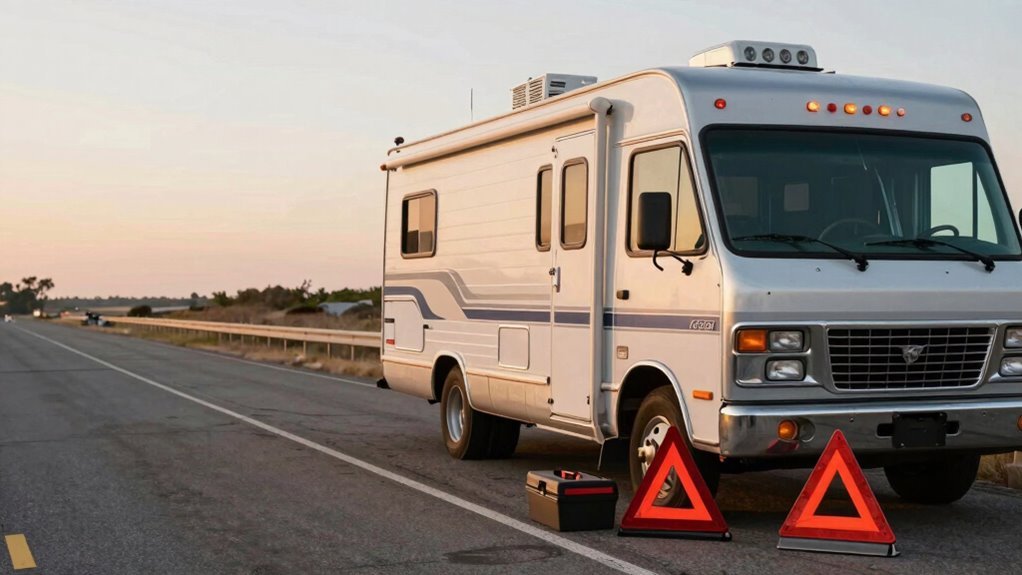
While your can-do spirit is admirable, some fixes on the side of the road are better left to the pros—especially when your RV’s more house than hatchback. Changing a giant RV tire beside speeding traffic? Nope, don’t even try it.
These rigs have complex systems, and messing with them without know-how could spark a fire—seriously, 85% of RV fires start from mechanical issues.
Plus, improper towing can wreck your ride.
Leave it to trained experts with the right tools and experience.
Roadside assistance is affordable, available 24/7, and they’ll either fix it on the spot or tow you safely.
Think of them as your RV fairy godparents—minus the sparkles, but with way more wrenches.
You keep calm, stay safe, and let the pros handle the drama.
Your DIY moment can wait for simpler jobs—like rehanging that falling shelf *after* you’re back on solid ground.
Stay Aware of Your Surroundings and Stay Safe
Pulling over in an RV isn’t like stopping a sedan—it’s more like parking a small house, and you’ve gotta treat it with the respect (and caution) that size demands.
Get clear of traffic fast, turn on those hazard lights, and keep everyone buckled up inside.
If you’ve got warning triangles, pop them out at 10, 100, and 200 feet back—just don’t let the wind steal them like a mischievous raccoon.
Toss on a bright safety vest before stepping out, and if it’s dark, light up some flares or LEDs to scream “Hey, look here!” to other drivers.
Watch for soft shoulders, drop-offs, and speedy traffic—nature and humans alike can be sneaky.
Stay aware of weather, visibility, and just how far you’re from roaring highways.
Avoid standing behind the RV or between it and traffic—trust us, that’s not the time to play bumper tag.
Stay sharp, stay safe, and remember: you’re not just a driver now—you’re a road warrior.
Document the Incident for Insurance and Records
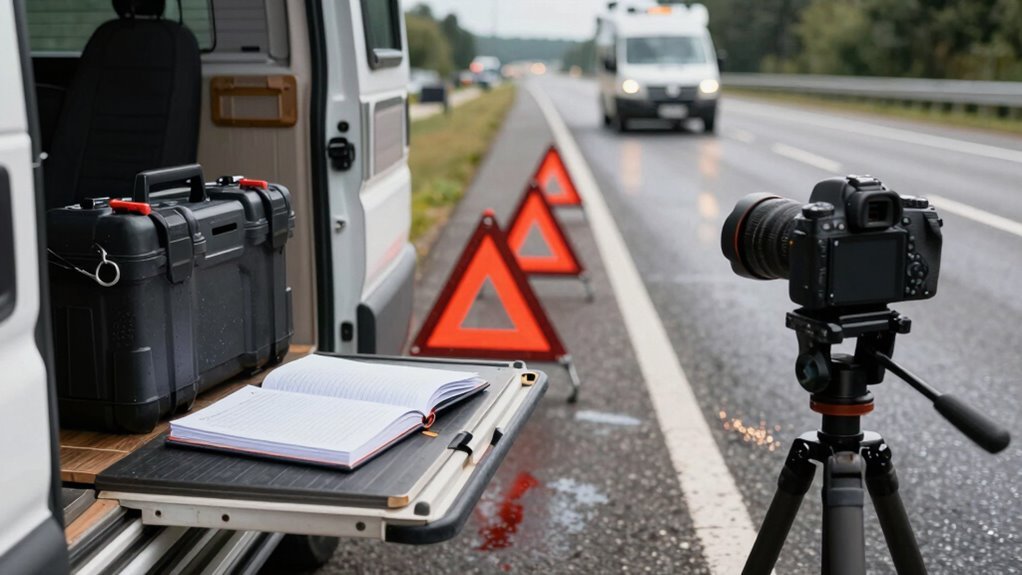
Snap those pics like you’re an RV detective on a reality show—because now’s the time to document everything. Grab your phone and shoot photos of the damage, inside and out, plus the scene around you, including any other vehicles or objects involved.
Don’t skip shots of your RV’s condition before you leave it—insurance folks love that stuff. Jot down the time, weather, weird noises, or smells, and exactly where you broke down.
Record how bad the damage looks and gather info from others involved: names, numbers, insurance, plates—the whole deal. Have your policy number, proof of insurance, and RV details handy, like size, age, and whether you live in it full-time.
Note any witnesses, emergency help, or mechanic checks, and save those receipts for hotels or meds. You’re building a rock-solid case, one smart snapshot at a time.
Plan for Next Steps Once Help Arrives
Now that you’ve snapped photos, gathered info, and built a solid paper trail like a true RV detective, it’s time to shift gears and get ready for the real action—because help is on the way!
When the technician arrives, check their ID and vehicle details—no random strangers fixing your home on wheels!
Clearly explain the weird noise or warning light that started it all, and hand over your RV’s model info like a pro.
Stay nearby, watch the repair or tow setup, and make sure they’re using the right gear—your RV’s no compact car.
Ask about covered costs right away—hello, free tow?—and grab that receipt.
Once fixed, test everything: blinkers, engine, fridge (because snacks matter).
Need a ride? Book it.
Update the fam, reschedule plans, and roll on—your adventure’s just getting a pit stop!
Frequently Asked Questions
How Much Does RV Roadside Assistance Typically Cost?
RV roadside assistance typically costs you between $65 and $300 a year, depending on the plan you pick.
You’ve got wallet-friendly options like Good Sam at $65, or pricier ones like RV Advisor near $290.
Most cover towing, jumpstarts, and flat tires.
Some even help your whole family—and your rental rig!
It’s like an insurance hug for your home on wheels, minus the awkwardness.
Can I Use My Car Insurance for RV Towing?
No, you can’t use your car insurance for RV towing—it doesn’t cover breakdown towing for RVs, even if you’re towing a trailer.
Your auto policy might cover liability for the trailer, but not repairs or towing costs.
For that, you’ll need RV-specific coverage or a roadside plan.
Think of it like bringing a backup dancer to a solo gig—it just won’t perform the right moves!
What Items Should Always Be in an RV Emergency Kit?
You’ve gotta pack smart: bandages, antiseptic wipes, and pain relievers keep boo-boos at bay.
Don’t forget tweezers—because pulling out splinters is way better than playing “guess what’s under the skin.”
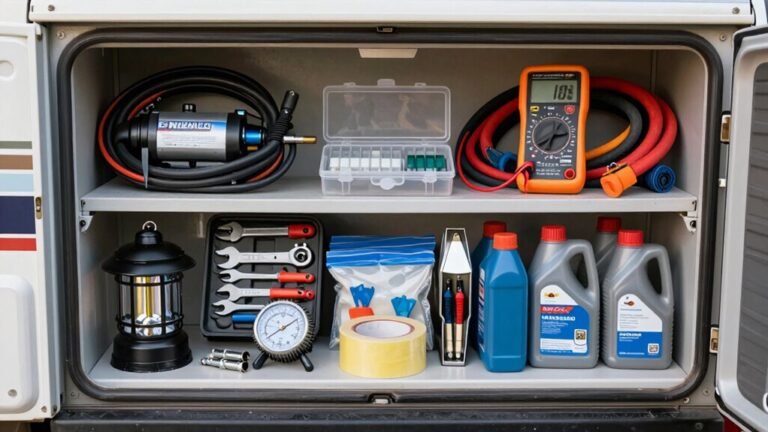
Toss in jumper cables, a fire extinguisher, and tire gauge—your RV’s BFFs.
Water, flashlights, and a whistle? Absolute musts.
And hey, add a window breaker—nobody wants to play “escape artist” the hard way!
Will My Warranty Cover Breakdowns During Long Trips?
Yes, your warranty’s got your back on long trips, like a trusty sidekick in a road movie.
If you’ve got an exclusionary or extended plan, it covers breakdowns—often 100 miles from home.
You’ll score roadside assistance, towing, even rental reimbursement.
Just check if your policy’s inclusionary or powertrain-only; they’re pickier.
And hey, flat tires? Some plans shrug those off, so don’t get caught sleeping.
How Long Does It Usually Take for Help to Arrive?
You’ll usually wait between 30 to 45 minutes for help, but it could be as quick as half an hour or stretch past an hour, depending on where you’re stuck—remote spots take longer.
Big names like AAA average around 35 minutes, while services like Good Sam vary.
If you’re in a jam during rush hour or weekend chaos, grab a snack; it might take a bit longer.
Good news? Most issues get fixed on the spot, so you’re not just sitting around twiddling your thumbs!
Conclusion
You pull over, you check the problem, you stay safe. You call for help, you keep calm, you wait it out. You document, you prepare, you get rolling again. Breakdowns happen, but now you know: stay smart, stay cool, and don’t wrestle your RV like it owes you money. Adventure’s still calling—this was just a dramatic pause. You’ve got this, road warrior!
References
- https://www.goodsamesp.com/what-to-do-if-your-rv-breaks-down/
- https://www.rv.com/servicing-care/safety-maintenance/how-to-stay-safe-during-a-roadside-breakdown/
- https://rvservices.koa.com/rvinformation/rvautosafety/handling-a-breakdown/
- https://www.rvlock.com/blogs/on-the-road/how-to-prepare-for-an-rv-breakdown-in-the-middle-of-nowhere
- https://www.rvsafe.com.au/are-you-rvsafe-episode-6-recap-mastering-breakdowns-and-off-road-recoveries/
- https://www.youtube.com/watch?v=lJKFuZqrGLk
- https://www.cochraneeagle.ca/rv-lifestyle/7-essential-tips-for-ensuring-rv-safety-while-your-out-on-the-road-7467410
- https://www.tranbc.ca/2011/06/30/on-the-road-to-rv-safety/
- https://roadtrippers.com/magazine/rv-setup-and-tear-down-checklist/
- https://roadside.goodsam.com/resources/pre-trip-inspection-checklist-for-rv-owners