5 Quiet Generators for RV Trips That Won’t Wake the Campsite
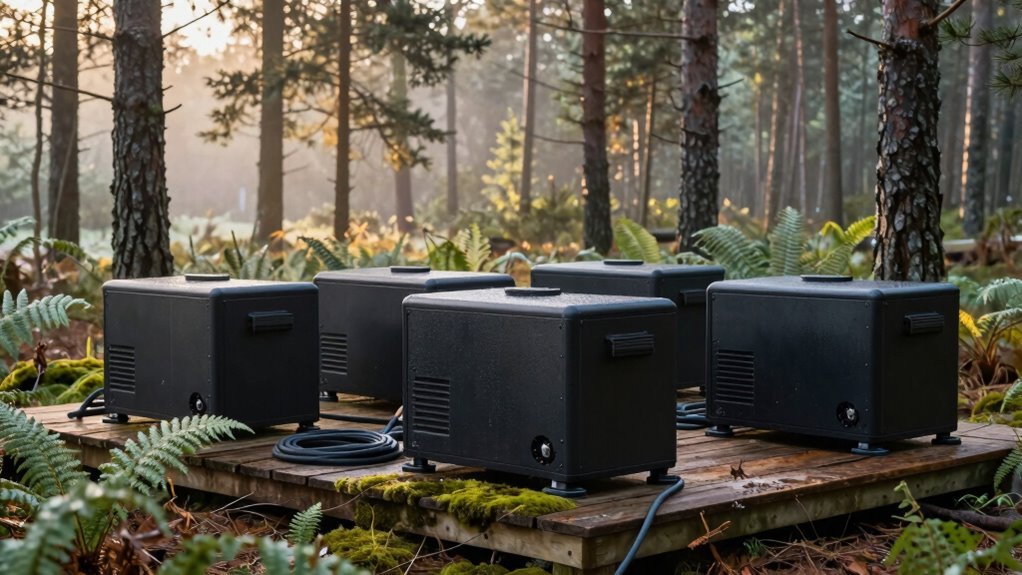
You’re sipping coffee at dawn, but will your generator ruin the peace for everyone else?
At 52 dba, the Westinghouse 2550W runs quieter than a bathroom fan—making it one of the quietest generators for RV trips—while delivering 2000 running watts.
Perfect for lights, fridge, and phone charging, this model balances power and noise control.
What if you need more power without turning your campsite into a construction zone?
The quiet generators for RV trips category keeps growing, offering solutions for both performance and tranquility.
| WEN 3600-Watt Dual Fuel Inverter Generator (DF360iX) | Best Dual-Fuel Performance | Power Source: Gasoline, Propane | Rated Watts: 2900 watts (gas), 2600 watts (propane) | Noise Level: Comparable to normal conversation (approx. 50–60 dB) | VIEW LATEST PRICE | Read Our Analysis | |
| WEN 6800-Watt Dual Fuel Inverter Generator (DF680iX) | Most Powerful Option | Power Source: Gasoline, Propane | Rated Watts: 5100 watts (gas), 4500 watts (propane) | Noise Level: 64 dB at quarter load | VIEW LATEST PRICE | Read Our Analysis | |
| WEN 4800-Watt Portable Inverter Generator (56477i) | Top Mid-Range Pick | Power Source: Gasoline | Rated Watts: 4000 watts | Noise Level: 62 dB at quarter load | VIEW LATEST PRICE | Read Our Analysis | |
| Westinghouse 2550W Portable Inverter Generator (RV Ready) | Best Runtime Efficiency | Power Source: Gasoline, Propane | Rated Watts: 1900 watts | Noise Level: 52 dBA | VIEW LATEST PRICE | Read Our Analysis | |
| 2500W Inverter Generator CO Sensor RV Ready | Most Portable Choice | Power Source: Gasoline | Rated Watts: 1900 watts | Noise Level: 59 dB(A) at 23 feet | VIEW LATEST PRICE | Read Our Analysis |
More Details on Our Top Picks
WEN 3600-Watt Dual Fuel Inverter Generator (DF360iX)
If you’re the kind of RVer who values a quiet campsite but still needs reliable power for your air conditioner, fridge, and phone, the WEN 3600-Watt Dual Fuel Inverter Generator (DF360iX) might just be your best bet. It offers the flexibility to switch between gasoline and propane, ensuring you’re never left without power.
You get 2900 rated watts on gas (3600 surge) or 2600 on propane (3500 surge), all while running as quietly as a normal conversation—around 57 dB, according to US DHHS. That makes it ideal for nighttime use without disturbing your fellow campers.
It delivers clean power, so your laptop and phone won’t fry, and features two 120V plugs, a TT-30R for RVs, 12V DC, and dual 5V USB ports—covering all your essential devices. The CO sensor shuts it off automatically, adding a smart layer of safety.
And with a three-year warranty plus fuel shut-off for less maintenance, this generator offers real peace of mind. It’s built to last and designed with the RVer in mind.
- Power Source:Gasoline, Propane
- Rated Watts:2900 watts (gas), 2600 watts (propane)
- Noise Level:Comparable to normal conversation (approx. 50–60 dB)
- CO Safety:WEN Watchdog CO Shutdown Sensor
- RV Ready:Yes (TT-30R outlet)
- Weight:Not specified
- Additional Feature:Tool-free LPG quick-connector
- Additional Feature:Three-year warranty
- Additional Feature:Clean power for electronics
WEN 6800-Watt Dual Fuel Inverter Generator (DF680iX)
You’ll appreciate the WEN DF680iX if you need a rugged, dual-fuel generator that handles RV power demands without drowning out the campsite ambiance. Its 64 dB noise level at quarter load keeps things civil, even when your neighbor’s trying to nap.
You get 5,100 watts (6,800 surge) on gas or 4,500 watts (6,000 surge) on propane, cleanly delivered with less than 1.2% THD—safe for sensitive electronics. Need to charge an EV? The bonded-neutral 240V L14-30R outlet’s got you covered.
At 99.2 pounds, it’s heavy, but the wheels and handle help. Plus, 9 hours of runtime on a 20-lb propane tank is hard to beat.
- Power Source:Gasoline, Propane
- Rated Watts:5100 watts (gas), 4500 watts (propane)
- Noise Level:64 dB at quarter load
- CO Safety:WEN Watchdog CO Shutdown Sensor
- RV Ready:Yes (TT-30R outlet)
- Weight:99.2 pounds
- Additional Feature:Bonded-neutral 240V EV charging
- Additional Feature:Built-in wheels and handle
- Additional Feature:ECO mode for efficiency
WEN 4800-Watt Portable Inverter Generator (56477i)
The WEN 56477i isn’t the kind of generator that whispers—it hums at a modest 62 dB, which is quieter than most conversations. This makes it perfect for campers who’d rather not disturb the serenity of a lakeside retreat or earn side-eye from neighboring RVs.
You’ve got 4,000 rated watts (4,800 surge) from a 224cc 4-stroke engine, running up to 7 hours at half-load on 1.9 gallons. Eco-mode and a fuel-preserving shutoff help maximize efficiency and runtime.
With pure sine wave power (THD <1.2% full load), you’re safe powering sensitive electronics. The generator includes four 5-20R outlets, a TT-30R for RVs, and even USB ports for added convenience.
Weighing 72.7 lbs, it’s equipped with wheels and a pull handle for easy transport. However, relying on recoil-starting feels outdated—especially for a generator in this class.
- Power Source:Gasoline
- Rated Watts:4000 watts
- Noise Level:62 dB at quarter load
- CO Safety:CO shutdown sensor
- RV Ready:Yes (TT-30R outlet)
- Weight:72.7 pounds
- Additional Feature:Parallel-ready capability
- Additional Feature:Onboard wheels and handle
- Additional Feature:Fully enclosed design
Westinghouse 2550W Portable Inverter Generator (RV Ready)
You’re looking at 1900 rated watts (2550 peak) with less than 3% THD—clean, stable power that won’t fry your RV’s sensitive electronics. This makes the Westinghouse 2550W Portable Inverter Generator a smart pick for travelers who want reliability without the roar.
Weighing in at 42.4 pounds, it’s not feather-light, but the carry handle helps. Plus, you’re getting gas and propane operation (up to 12 hours on a 1.16-gallon tank), so fuel flexibility? Check.
At just 52 dBA, it’s whisper-quiet, and with an RV-ready TT-30R outlet, dual 20-amp household plugs, two USB ports, and economy mode for efficiency, you’re covered. Three-year warranty, EPA compliant, and yeah, it might smell slightly like factory testing—but isn’t that better than breakdowns?
- Power Source:Gasoline, Propane
- Rated Watts:1900 watts
- Noise Level:52 dBA
- CO Safety:CO detection
- RV Ready:Yes (TT-30R outlet)
- Weight:42.4 pounds
- Additional Feature:Includes oil and toolkit
- Additional Feature:12-hour runtime on gas
- Additional Feature:Plug-and-play ready
2500W Inverter Generator CO Sensor RV Ready
Looking for a generator that won’t weigh you down or wake your campsite neighbors? The 2500W Inverter Generator CO Sensor RV Ready packs 39 pounds into a compact 19.3 x 12 x 20-inch frame—easy to lift, stash, and transport.
You’ll get 1900 rated watts (2500 surge), clean power for phones, laptops, even your RV’s TV, and run it for 5.5 hours at 50% load without guzzling gas. It’s whisper-quiet at 59 dB(A)—about as loud as a fridge.
Plus, it’s EPA-compliant, with CO detection, low oil shutdown, and overload protection for safe, worry-free operation. You’ve got two 120V outlets, USB, and 12V DC ports for versatile charging options.
Parallel it with another unit when you need more juice. Pretty smart design, right?
- Power Source:Gasoline
- Rated Watts:1900 watts
- Noise Level:59 dB(A) at 23 feet
- CO Safety:CO detection
- RV Ready:Yes
- Weight:39 pounds
- Additional Feature:Parallel capability
- Additional Feature:Ultra quiet operation
- Additional Feature:Compact size
Factors to Consider When Choosing Quiet Generators for RVs
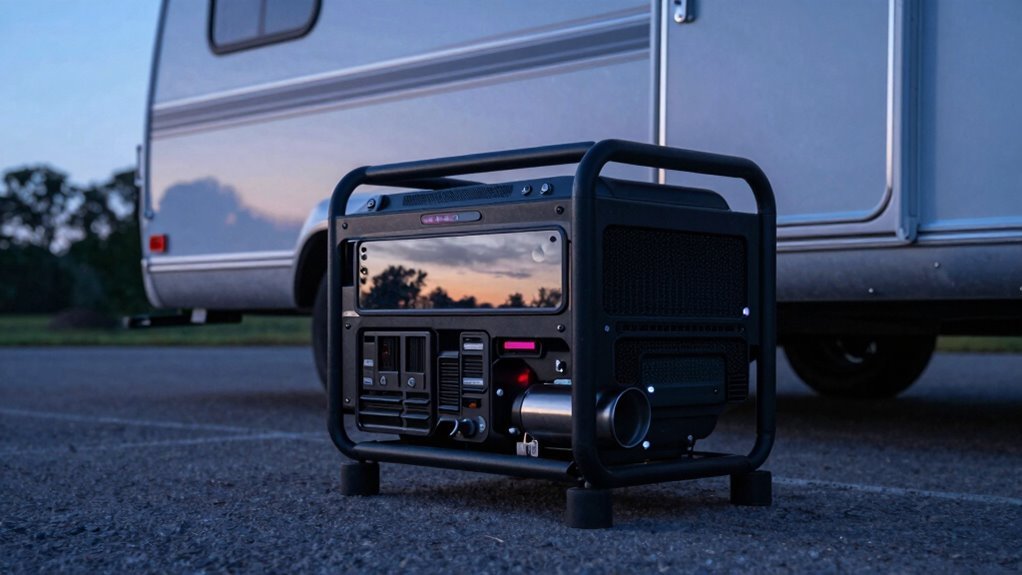
You’ll want a quiet generator that won’t wake your camping neighbors—ideally under 60 decibels, about as loud as a normal conversation—so noise level should be your first priority. Think about how much power you actually need (2,000–3,500 watts covers most RVs), what fuel type you’d rather haul (gasoline, propane, or dual-fuel), and whether you can carry 40–50 pounds solo when portability matters. And hey, do you really want to risk carbon monoxide poisoning or tripped breakers just to save $100?—safety features like CO detection and automatic shutoffs aren’t flashy, but they’re non-negotiable for peace of mind.
Noise Level
Ever wonder why some generators whisper while others shout? It’s all about the decibels—most quiet inverter models run between 50 and 60 dB, about as loud as a normal conversation.
You’ll see some, like one rated at 52 dBA during typical use, branded as “extremely quiet,” which means you can actually hear yourself think while they power your RV essentials. At quarter load, mid-sized units might hit 62 dB—still reasonable—while compact or small-turbo designs can climb to 64 dB, not exactly silent, even when not under heavy demand.
Remember, noise levels vary with load, so don’t just check peak output; look at performance during moderate, real-world use. Manufacturers often highlight their quietest possible operation, but real camping conditions (like nighttime or early morning) demand consistency.
Choosing low dB ratings means fewer side-eye glances from neighboring campers—because nobody likes a noisy neighbor, especially at 2 a.m.
Power Output
You’ll want a generator that handles both surge watts—those quick spikes when devices start—and rated watts for steady operation. Most RV-ready inverter generators deliver 2,500–6,800 surge and 1,900–5,100 rated watts, which means you can run several appliances, but not everything at once.
Make sure the surge rating tops the combined startup draw of your microwave, A/C, and fridge—otherwise, you’re in for a surprise shutdown. For sensitive electronics, pick a model with clean sine wave output and low THD (under 3% no-load, under 1.2% full-load) so your gear runs safely.
Outlet types matter too: 120V works for basics, but dual 120/240V or parallel capability gives you real flexibility when demand climbs.
Fuel Type
Why settle for one fuel when you can have two? Dual-fuel generators let you run on gasoline or LPG—propane—switching based on what’s available at the campground or hardware store.
You’ll hook up propane with a tool-free quick-connector and regulator hose, making setup easy. And yes, you *can* avoid fumbling in the dark.
But here’s the catch: propane usually delivers about 10–15% less continuous power than gas on the same engine. So don’t expect max output when running your AC and microwave at full tilt.
Your runtime? A 20-lb propane tank lasts roughly 6–10 hours, depending on load. That’s great for overnight use, but pack a spare if you’re off-grid.
Just remember: store propane upright, check connections for leaks, and rely on built-in CO shutdowns and fuel shutoffs for safety. Smart fuel choices keep your trip quiet—literally and figuratively.
Portability
A generator that fits your RV’s storage bay but weighs like a bag of cement might save space—yet turn portability into a chore. You’re looking at models between 39 and 99 pounds, so think hard: can you really haul a 90-pound unit solo after a long drive?
Lighter ones, around 39–40 pounds, are easier to lift—one person can manage without grunting or risking a back twist. Heavier units, though more powerful, often need two people or a dolly—unless they’ve got built-in wheels and a telescoping handle (which many do, thank goodness).
A compact, streamlined frame helps it slide into tight storage spots, but don’t sacrifice mobility for fit. Can you maneuver it on uneven campsite gravel?
Real talk: wheels help, but they’re not magic. Choose based on your strength, setup routine, and how often you’ll move it—because nobody enjoys wrestling machinery at midnight.
Safety Features
You’ll nearly always want a quiet generator that protects both you and your gear—because let’s be honest, the last thing you need after a peaceful night under the stars is a carbon monoxide scare or a fried inverter. A built-in CO shutdown sensor automatically kills the engine if carbon monoxide levels get too high—no guesswork, just peace of mind.
You’ll also appreciate low-oil auto shutdown, which kicks in before your engine seizes from insufficient lubrication. Overload protection watches your power draw like a hawk, cutting off or alerting you (via indicator lights) when you’re pushing too hard.
Need to store it long-term? A fuel shutoff valve drains the carburetor—cutting gum buildup from stale gas by up to 70% over three months. And look for EPA compliance and other safety certifications; they’re not just stickers, they’re proof of tested emissions control and consistent safety performance.
Frequently Asked Questions
How Long Do Quiet Generators Typically Last?
They usually last 1,000 to 2,000 hours if you maintain them well. You’ll get more life from yours by changing the oil regularly, cleaning the air filter, and running it at stable loads. You can’t expect it to last forever, but proper care helps.
Can I Use a Quiet Generator Indoors?
You’d be crazy to use a generator indoors—it’s a death trap waiting to happen. Never run it inside your home or RV. Always place it outside, far from windows and vents, or you’ll risk carbon monoxide poisoning. Stay safe, keep it outdoors.
Do Quiet Generators Require Special Maintenance?
You don’t need special maintenance, but you still gotta check oil, clean air filters, and run it monthly. Keep the muffler clear and use fresh fuel—skipping these means quieter won’t last, and repairs’ll cost more than time saved.
Are Quiet Generators Safe for Electronics?
Yes, they’re safe for your electronics because they produce clean power with low harmonic distortion. You won’t fry your devices, and you can confidently run laptops, phones, or TVs without worrying about voltage spikes damaging them during use.
Can I Run My AC All Night on a Quiet Generator?
You can run your AC all night on a quiet generator if it has enough wattage and fuel. Just check your AC’s power needs, match it to the generator’s output, and guarantee proper ventilation so you don’t trip breakers or run out of gas mid-night.
Conclusion
You’ve got options that won’t rattle the campsite—like the Westinghouse at 52 dBA, quieter than a typewriter in a 1950s office—and with TT-30R outlets, dual fuel, and wheels, they’re practical; but ask yourself, do you really need 6,800 watts, or are you just drafting like it’s the Roman Empire hauling siege engines? Balanced? Yes. Perfect? Well, nothing’s silent—not even stealth mode.