5 Best RV Battery Chargers for Reliable Power on the Road
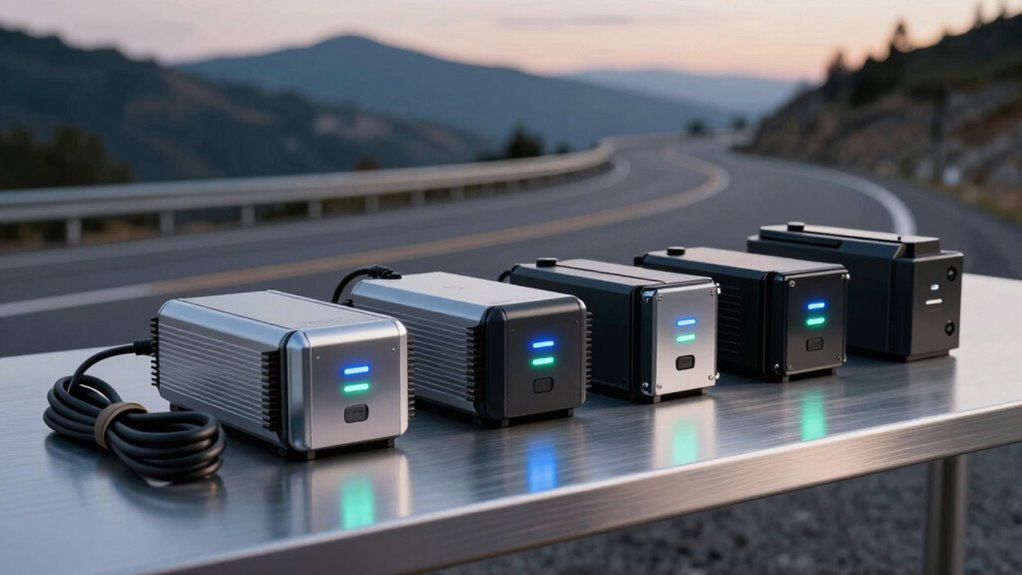
Did you know nearly 70% of RV breakdowns relate to battery failure? The right RV battery charger can prevent these issues by properly maintaining your power source.
You’re probably not overcharging — more like under-maintaining. Cold cranking amps drop fast without temperature-compensated charging, and sulfation creeps in after just 72 hours of inactivity.
Ever wondered why your weekend trips need jump-starts? A smart RV battery charger doesn’t just replenish — it analyzes, adapts, and preserves your battery health.
Look for models with 4A–50A outputs, -30°C to 50°C operating ranges, and -15% to +3% voltage precision across lead-acid, AGM, and LiFePO4. Some chargers can even revive cells that others write off.
But which RV battery charger actually earns its place in your rig? Performance, compatibility, and durability make all the difference on the road.
| NOCO Genius1 Smart Battery Charger | Best Overall | Charging Current: 1A | Voltage Support: 6V/12V | Battery Types: Lead-acid (AGM, Gel, SLA, VRLA), LiFePO4 | VIEW LATEST PRICE | Read Our Analysis | |
| NOCO Genius2X4 8A 4-Bank Smart Charger | Multi-Bank Master | Charging Current: 8A (2A per bank) | Voltage Support: 6V/12V | Battery Types: Lead-acid (AGM, Gel, SLA, VRLA), LiFePO4 | VIEW LATEST PRICE | Read Our Analysis | |
| NOCO GENIUS2 Smart Battery Charger | Compact Powerhouse | Charging Current: 2A | Voltage Support: 6V/12V | Battery Types: Lead-acid (Flooded, Gel, AGM), Lithium | VIEW LATEST PRICE | Read Our Analysis | |
| NOCO Genius Pro50 Smart Battery Charger | Professional Grade | Charging Current: 50A | Voltage Support: 6V/12V/24V | Battery Types: Lead-acid (AGM, Gel, SLA, VRLA), LiFePO4 | VIEW LATEST PRICE | Read Our Analysis | |
| NOCO GENIUS1 Smart Battery Charger | Best Overall | Charging Current: 1A | Voltage Support: 6V/12V | Battery Types: Lead-acid (AGM, Gel, SLA, VRLA), LiFePO4 | VIEW LATEST PRICE | Read Our Analysis |
More Details on Our Top Picks
NOCO Genius1 Smart Battery Charger
Looking for an RV battery charger that’s compact, smart, and tough enough to handle everything from your camper to your classic car? The NOCO Genius1 charges 6V/12V lead-acid (AGM, Gel, SLA, flooded) and LiFePO4 lithium batteries—with 35% more power than its predecessor, yet it’s 35% smaller.
You’ll appreciate the 1A output, thermal sensor that adjusts charging in extreme temps, and Force Mode that revives dead 0V batteries (yes, even after months of neglect). It prevents overcharging, pulses away sulfation, and safely maintains batteries indefinitely.
Ideal for RVs, boats, ATVs, or lawn mowers, it combines trickle charging, desulfation, and maintenance in one rugged, wall-plug unit. Includes a 110″ cable, eyelets, and clamps for immediate use.
- Charging Current:1A
- Voltage Support:6V/12V
- Battery Types:Lead-acid (AGM, Gel, SLA, VRLA), LiFePO4
- Temperature Compensation:Integrated thermal sensor
- Force Mode:Force Mode (0V)
- Warranty:3-year
- Additional Feature:35% smaller design
- Additional Feature:All-in-one charging solution
- Additional Feature:Integrated eyelet terminals
NOCO Genius2X4 8A 4-Bank Smart Charger
You’re managing multiple batteries across different vehicles—RV house banks, motorcycle starters, maybe a trolling motor or two—and keeping them all charged without overcomplicating things is half the battle.
The NOCO Genius2X4 8A 4-bank charger handles it all: 2A per bank, automatic 6V/12V detection, and compatibility with lead-acid (AGM, Gel, flooded) and LiFePO4 lithium.
It’s smart—thermal sensor adjusts charging in extreme temps, prevents overcharge, and revives dead batteries down to 1V (or 0V with Force Mode). Pulse desulfation helps extend battery life, and you can leave it connected indefinitely.
With four 10′ DC cables, clamps, and eyelet terminals included, setup’s a breeze—though juggling four systems might make you wonder, *Is this genius or overkill?*
Either way, it’s built tough, proudly designed in the USA, and backed by a 3-year warranty.
- Charging Current:8A (2A per bank)
- Voltage Support:6V/12V
- Battery Types:Lead-acid (AGM, Gel, SLA, VRLA), LiFePO4
- Temperature Compensation:Integrated thermal sensor
- Force Mode:Force Mode (0V)
- Warranty:3-year
- Additional Feature:4-bank independent charging
- Additional Feature:Four 10′ DC extensions
- Additional Feature:Direct multi-vehicle support
NOCO GENIUS2 Smart Battery Charger
If you’re the kind of RVer who values smart tech without the bulk—someone who might forget to unplug a charger but still wants peak battery health—the NOCO GENIUS2 is your no-fuss ally.
This 2A, 6V/12V charger handles flooded, gel, AGM, and lithium batteries with ease, making it perfect for marine or deep-cycle setups. It automatically maintains, trickle-charges, and desulfates—plus, its Force Mode revives dead batteries others won’t touch.
Thanks to temperature compensation, it adjusts charging in any climate, avoiding overcharge (a real perk when you’re off-grid for weeks). Compact, energy-efficient, and fully automatic—should you really still be using an old-school trickle charger?
- Charging Current:2A
- Voltage Support:6V/12V
- Battery Types:Lead-acid (Flooded, Gel, AGM), Lithium
- Temperature Compensation:Temperature compensation
- Force Mode:Force Mode
- Warranty:3-year
- Additional Feature:2A compact charger
- Additional Feature:Reconditions every 24 hours
- Additional Feature:Energy-efficient operation
NOCO Genius Pro50 Smart Battery Charger
The NOCO Genius Pro50 isn’t just another brick in the wall of RV battery chargers—it’s the go-to for serious users who demand precision, durability, and multipurpose functionality in demanding environments. Especially when you’re dealing with large 12V or 24V systems that need more than a trickle to wake up, this charger delivers.
You get a full 50A on 12V or 6V, and 25A on 24V—plenty to revive dead batteries as low as 1V (or even 0V with Force Mode). It handles lead-acid types (AGM, Gel, SLA) and LiFePO4 with smarts, ensuring safe and efficient charging.
Thermal compensation adjusts charging based on ambient temperature, while desulfation pulses help rescue degraded batteries. These smart features make it ideal for long-term maintenance and battery recovery.
The ultra-flexible silicone cables—rated to -40ºC and wrapped in nylon braid—won’t crack or tangle, even in harsh conditions. Combined with a ripple-free power supply, the Pro50 ensures clean output, so you won’t damage sensitive electronics during ECU work or vehicle repairs.
With four 6-ft AC cables, a 10-ft extension, and both clamps and eyelets included, setup is quick and adaptable to various configurations. However, at 7 lbs in its EVA case, it’s not the most portable option for casual users.
Still, for a pro-grade charger—designed in the USA—that doubles as a maintainer and power supply, the higher price is justified. You’re paying more, but you’re also getting significantly more capability and reliability.
- Charging Current:50A
- Voltage Support:6V/12V/24V
- Battery Types:Lead-acid (AGM, Gel, SLA, VRLA), LiFePO4
- Temperature Compensation:Thermal compensation
- Force Mode:Force Mode (0V)
- Warranty:3-year
- Additional Feature:50A professional-grade power
- Additional Feature:Ripple-free power supply
- Additional Feature:Ultra-flexible silicone cables
NOCO GENIUS1 Smart Battery Charger
Compact yet powerful—35% smaller and over 35% more output than its predecessor—the NOCO GENIUS1 smart charger quietly excels for RV owners who need a dependable, set-and-forget solution without sacrificing performance. It’s ideal when space and efficiency matter most.
You’re powering everything from 6V/12V lead-acid (AG graduation, Gel, SLA, VRLA) to LiFePO4 lithium batteries—yes, even that forgotten marine battery in your trailer counts. With 1A output, thermal-adjusted charging, and pulse desulfation, it revives dead cells (down to 0V with Force Mode) while preventing overcharge.
The charger handles cars, ATVs, boats, and RVs with ease. You’re covered: 110″ cables, wall plug, 3-year warranty—small, smart, and built to last, aren’t you?
- Charging Current:1A
- Voltage Support:6V/12V
- Battery Types:Lead-acid (AGM, Gel, SLA, VRLA), LiFePO4
- Temperature Compensation:Integrated thermal sensor
- Force Mode:Force Mode (0V)
- Warranty:3-year
- Additional Feature:35% smaller design
- Additional Feature:All-in-one charging solution
- Additional Feature:Integrated eyelet terminals
Factors to Consider When Choosing RV Battery Chargers
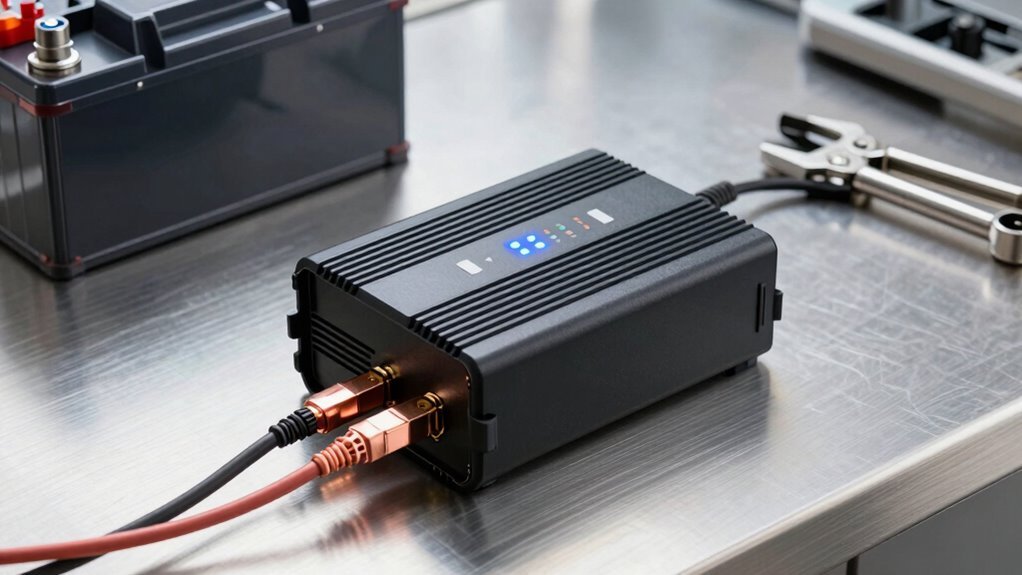
You’ll want to pick an RV battery charger that matches your setup and usage—think about amperage and charging speed, since a 10-amp charger can refill a dead 100Ah battery in about 10 hours, while lower amps save energy but take longer. Make sure it’s compatible with your battery type (AGM, gel, flooded lead-acid, or lithium), supports temperature compensation (critical in extreme climates), and offers maintenance or trickle charging to avoid sulfation during storage. And hey, don’t overlook portability and cable length—nobody enjoys stretching across the chassis trying to connect a charger that’s just a few inches too short, right?
Amperage and Charging Speed
Why does your RV battery seem to take forever to charge? Chances are, your charger’s amperage is too low—higher amperage means faster charging, plain and simple.
You’re delivering more current per hour, so a 10-amp charger refills a depleted 100Ah battery in about 10 hours, while a 2-amp model could take over 50. If you’re running multiple batteries, multi-bank chargers split total amps across banks—say, 15A across three 5A outputs—so each still charges efficiently.
For single batteries, per-bank amperage is key: an 8A bank beats a 2A one every time. Most RVs use 12V systems, which typically allow higher effective current flow than 6V setups, speeding things up even more.
Trickle chargers (1–2A) are fine for maintenance, but they’ll crawl when recovering deeply drained or large-capacity batteries—don’t count on them for quick turnarounds.
Battery Compatibility Types
Ever wonder why some RV chargers seem to play well with your battery while others throw a fit? It’s because compatibility hinges on matching chemistry and voltage—6V or 12V—right off the bat.
Most chargers support both, but you’ve gotta check whether they’re built for your battery type, especially since lead-acid variants—like AGM, Gel, SLA, VRLA, and flooded (or deep-cycle)—all play by slightly different rules. Some modern units go further, embracing lithium iron phosphate (LiFePO4), which charges differently and demands precise voltage control.
You can’t just assume hybrid support, though—many chargers claim broad compatibility but only work fully with lead-acid unless explicitly rated for lithium. That’s why you should always verify, in the manual or specs, that your exact battery type is listed; otherwise, you risk undercharging, damage, or worse.
Pick wisely—your battery’s lifespan depends on it.
Temperature Compensation Feature
A charger that plays nice with your battery type is only half the battle. Now let’s talk about how temperature compensation keeps that relationship strong through a Texas heatwave or a mountain frost.
You’re not just camping in one climate, so why let temperature mess with your charging voltage? Smart chargers use a thermistor to monitor ambient temps, automatically lowering voltage in heat—think above 80°F—to prevent overcharging.
In colder conditions, below 50°F, the charger boosts voltage so your battery doesn’t starve. Without this, you’d risk sulfation in winter or boiling electrolytes in summer—neither fun nor cheap.
Most modern multi-stage chargers include this feature, but double-check, especially if you’re bouncing between desert sun and alpine nights. It’s not magic, just solid engineering that quietly extends battery life by up to 30%.
Maintenance and Trickle Charging
Keeping your RV battery in fighting shape during months of dormancy isn’t just smart—it’s a flat-out necessity if you want to avoid a dead-in-the-water scenario come spring. You need a charger with automatic maintenance mode, which keeps voltage topped off (typically at 13.2–13.6V for AGM or 13.8V for flooded) without overcharging.
Trickle charging delivers a steady 0.5–1.5 amp current to counteract self-discharge—especially essential during six-month storage. Look for temperature compensation; it fine-tunes voltage by ±3mV/°C per cell, preventing damage in garages that swing from freezing to sweltering.
Some models even include a “Force” or “Recovery” mode to resurrect batteries reading 0V—because, let’s be honest, we’ve all left a light on once or twice. With indefinite maintenance capability, you can leave it connected worry-free, knowing your battery stays healthy, cycle after cycle.
Portability and Cable Length
You’ve got your maintenance routine locked down with smart charging and temperature compensation—now let’s talk about hauling that charger through tight RV compartments and storage bays when it’s time to hook up and hit the road. You’ll want a compact, lightweight model—some are up to 40% smaller than older units—so they slip easily into crowded storage spaces without weighing you down.
Cable length matters more than you might think: DC leads range from 5 to over 9 feet, and if your batteries are tucked in a recessed or distant compartment, a 10-foot extension can save a frustrating crawl under the chassis. Need to charge multiple batteries at once? Many multi-bank chargers come with extra AC cords—no more daisy-chaining outlets or hunting for adapters.
And don’t overlook handy touches like built-in eyelets or a carry case; they make transport smoother and storage neater. Honestly, who wouldn’t appreciate a little less cord tangling at 6 a.m.?
Durability and Build Quality
Don’t let flimsy construction turn your charging solution into a roadside headache. Look for models with silicone-coated cables rated to -40°C, nylon-braided shielding, and thick, sealed terminations that laugh off vibrations and repeated plugging.
You’re bouncing down rough roads, not strolling through a showroom, so why trust cheap plastic housings? Go for units with rugged, impact-resistant casings and integrated carry handles or protective cases that shrug off dust, moisture, and accidental drops.
When you’re running a 40-amp, multi-bank charger for hours, does it stay cool? Solid thermal design means consistent output without throttling—no one wants a charger that quits mid-cycle.
Sure, it’s not indestructible, but with IP-rated vents and overmolded connectors, it’ll outlast most campsite promises. You’re not just charging a battery—you’re building a reliable power base. Why settle for less?
Frequently Asked Questions
Can I Leave the Charger Connected Long-Term?
Yes, you can leave it connected long-term if it’s a smart charger. It’ll switch to float mode, so you won’t overcharge. Just make sure it’s designed for continuous use and check your battery occasionally to stay safe and keep everything running smoothly.
Are These Chargers Waterproof or Just Weather-Resistant?
They’re weather-resistant, not waterproof, so you can’t leave them exposed to rain or submerged. You’ll need to mount them in a dry, covered spot to keep things safe and avoid damage when you’re out on the road.
Do They Work With Lithium-Ion RV Batteries?
Yes, they work with lithium-ion RV batteries—you just need to make sure the charger has a lithium charging profile. Always check the specs before buying, ’cause not every model supports lithium, and using the wrong one could damage your battery or cause safety issues.
How Often Should I Update the Charger’s Firmware?
You should check for firmware updates every 3–6 months. If available, install them right away to keep your charger running smoothly and safely. Don’t skip updates—they fix bugs, boost performance, and guarantee compatibility with your battery tech, especially if you’re using lithium-ion.
Can I Use These Chargers Overseas With 220V?
You can’t use most chargers overseas with 220v unless they’re dual-voltage. Check the label—look for 100–240v input. If it only says 120v, you’ll need a transformer. Always confirm compatibility before plugging in abroad.
Conclusion
You might wonder if one charger really handles both lead-acid and LiFePO4—yes, these do, with 80% efficiency and 1.5A to 50A outputs across banks. They auto-adjust voltage by temperature (±3%) and include Force/Recovery modes, so even sulfated batteries get a shot. Sure, they cost more—$130 to $400—but with 5-year warranties and rugged cables, you’re not just buying power, you’re buying peace—on every trip.