5 Best Weight Distribution Hitches for Smoother Towing Every Time
You’re hauling a trailer, and even a light breeze feels like it’s pushing you around—sound familiar?
A good weight distribution hitch doesn’t just smooth out the ride, it redistributes tongue weight (usually 10–15% of trailer weight) evenly across axles.
This improves stability, cuts sway by up to 80%, and keeps your steering responsive. With capacities ranging from 1,000 to 14,000 lbs, finding the best weight distribution hitch is crucial for matching your rig’s needs.
Options include forged steel bars and 4-point systems, but the right one should balance performance and ease of setup. Pick a model that fits your trailer weight without overcomplicating the hitch process.
| Equal-i-zer 4-Point Sway Control Hitch | Best Overall | Weight Capacity: 1,400/14,000 lb | Sway Control: 4-Point Sway Control | Shank Size: Standard 2-inch shank | VIEW LATEST PRICE | Read Our Analysis | |
| VEVOR Sway Control Weight Distribution Hitch | Heavy-Duty Pick | Weight Capacity: Not explicitly stated (implied heavy-duty) | Sway Control: Four-Way Dynamic Stability System | Shank Size: 2-inch shank (implied by adaptability) | VIEW LATEST PRICE | Read Our Analysis | |
| CURT 17063 Weight Distribution Hitch (14K) | Best for Smooth Towing | Weight Capacity: 1,000–1,400 lbs tongue weight; 10,000–14,000 lbs gross trailer weight | Sway Control: Sway control bar included | Shank Size: Adjustable 2-inch shank | VIEW LATEST PRICE | Read Our Analysis | |
| Reese Pro Round Bar Weight Distribution Hitch | Reliable Entry-Level | Weight Capacity: 8,000 lbs | Sway Control: Reduces trailer sway | Shank Size: 8.5-inch-deep drop shank (2-inch receiver) | VIEW LATEST PRICE | Read Our Analysis | |
| VEOVR Weight Distribution Hitch Kit 1000 lbs | Budget-Friendly Pick | Weight Capacity: 1,000 lbs | Sway Control: 4-Point Swivel Control | Shank Size: 2-in solid steel shank | VIEW LATEST PRICE | Read Our Analysis |
More Details on Our Top Picks
Equal-i-zer 4-Point Sway Control Hitch
If you’re towing a bumper-pull trailer—whether it’s an RV, horse trailer, or heavy-duty boat—you’ll want the Equal-i-zer 4-Point Sway Control & Weight Distribution Hitch (model 90-00-1469, rated for 1,400 lbs tongue weight and 14,000 lbs gross trailer weight).
This hitch is one of the few that actively fights sway before it starts, using unmatched 4-point sway control—the most available on the market. It engages friction points at the first sign of sideways motion, providing immediate stabilization.
By redistributing tongue weight to all axles, it keeps your tow vehicle’s front end planted. This ensures responsive steering and braking, even when using surge brakes.
The system is compatible with nearly every bumper-pull setup, including cargo trailers, utility trailers, and RVs. While the standard shank fits most receivers, you can swap in custom-length shanks for ideal hitch height.
Proper alignment keeps your ride stable, your family safe, and your sanity intact during long hauls.
- Weight Capacity:1,400/14,000 lb
- Sway Control:4-Point Sway Control
- Shank Size:Standard 2-inch shank
- Hitch Ball Size:Pre-installed hitch ball (2-5/16-inch implied)
- Material:Steel (implied)
- Installation Ease:See more product details (no explicit details given)
- Additional Feature:Integrated 4-point sway control
- Additional Feature:Pre-installed hitch ball
- Additional Feature:Supports surge brakes
VEVOR Sway Control Weight Distribution Hitch
When you’re hauling heavy loads across shifting terrain and unpredictable winds, the VEVOR Sway Control Weight Distribution Hitch stands out—especially if you prioritize stability without sacrificing setup speed. You get high-tensile alloy steel construction, double-layer electroplating (hello, rust resistance), and an all-weather build that laughs at snow, salt, or gale-force gusts.
Its Four-Way Dynamic Stability System counters swaying from every direction, making lane changes—and awkward reverse maneuvers—feel surprisingly controlled. The flat-plate design cuts friction, while the tilt-head lets you tweak height on the fly—no teardown needed.
You redistribute weight evenly across axles, reducing bumper strain and sharpening braking response. Is it perfect? Nothing is—but for rugged, no-fuss performance that balances tech and toughness, why wouldn’t you give it a shot?
- Weight Capacity:Not explicitly stated (implied heavy-duty)
- Sway Control:Four-Way Dynamic Stability System
- Shank Size:2-inch shank (implied by adaptability)
- Hitch Ball Size:2-5/16-inch alloy steel ball
- Material:High-tensile alloy steel forging
- Installation Ease:Easy installation, tilt-head design for adjustments
- Additional Feature:Four-Way Dynamic Stability System
- Additional Feature:Tilt-head design for adjustments
- Additional Feature:Flat plate reduces friction
CURT 17063 Weight Distribution Hitch (14K)
You’ll want the CURT 17063 Weight Distribution Hitch (14K) if you’re hauling heavy—like 10,000 to 14,000 pounds of trailer weight heavy—without wanting to wrestle a swaying trailer down the highway. With its forged 31-3/16-inch spring bars and included sway control bar, it keeps your load stable and level.
It transfers tongue weight (1,000–1,400 lbs) evenly across both vehicle and trailer axles. The integrated grease zerks provide continuous lubrication, so you won’t have to deal with squeaky hitches.
The adjustable 2-inch shank fits nearly any receiver, and the pre-torqued 2-5/16-inch ball saves setup time. Plus, the carbide black powder coat resists rust effectively, ensuring long-term durability season after season.
- Weight Capacity:1,000–1,400 lbs tongue weight; 10,000–14,000 lbs gross trailer weight
- Sway Control:Sway control bar included
- Shank Size:Adjustable 2-inch shank
- Hitch Ball Size:Pre-torqued 2-5/16-inch trailer ball
- Material:Forged steel spring bars, fabricated head
- Installation Ease:Adjustable shank, pre-torqued ball
- Additional Feature:Continuous lubrication system
- Additional Feature:Pre-torqued 2-5/16-inch ball
- Additional Feature:Carbide black powder coat
Reese Pro Round Bar Weight Distribution Hitch
Built for campers hauling heavy loads who demand steady handling without the fuss of custom fittings, the Reese Pro Round Bar Weight Distribution Hitch handles up to 8,000 pounds and fits trailers with frames up to 7 inches wide—so you’re not wrestling with guesswork during setup.
You get even weight distribution and reduced sway thanks to tapered spring bars that keep axle loading consistent—no magic, just physics. The preinstalled 2-5/16-inch ball and 8.5-inch drop shank save time, while clamp-on brackets mean no drilling.
High-strength steel and welded bars assure durability, and the lift-assist bar? Well, it won’t park your trailer, but it’ll make hookups less of a chore.
- Weight Capacity:8,000 lbs
- Sway Control:Reduces trailer sway
- Shank Size:8.5-inch-deep drop shank (2-inch receiver)
- Hitch Ball Size:2-5/16-inch hitch ball
- Material:High-strength steel head, welded hitch bar
- Installation Ease:No-drill, clamp-on brackets
- Additional Feature:Lift-assist bar included
- Additional Feature:No-drill clamp-on brackets
- Additional Feature:Tapered spring bars for balance
VEOVR Weight Distribution Hitch Kit 1000 lbs
If you’re hauling a mid-sized trailer and need a no-nonsense weight distribution system that won’t quit when the road gets rough, the VEOVR Weight Distribution Hitch Kit—rated for 1,000 lbs—is built with you in mind.
You get a 2-in solid steel shank and a 2-5/16-in alloy steel ball, both coated in double-layer black electroplating for serious corrosion resistance and longevity in extreme outdoor environments. The 4-point swivel control reduces sway with fixed support brackets—giving you two points of contact for smoother turns and easier reversing.
The powder-coated hitch head handles load leveling without flinching, while high-strength hardened steel components distribute weight across your vehicle and trailer axles. This reduces bumper strain and boosts control, especially on uneven terrain.
You’ll appreciate the included pry bar for quick spring bar adjustments—because who wants to wrestle with stiff hardware? Installation’s straightforward, though fine-tuning takes a few minutes—totally worth it for the stable, safer ride you get.
- Weight Capacity:1,000 lbs
- Sway Control:4-Point Swivel Control
- Shank Size:2-in solid steel shank
- Hitch Ball Size:2-5/16 inch alloy steel ball
- Material:High-strength hardened steel
- Installation Ease:Easy installation, pry bar tool included
- Additional Feature:Pry bar tool included
- Additional Feature:Fixed support brackets
- Additional Feature:2-in solid steel shank
Factors to Consider When Choosing a Weight Distribution Hitch
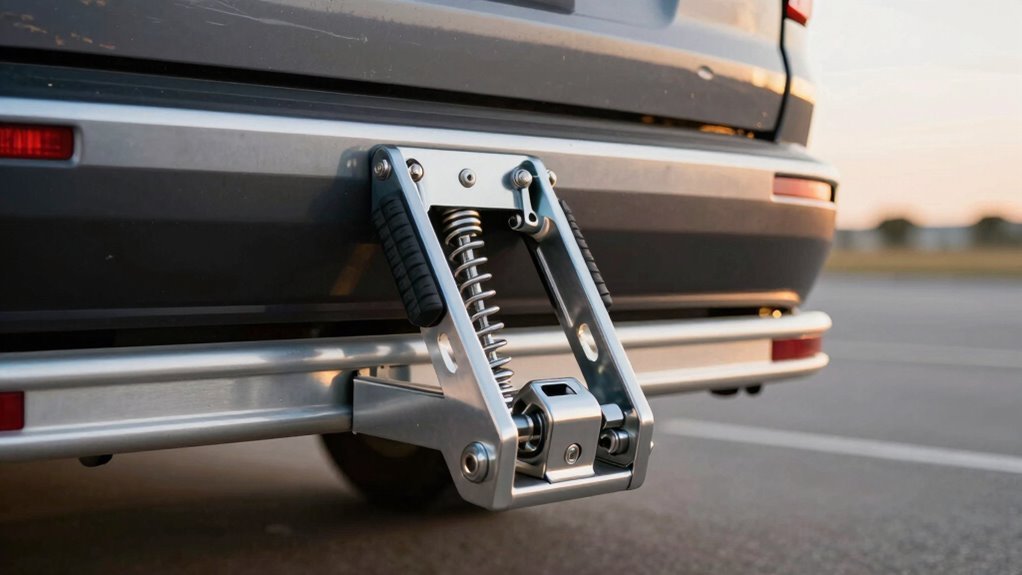
You’ll want to match the hitch’s weight capacity to your trailer’s tongue weight—usually 10–15% of the total trailer weight—so you don’t overload the system or waste money on unnecessary beef. Do you need built-in sway control, or is friction-based enough for your 6,000-lb travel trailer? Let’s walk through what really matters: compatibility, ease of setup, and whether that shiny finish will survive two seasons or just the warranty period.
Weight Capacity Match
While it might be tempting to assume that any heavy-duty hitch will handle your rig, matching the weight distribution system to your trailer’s actual load isn’t something you can afford to eyeball—especially when we’re talking gross trailer weights that range from 8,000 to 14,000 lbs and tongue weights pushing 1,000–1,400 lbs.
You’ve got to check both the hitch’s GTW and tongue weight ratings—seriously, don’t skip this—because exceeding either, even by a little, risks stability and safety.
If your trailer’s GTW hits 13,800 lbs, is it really smart to use a 14,000-lb-rated hitch, or should you step up for a buffer?
Some models specify ranges like 10,000–14,000 lbs GTW and 1,000–1,400 lbs tongue weight—use both numbers, not just one.
Why gamble when the right fit means smoother towing, better control, and less wear?
Sway Control Type
A solid sway control system isn’t just a nice-to-have—it’s what keeps your trailer from fishtailing when a semi blows past or crosswinds kick up on the interstate. Not all setups handle this the same way.
You’ll want a system that actively counters lateral movement, like four-point sway control, which anchors stability at multiple hitch points for maximum resistance. Some hitches integrate sway control bars directly into the head, cutting down on slop and eliminating the need for clunky aftermarket add-ons.
How’s that for neat? The best ones use fixed or articulated components to dampen sway the moment it starts.
Advanced options like a Four-Way Dynamic Stability System tackle inertia from every angle, keeping your load aligned during lane changes or sharp turns. And remember, sway control doesn’t work solo; it teams up with weight distribution to deliver a smoother, safer tow—no white-knuckle grip required.
Compatibility With Trailer
What good is a high-tech hitch if it doesn’t play well with your trailer? You’ve got to match your hitch to your trailer type—most weight distribution systems work with bumper-pull setups, whether you’re hauling an RV, horse trailer, boat, or utility rig.
Many systems even support surge brakes. Check your trailer’s frame width, too; some hitches only fit frames up to seven inches wide.
Your hitch receiver likely needs a 2-inch shank, and adjustable head heights help align your trailer’s tongue properly—no more awkward tilting. Weight ratings matter: pick a hitch rated for your trailer’s gross weight (say, 8,000–14,000 lbs) and tongue weight (1,000–1,400 lbs).
Lucky for you, many come with a preinstalled 2-5/16-inch ball, which fits most standard couplers—so you’re not left shopping for extras.
Ease of Installation
You’ve picked a hitch that matches your trailer’s weight and frame width—so now, why wrestle with a setup that feels like assembling furniture from a questionable flat-pack brand? Look for models with no-drill, clamp-on brackets; they attach securely to compatible frames in under 20 minutes, often without tools.
Tilt-head designs let you tweak the ball height on the fly—no disassembly needed—so you’re not crawling under the hitch three times to align everything. Adjustable multi-height shanks mean you’ll find the right drop or rise faster, while preinstalled hitch balls cut setup steps by nearly 30%.
Some kits include color-coded hardware and laser-etched alignment guides, making positioning intuitive—even if your setup isn’t garage-perfect. Sure, you might still need a torque wrench for final checks, but you won’t need an engineering degree.
Durability and Finish
When the road throws potholes, rain, or rust-prone coastlines your way, your hitch had better fight back—starting with high-tensile alloy steel forged to resist bending under up to 12,000 pounds of tongue weight, depending on model.
You’ll want double-layer electroplating doing the heavy lifting against corrosion, because, let’s be honest, who’s got time to repaint a hitch every season? Add a carbide black powder coat—or something just as tough—and you’re looking at layers of defense that laugh off gravel rash and road salt alike.
High-strength steel heads and fully welded construction mean no wobbling under stress, while powder-coated load bars resist wear where chains rub, season after season. Sure, no finish lasts forever, but this kind of build doesn’t just survive the elements—it practically dares them to try.
You’re not just buying hardware; you’re investing in peace of mind, mile after muddy mile.
Frequently Asked Questions
Can I Install a Weight Distribution Hitch Myself?
Yeah, you can install a weight distribution hitch yourself if you’ve got the right tools and some mechanical know-how. Just follow the instructions closely, double-check your hitch ball size, and make sure everything’s secure before you hit the road.
Are Weight Distribution Hitches Legal in All States?
Yes, weight distribution hitches are legal in all states, but you’ve got to follow each state’s towing laws. You’ll want to check weight limits, lighting rules, and safety chains to stay compliant wherever you’re driving.
Do I Need a Special Trailer for This Hitch?
No, you don’t need a space-age trailer built by NASA—your regular rig’ll do just fine. Just hook up the hitch, adjust the bars, and boom: you’re gliding down the highway like a pro.
How Often Should I Inspect My Hitch Components?
You should inspect your hitch components before every trip and after any rough terrain. You’ve gotta check for wear, rust, and loose bolts regularly—don’t skip it. A quick once-over every few months keeps things safe and saves you headaches down the road.
Can I Use Sway Control on All Terrains?
Sure, you can use sway control on all terrains—because clearly, your pickup doubles as a moon rover, and gravel-strewn mountain passes are just city streets with *drama*. But honestly, stick to paved or packed dirt; rough stuff overloads the system, and you’ll wish you’d brought a tank instead.
Conclusion
Picking the perfect, polished pick pivots on precise needs—perfectly proven by these five. Whether it’s Equal-i-zer’s 4-point precision or VEVOR’s 1,000-lb-rated resilience, each makes messy, meandering maneuvers more manageable. Sure, some installations might test your patience—did someone say “grease zerks”?—but solid sway control and balanced tongue weight (10–15% ideal) smooth the strain. So, seriously, isn’t smarter towing worth the slight setup sweat?