5 Best RV Cell Signal Boosters for Reliable Roadside Connectivity
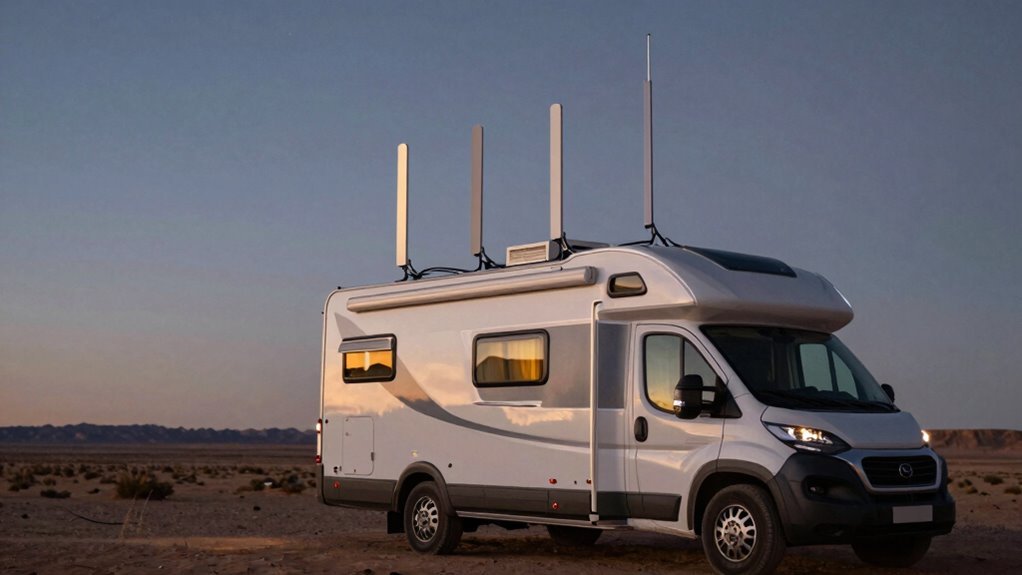
You’ve probably heard that a strong cell signal is impossible in remote areas—but what if the right RV cell signal booster could change that?
With the best RV cell signal boosters, reliable connectivity is possible even off the grid.
These boosters offer 4G LTE and 5G support, with signal gains up to 50 dB.
Choose between directional and omnidirectional antennas depending on your travel patterns and coverage needs.
Installation quirks and carrier compatibility still matter when selecting a model.
You’ll also want to consider power options, weather resistance, and FCC approval for optimal performance.
| weBoost Destination RV Signal Booster (470159) | Best Overall | 5G Support: 5G supported | Carrier Compatibility: All U.S. carriers | Frequency Bands: Bands 12/17, 13, 5, 4, 2/25 | VIEW LATEST PRICE | Read Our Analysis | |
| Cell Phone Signal Booster for 5G/4G LTE | Best Value | 5G Support: 5G supported | Carrier Compatibility: All U.S. carriers | Frequency Bands: Bands 12/17, 13, 5, 4, 2/25 | VIEW LATEST PRICE | Read Our Analysis | |
| Cell Phone Signal Booster for RV Trucks | Budget-Friendly Pick | 5G Support: 5G supported | Carrier Compatibility: All U.S. carriers | Frequency Bands: Bands 12/17, 13, 5, 4, 2/25 | VIEW LATEST PRICE | Read Our Analysis | |
| Cell Phone Booster for RV (FCC Approved) | Editor’s Choice | 5G Support: 5G supported | Carrier Compatibility: All U.S. carriers | Frequency Bands: Bands 12/17, 2/25, 5, 13, 4 | VIEW LATEST PRICE | Read Our Analysis | |
| HiBoost RV Cell Phone Booster 2025 | Premium Pick | 5G Support: 5G supported | Carrier Compatibility: All U.S. carriers | Frequency Bands: Bands 12/17, 13, 5, 4, 25/2 | VIEW LATEST PRICE | Read Our Analysis |
More Details on Our Top Picks
weBoost Destination RV Signal Booster (470159)
Looking for a reliable signal boost while parked at a remote campsite or RV park? The weBoost Destination RV Signal Booster (470159) gives you that—fast.
You’ll get 5G support, work across all major U.S. carriers (Verizon, T-Mobile, AT&T, even Dish and US Cellular), and a directional antenna fine-tuned for stationary use. Setup takes just 10 minutes, and teardown is just as quick.
It works with your RV, trailer, or camper, supports multiple users, and lets you stream, hotspot, and navigate without constant dropouts. The app guides DIY installation, and yes, it’s FCC approved and made in the USA—so you’re not just buying gear, you’re backing a standard.
- 5G Support:5G supported
- Carrier Compatibility:All U.S. carriers
- Frequency Bands:Bands 12/17, 13, 5, 4, 2/25
- Antenna Type:Directional
- Installation Type:DIY setup, app-assisted
- FCC Approval:FCC approved
- Additional Feature:10-minute setup/takedown
- Additional Feature:WeBoost app guidance
- Additional Feature:Made in the USA
Cell Phone Signal Booster for 5G/4G LTE
You’ll get the strongest 5G and 4G LTE performance in your RV with this five-band booster—it supports bands 12/17, 13, 5, 4, and 2/25, covering every major U.S. carrier including Verizon, AT&T, T-Mobile, Sprint, and U.S. Cellular, so you’re never left scrambling for a signal.
You’ll enjoy up to 100X performance gains—fewer dropped calls, faster data (think 5–8 miles max range), and smoother video calls—thanks to its omnidirectional outdoor antenna, which grabs signals from all directions, even in rough terrain.
Sure, you’ll need at least 1 bar outside (~-110 dBm), but setup’s a breeze: just one person, no tech degree required. The rugged, spring-loaded antenna shrugs off dust, water, and vibration like a pro.
With FCC approval (ID A7V-SR75502001), you know it’s legit—though if issues pop up, help’s just a call away.
- 5G Support:5G supported
- Carrier Compatibility:All U.S. carriers
- Frequency Bands:Bands 12/17, 13, 5, 4, 2/25
- Antenna Type:Omnidirectional
- Installation Type:DIY, no technical experience
- FCC Approval:FCC certified (ID: A7V-SR75502001)
- Additional Feature:Spring design antenna
- Additional Feature:12V DC power cord included
- Additional Feature:Omnidirectional outdoor antenna
Cell Phone Signal Booster for RV Trucks
Who hasn’t lost a call while barreling down a remote stretch of I-80 or watched their GPS buffer endlessly just as a turn approaches? You’re not alone — but now you can fix it.
This five-band RV truck booster pulls in signals across bands 2, 4, 5, 12/17, and 13, amplifying weak 3G, 4G LTE, and 5G up to 100x. It reaches towers 5–8 miles away, so you stay connected.
The omnidirectional outdoor antenna is rugged, vibration-resistant, and weatherproof, grabbing signals from every direction — even off-road. You’ll get clearer calls, faster data, and stronger hotspots.
It works with Verizon, AT&T, T-Mobile, and others, supporting multiple devices at once. Installation takes minutes with no extra tools — just plug in the 12V cord and go.
- 5G Support:5G supported
- Carrier Compatibility:All U.S. carriers
- Frequency Bands:Bands 12/17, 13, 5, 4, 2/25
- Antenna Type:Omnidirectional
- Installation Type:DIY, no technical experience
- FCC Approval:FCC certified (ID: A7V-SR75502001)
- Additional Feature:Spring base vibration absorption
- Additional Feature:One-person installation
- Additional Feature:Rugged off-road ready
Cell Phone Booster for RV (FCC Approved)
This FCC-approved cell phone booster for RVs stands out as the top pick for travelers who routinely lose signal in remote areas—especially if you’re switching between AT&T, Verizon, or T-Mobile and need reliable issuance of 5G and 4G LTE support across bands 12/17, 2/25, 5, 13, and 4.
You’ll love how it powers up weak signals in trucks, trailers, or campers, delivering clearer calls, faster data, and fewer dropped connections—no matter how many devices are connected. Its carbon fiber omnidirectional antenna grabs signals from every direction, ensuring strong reception.
The rugged, waterproof design laughs off rain, dust, or bumps, making it perfect for all-weather adventures. Setup is super easy—no app, no degree, just plug in and go.
LED lights show band activity, so troubleshooting’s a breeze. And hey, FCC certification (ID: 2A34B-SFZN002) means it’s legit, not some sketchy gadget—plus, real tech support’s just a call away if things act up.
- 5G Support:5G supported
- Carrier Compatibility:All U.S. carriers
- Frequency Bands:Bands 12/17, 2/25, 5, 13, 4
- Antenna Type:Omnidirectional
- Installation Type:DIY, no app or tech needed
- FCC Approval:FCC Approved (ID: 2A34B-SFZN002)
- Additional Feature:Carbon fiber antenna
- Additional Feature:LED status indicators
- Additional Feature:No app required
HiBoost RV Cell Phone Booster 2025
Ever wonder which RV cell signal booster actually delivers strong, reliable 5G and 4G LTE performance across all major U.S. carriers—especially when you’re off-grid or bouncing down a rough backroad? The HiBoost RV Cell Phone Booster 2025 (Travel 3.0 RV Max) does just that, offering 50 dB max gain on bands 12/17, 13, 5, 4, and 25/2—perfect for T-Mobile, AT&T, and Verizon users.
Its 180° folding bracket mounts almost anywhere, while the vibration-dampening base keeps your signal stable on rocky terrain. With a rugged, weatherproof antenna (UV-resistant, survives 149°F), upgraded 26 ft copper cable (30% less signal loss), roof cable entry cover, and dual power options (12V/120V), it’s built for real RV life.
You get reliable connectivity no matter where you roam, backed by a 3-year warranty and lifetime U.S. support.
- 5G Support:5G supported
- Carrier Compatibility:All U.S. carriers
- Frequency Bands:Bands 12/17, 13, 5, 4, 25/2
- Antenna Type:Bi-directional folding
- Installation Type:DIY with mounting bracket
- FCC Approval:FCC approved
- Additional Feature:180° adjustable folding bracket
- Additional Feature:26 ft high-purity copper cable
- Additional Feature:3-year warranty + lifetime support
Factors to Consider When Choosing RV Cell Signal Boosters
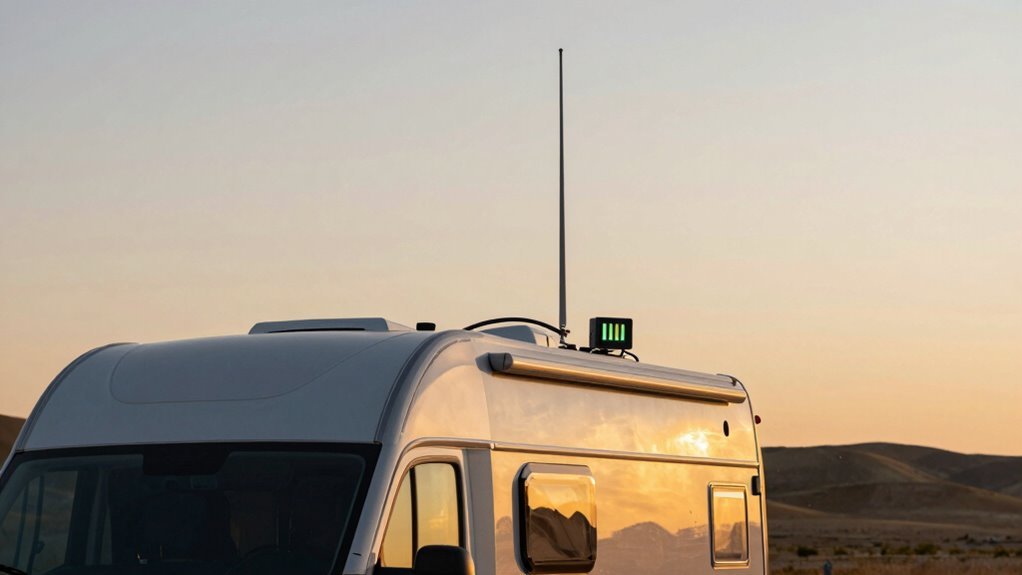
You’ll want to check if the booster supports 5G bands—especially mid- and high-band frequencies—since coverage can vary by carrier and region, and not all models play nice with every provider. Think about how easy it is to install: some systems need drilling and roof mounts (ugh), while others snap together like Lego for under-the-radar setups in under two hours. And don’t overlook the antenna type and signal range—omnidirectional antennas are simpler but often max out around 2,000 sq. ft., while directional ones can pull in signals from towers over 25 miles away, if you don’t mind aiming them like a satellite dish from the ’90s.
5G Compatibility
Why does 5G compatibility matter when picking an RV signal booster, especially if you’re chasing reliable coverage off-grid? Because 5G isn’t just faster—it’s more responsive, cuts through congestion, and (when available) slashes load times by up to 70% compared to LTE.
Every booster here supports 5G, covering key bands like n5, n2, and n25—plus legacy 3G and 4G—so you stay connected across networks. They’re all FCC-approved for 5G use, meaning you’re not just buying hype; you’re getting hardware designed for real-world, multi-user performance.
But here’s the catch: your carrier’s 5G bands must match the booster’s supported spectrum, or you won’t see that speed boost—so double-check band support before assuming you’re future-proofed. Is true 5G enhancement always guaranteed? Not quite, but with the right match, you’re far more likely to get stable, high-speed data where signals are spotty.
Carrier Support
Just because a booster handles 5G doesn’t mean it’ll work smoothly with your carrier—especially if you’re counting on T-Mobile’s Band 12, Verizon’s Band 13, or AT&T’s Bands 2 and 25. Carrier support hinges on precise band alignment, not just broad marketing claims.
You’re better off checking that the booster covers all key LTE and 5G bands—like 5, 4, 12/17, 13, and 2/25—so it actually aligns with your carrier’s spectrum in your usual travel zones. Most five-band boosters support 3G, 4G LTE, and 5G across Verizon, AT&T, T-Mobile, Sprint, U.S. Cellular, and even Dish, offering solid multi-network flexibility.
But here’s the catch: even FCC-approved models can underperform if they miss a critical band your carrier relies on locally. So, ask yourself—does “universal” really mean universal for *you*?
Verify specs carefully, because seamless switching between networks isn’t magic—it’s math, and the right frequencies make all the difference.
Installation Ease
Setting up a cell booster in your RV isn’t as complicated as it might seem, especially with kits labeled “plug and play.” Most include everything you need for a single-person installation, requiring no special tools or technical background.
You’ll usually plug the booster into your 12V DC outlet, mount the outside antenna magnetically or with brackets, and connect the inside antenna—all in about 10 minutes. Clear LED indicators guide the process, showing power status, signal lock, and any interference issues.
While drilling a small hole for cable pass-through may be needed for hardwiring, it’s often optional. These systems aren’t completely foolproof, but they’re designed to be user-friendly for the average RV owner.
With just a bit of patience and the instruction manual, you can significantly improve your cell reception—no engineering degree required.
Signal Range
Now that you’ve got the booster mounted and powered up—no toolkit diploma required—it’s time to talk about how far that signal can actually reach. Most RV boosters claim a max range of 5 to 8 miles from a cell tower, but real-world performance depends on more than just specs.
You’ll get better reach with higher gain—up to 50 dB—since it amplifies weak signals effectively, especially when you’re parked in a remote spot. While terrain matters, an omnidirectional outdoor antenna (more on antenna types later) helps pull in signals from all around, which is handy if you’re not sure where the nearest tower is.
With support for 3G, 4G LTE, and 5G, your booster stays useful across carriers and networks—no carrier hopscotch needed. Just remember: range isn’t everything—stable, consistent signal beats raw distance every time, right?
Antenna Type
Since you’re stuck with spotty coverage no matter which way your RV faces, picking the right antenna type makes or breaks your connection—especially when you’re parked between hills or under dense tree cover.
If you’re always on the move, an omnidirectional outdoor antenna’s your go-to—it pulls signals from all directions, no aiming needed, though it sacrifices some strength for convenience. But when you’re parked, why not go all-in?
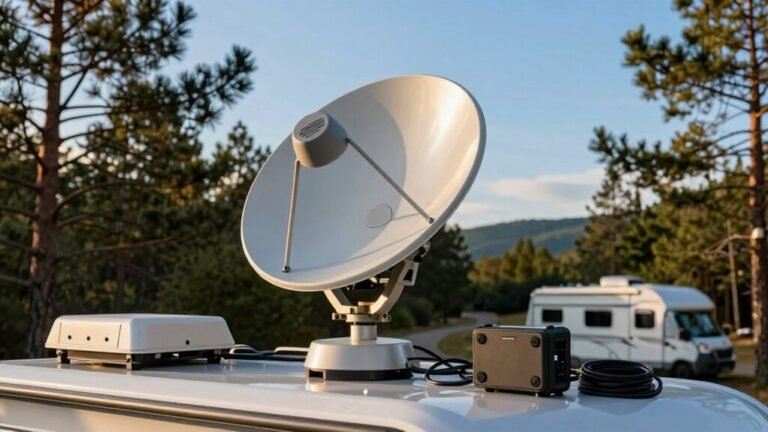
Directional antennas focus like a laser on the nearest tower, boosting gain by up to 10 dB—but only if you point it right (spoiler: trees and tilt matter). Got a rooftop that doubles as a storage puzzle? Look for models with 180° folding brackets—easy to mount, easier to stow.
And while bumping down a gravel road, vibration-dampening springs keep your signal from turning into digital soup.
Durability Build
Durability isn’t just a feature—it’s your first line of defense when your RV’s signal booster faces dust storms, downpours, or the constant thump-thump-thump of backcountry roads. You need an outdoor antenna and housing that shrug off dust, oil, and water—look for IP65 or higher ratings.
Let’s be honest, will that sleek plastic box last six months on a desert trek? A rugged, shockproof design isn’t optional if you’re tackling rough terrain.
Vibrations from long hauls or off-road bumps can misalign components or degrade connections over time. UV-resistant materials keep rooftop or pole-mounted gear from cracking or fading under relentless sun.
Plastics that yellow at year two aren’t doing you any favors. Spring bases or vibration-dampening mounts help maintain stability—and signal consistency—when the road turns bumpy.
Bottom line? Your booster must survive extremes—so prioritize weatherproof, impact-resistant construction that won’t quit when you need it most.
Multi-Device Use
You’ve armored your RV signal booster against dust, rain, and bone-jarring roads—so why let your crew’s devices fight for bandwidth like they’re sharing a single charging port at a rest stop? Choose a booster that supports multiple users at once, so your smartphone, tablet, and hotspot all stay online without lag or dropouts.
This is especially important when someone’s streaming, another’s video calling, and the kids are glued to YouTube. A five-band design handles 3G, 4G LTE, and 5G across carriers, making sure every device—even older models—gets solid service.
An omnidirectional outside antenna pulls signal from all directions, reducing dead zones and contention. These systems must manage combined data loads efficiently.
Look for clear status indicators or app-based dashboards so you’re not blindly troubleshooting when speeds dip. It’s not magic—just smart engineering.
Power Options
While chasing a steady signal across remote stretches, don’t let your booster die mid-upgrade because it’s sipping power from an incompatible source—most units run on 12V DC, so you’ll plug straight into your RV’s battery for the road. But check the amperage: some draw up to 2.5A and need a dedicated fuse (usually 3A) to avoid frying circuits.
Good news? Many boosters include a 12V DC cord for mobile use, and several even throw in a 120V AC adapter—handy when you’re parked at a campground with shore power. Better yet, dual-power models let you switch seamlessly between driving and docking, no rewiring needed.
Before you route cables through bulkheads, ask yourself: are your connections weatherproof and clean? Exposed wires invite corrosion or shorts, so seal and secure them. Also, verify your booster’s exact input specs—most stick to 12V, but current draw varies, and skimping on fuse ratings risks more than just a reboot.
Frequently Asked Questions
Can I Install the Booster Myself Without Professional Help?
Yeah, you can install it yourself without professional help. Just follow the included instructions, mount the antennas properly, connect the wiring, and power it up. Most kits are designed for DIY setup, so you’ll have it running in no time with basic tools and a little patience.
Will the Booster Work While My RV Is Moving?
Yes, you can use the booster while driving—it stays active and works on the move. Just make sure it’s mounted securely, and you’ll keep a steady signal even when you’re cruising down the highway.
Does the Booster Improve Wi-Fi or Only Cell Signal?
It boosts cell signal, not Wi-Fi—like a bridge carrying your call across silent valleys. You’ll still need internet nearby, but once it’s there, your phone connects stronger, clearer, and faster, even on the loneliest roads.
Can Multiple Devices Use the Boosted Signal at Once?
Yes, you can connect multiple devices at once. The boosted signal lets your phone, tablet, and hotspot all use the stronger cell connection simultaneously. You stay online together without lag or dropped service, even in remote areas where signal’s weak. You’re covered.
Is There a Monthly Fee to Use the Signal Booster?
You won’t pay a monthly fee—unlike streaming that endless series, your booster’s a one-time buy. Just install it, and boom: stronger signal wherever you roam, no subscription traps waiting to surprise you down the road.
Conclusion
You’re the captain steering a sea of dead zones, and these boosters? They’re your compass, not magic wands—(yes, even FCC-approved ones tap out past 50 dB). The weBoost and HiBoost models anchor solid 5G/4G grabs, while omnidirectional antennas cast wide nets. But ask yourself: will rugged design matter more than dual power options when rain drowns your campsite at dusk—or did you really think connectivity came free?