30 Amp Vs 50 Amp RV: What’s the Difference?
When comparing a 30 amp vs 50 amp RV, you’re dealing with two very different power capacities. A 30-amp RV runs on a single 120-volt circuit, delivering up to 3,600 watts—enough for basic needs like lights, a fridge, and limited AC use.
In contrast, a 50 amp RV provides two 120-volt circuits, combining for 12,000 watts total. This allows you to run high-demand appliances like an air conditioner, microwave, and electric heater simultaneously without overloading the system.
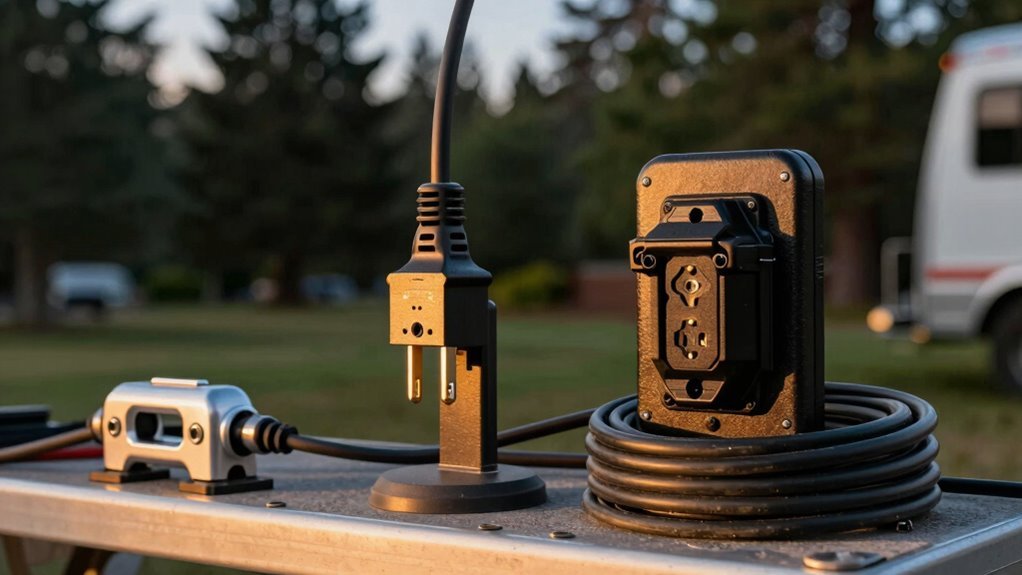
The plug types also differ: 30-amp RVs use a TT-30 connector, while 50-amp models require a larger 14-50 plug. Adapters can help you connect to different power sources, but they don’t increase the available amperage.
Knowing the difference between a 30 amp vs 50 amp RV helps you manage power use efficiently and avoid tripped breakers or damage to your electrical system.
Understanding RV Electrical Systems

Ever wonder how your RV keeps the lights on and the AC humming without turning into a hot mess?
It’s all thanks to split-phase 50-amp power—basically, two 120-volt highways (L1 and L2) delivering up to 6,000 watts each, so you’ve got around 12,000 watts total to play with.
Your RV smartly splits outlets and appliances between both legs, balancing the load like a pro juggler.
Big-ticket items—AC, microwave, heater—get their own dedicated lanes to avoid blowouts.
The neutral wire handles the leftovers, while the ground keeps things safe.
With 6 AWG wires and a 50-amp double breaker, everything runs smoothly unless you try to run *all* the things at once—then, boom, the breakers tap out.
Some rigs even have Energy Management Systems that play power bouncer, shutting off lesser loads to save the party.
It’s like having a mini power grid on wheels—neat, right?
This setup allows for 240 VAC between legs, enabling high-demand appliances when properly configured.
Breaking Down the 30 Amp Service
While your RV’s got plenty of comforts, running it on a 30 amp service means you’ve got to play a little power chess—because you’re working with just one 120-volt lane delivering up to 3,600 watts, which sounds like a lot until you fire up the AC and microwave at the same time.
Here’s what you’re really working with:
- Your plug—the NEMA TT-30—carries one hot wire, powering everything from a single 30-amp breaker.
- Big-ticket items like the air conditioner (10–20 amps) and microwave (10+ amps) eat up your budget fast—like ordering two pizzas and realizing you only paid for one.
- You’ve gotta stagger appliances—no hair dryer during dinner prep—or risk a trip.
- Use a power monitor, stick to LED lights, and lean on propane to stay under the limit and keep the lights (and AC) on.
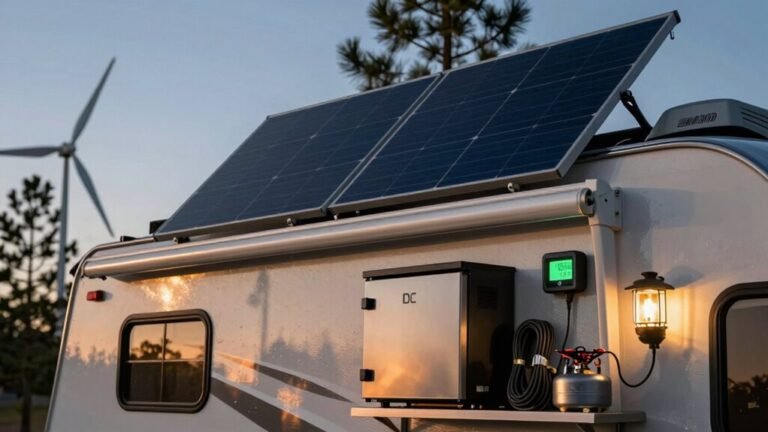
One way to extend your off-grid capability is by adding solar—200–400 watts of solar can cover basic loads like lights and charging without draining your battery.
Examining the 50 Amp Setup
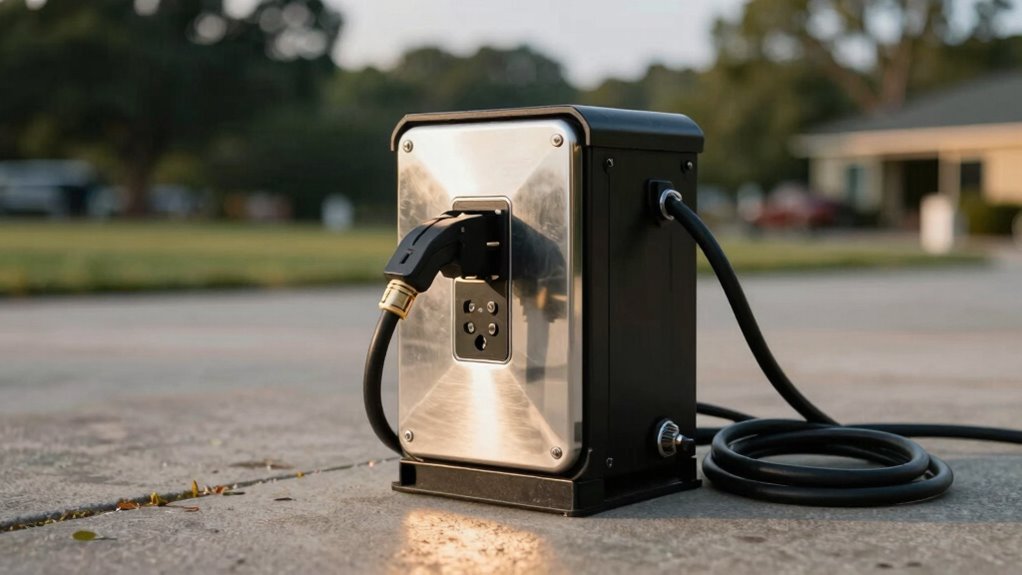
You’ve already seen how tight the power game gets on a 30 amp system—juggling the microwave and AC like they’re on a seesaw—but now let’s crank it up.
Your 50 amp setup runs on a beefier NEMA 14-50 plug with four prongs—two hot wires, neutral, and ground—so it can’t accidentally plug into household outlets (safety first!).
Power flows through a double-pole 50A breaker, feeding two 120V legs that split in your RV’s panel to power different circuits.
These legs are out of phase, which means you can pull up to 12,000 watts—yep, that’s enough juice to run multiple ACs, a microwave, *and* an induction cooktop without tripping a breaker.
Wiring’s thicker (6/3 or 8/3 cable), everything’s balanced across legs, and yeah, your socks might fly off when you flip the switch on that electric water heater.
This robust setup is ideal for extended off-grid adventures, especially when paired with a 15 Amp RV – Off-Grid System Design and Equipment List to optimize energy use.
Voltage and Power Capacity Compared
Imagine this: instead of juggling one power line like in a 30-amp system, you’ve got two 120-volt hot wires working for you in a 50-amp setup—that’s 240 volts total, split down the middle to keep things balanced and efficient.
You get way more juice without breaking a sweat. Here’s how they really stack up:
- Your 30-amp RV runs on 120 volts and caps out at 3,600 watts—great for basics, but forget running the AC and microwave at the same time.
- A 50-amp rig delivers 12,000 watts—over three times the power—so you can chill, cook, *and* charge your phone without tripping a breaker.
- Need to swap outlets? Adapters let you plug in, but you’re still stuck at 3,600 watts max—no magic here!
- Voltage drops over long cords, so keep it short and stay powered up like a pro.
Physical Differences in Plugs and Receptacles
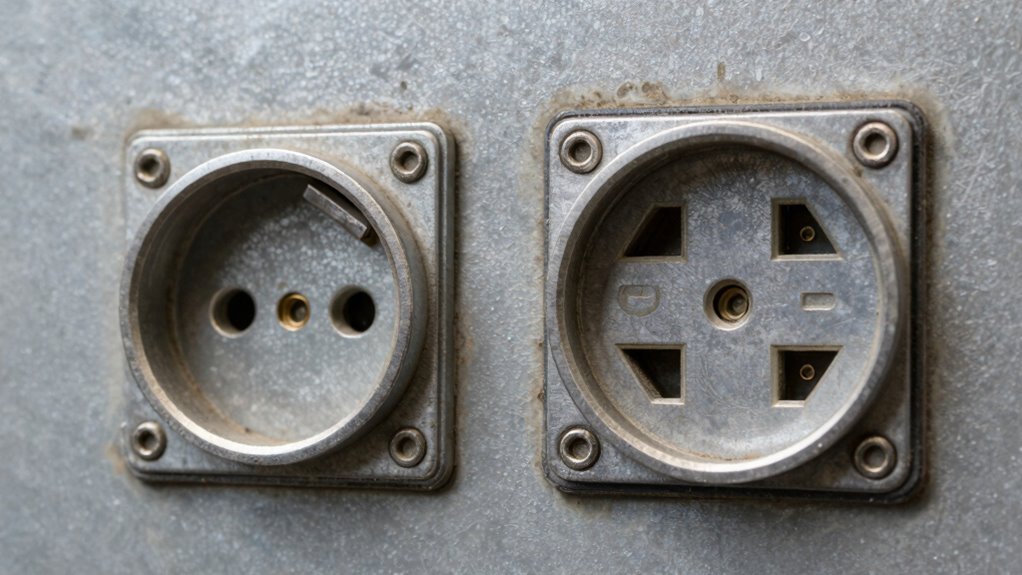
Now that you’ve got a feel for how much more power a 50-amp system can handle, let’s take a look at what actually connects your rig to the juice—the plugs and sockets themselves.
You’ll notice right away the 30-amp plug has three prongs and uses the NEMA TT-30P standard, carrying one 120-volt hot wire, plus neutral and ground.
It plugs into a matching TT-30R receptacle, usually on older pedestals.
But the 50-amp setup? It’s beefier—four prongs, two hot wires (NEMA 14-50P), delivering double the circuits and even 240 volts across the legs.
Its receptacle handles up to 12,500 watts—way more muscle.
And while adapters let you plug one into the other, they don’t boost power—kind of like using a garden hose on a fire hydrant.
Size, shape, and prong count? They’re dead giveaways.
Matching Your RV to the Right Service
How do you make sure your RV gets the right juice without a power party gone wrong?
Matching your rig to the right service keeps your appliances happy and your trips hassle-free.
Here’s how to get it right:
- Check campground specs – Smaller parks often have 30A, while big resorts pack 50A power.
- Know your RV’s limits – A 50A rig on a 30A feed (even with an adapter) means you’ll need to power down some goodies.
- Use the correct cord and inlet – TT-30 for 30A, 14-50 for 50A; mixing them up is like forcing a square peg into a round socket.
- Skip sketchy wiring – Home hookups need proper breakers and outdoor-rated outlets, or you’ll risk tripping every time you fire up the microwave.
When you sync your RV with the right service, you’re not just plugging in—you’re powering up peace of mind!
Common Appliances and Power Requirements
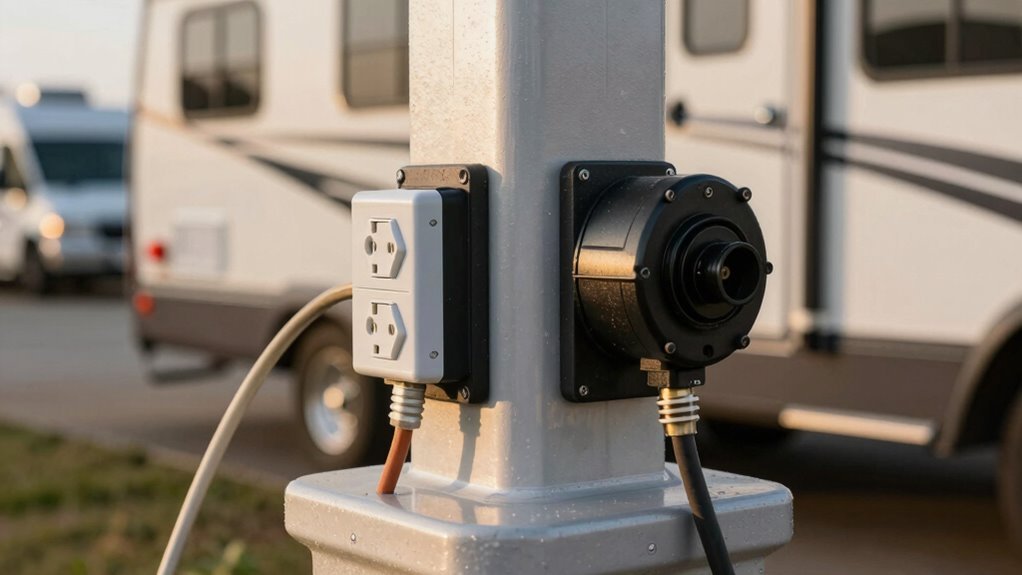
When your RV’s appliances start humming, you want them to sing in harmony—not trip the breaker mid-burger.
Running a 15,000 BTU AC? It pulls about 12 amps, but that startup surge can spike over 25 amps—ouch!
Add a microwave (1,200 watts) and coffee maker (1,000 watts), and your 30-amp system’s already sweating.
Electric heaters and induction cooktops each hog 1,500 watts, hitting that 30-amp wall fast.
But with a 50-amp hookup, you’ve got room to breathe—power two ACs, a fridge, and still pop popcorn without chaos.
Big rigs run washers, dual rooftop units, and fancy kettles, all needing balanced loads across two 120V legs.
On 30 amps, timing is everything: don’t toast, brew, and cool all at once.
With 50, you’re basically the chef and DJ of your own RV rock show—everything on, nothing out of tune.
Using Adapters: Pros and Limitations
You’ve got a 50-amp RV, but the campsite only offers 30 amps—don’t panic, that’s where adapters swoop in like the unsung heroes of the RV world.
Just remember: they’re smart helpers, not magic wands.
Here’s what you should know:
- A 50A-to-30A adapter lets you plug in, but you’re still limited to about 3,600 watts—so no running the AC and microwave at the same time.
- That second 120-volt leg in your 50A rig? Gone. All power squeezes onto one leg, which can trip breakers if you’re not careful.
- Never try homemade combos—like splicing two outlets together—unless you enjoy playing electrical Russian roulette.
- Stick to ETL/UL-listed adapters; they’re tested for safety and won’t turn your vacation into a campfire of regret.
Adapters work great—just respect their limits.
Frequently Asked Questions
Can I Upgrade My RV From 30 to 50 Amp Service?
Yeah, you can upgrade your RV from 30 to 50 amp service, but it’s not just a plug swap.
You’ll need a new inlet, heavier wiring, and a beefier breaker panel—think full electrical redo.
It’s doable, saves power headaches, and lets you run all your goodies at once, but don’t wing it.
Get help from a pro, or you might turn “amps” into “oops!”
Are 30 Amp and 50 Amp Services Available Worldwide?
No, you won’t find 30 amp and 50 amp services worldwide—they’re mainly a North America thing.
Sorry, but Europe and Australia aren’t hooking you up with NEMA plugs!
You’ll usually get 230V IEC outlets instead.
But hey, don’t sweat it—adapters and converters exist, though they can be quirky.
Think of it as RVing with a puzzle: annoying, yes, but totally solvable!
How Do I Know if My Campground Supports 50 Amp?
You’ll know your campground supports 50-amp by checking the site listing online—most will brag about it right in the description.
When you arrive, just peek at the pedestal: a four-prong outlet means you’re golden.
Apps like Campendium often show real photos so you can spy on it beforehand.
If your rig’s big and fancy, they’ll likely have it—parks love pampering power-hungry RVs!
What Happens if I Plug Into the Wrong Amperage?
You won’t fry your RV if you plug into the wrong amperage—don’t panic!
Using an adapter keeps things safe, but you’re stuck with less power.
Plug a 50-amp rig into 30-amp service, and you’ll need to juggle appliances like a circus act.
Run the AC? Great, but forget the microwave.
Exceed the limit, and the breaker trips—annoying, but it’s just your system saying, “Hey, slow down!”
Do Solar Panels Affect My Need for 30 or 50 Amp?
Yeah, solar panels totally cut your need for 30 or 50 amp hookups—you’re basically tapping into free sunshine power!
They handle lights, fans, fridges, and more, so you can boondock longer without plugging in.
Just size your system right, and you’ll roam free, laugh at empty outlets, and still keep your tunes blasting and coffee brewing—all while the sun does the heavy lifting.
Conclusion
You’ve got the power-hungry dream rig, yet campsite outlets aren’t all created equal. A 30 amp hookup sips power like a straw, while 50 amp gulps like a firehose—voltage matters, pals! Juggle ACs and microwaves? Go 50. Enjoy simpler stays? 30’s your trusty sidekick. Plugs don’t lie: one prong or three tells the whole tale. Adapters help, but they can’t magic away physics. Choose smart, charge on, and never let toast brown while your A/C snoozes!
References
- https://www.mygrandrv.com/threads/rv-50-amp-electrical-explained.69179/
- https://www.gearit.com/blogs/news/50-amp-rv-plug-wiring-diagram
- https://community.goodsam.com/discussions/motorhomesforum-board/how-does-50-amp-work/3613507
- https://www.youtube.com/watch?v=PQSdXbonq2Q
- https://www.northporthuronjellystone.com/navigating-rv-electricity/
- https://manuals.heartlandowners.org/manuals/Electrical/Basic Electrical Info/Understanding 50 Amp Shore Power System.pdf
- https://www.renogy.com/blogs/off-grid-power/rv-living-on-30-amps
- https://www.rvtravel.com/rv-electricity-30-amp-home-outlet/
- https://www.gorving.com/tips-inspiration/expert-advice/rv-living-30-amps
- https://www.nirvc.com/blog/rv-electricity/